
Control Line: Aerobatics
Wynn Paul
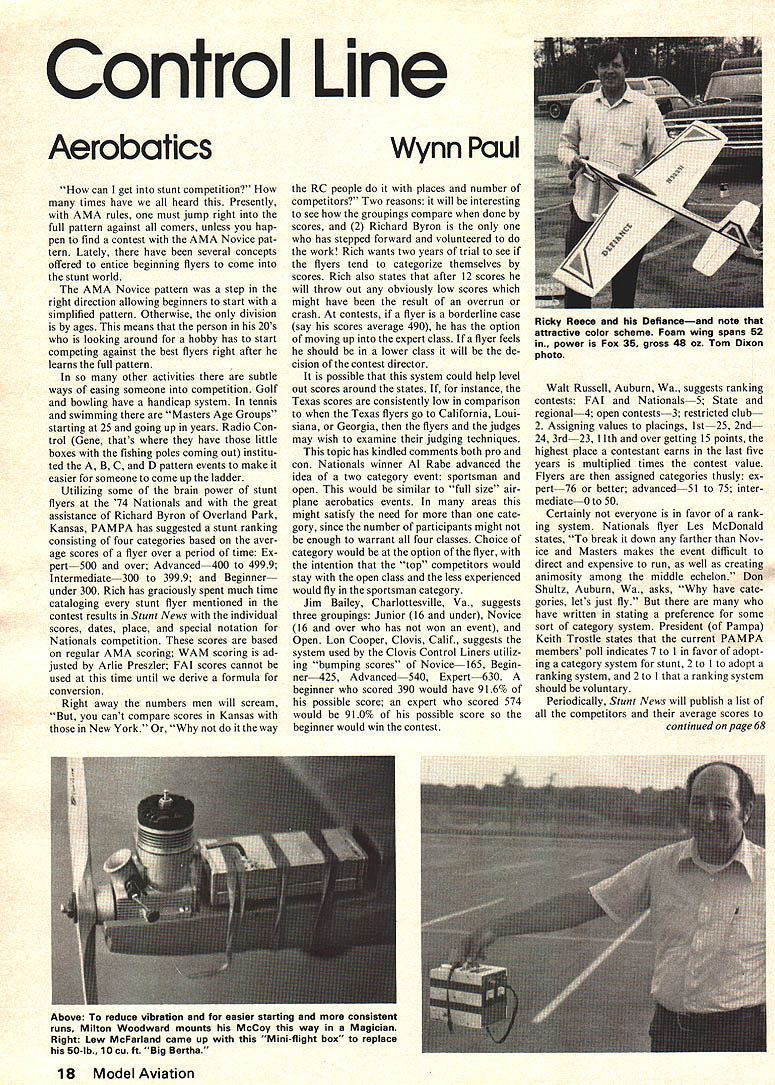
"How can I get into stunt competition?" How many times have we all heard this. Presently, with AMA rules, one must jump right into the full pattern against all comers, unless you happen to find a contest with the AMA Novice pattern. Lately, there have been several concepts offered to entice beginning flyers to come into the stunt world.
The AMA Novice pattern was a step in the right direction allowing beginners to start with a simplified pattern. Otherwise, the only division is by ages. This means that the person in his 20's who is looking around for a hobby has to start competing against the best flyers right after he learns the full pattern.
In so many other activities there are subtle ways of easing someone into competition. Golf and bowling have a handicapped system. In tennis and swimming there are "Masters Age Groups" starting at 25 and going up in years. Radio Control (Gene, that's have little boxes coming out) instituted the A, B, C, and D pattern events to make it easier for someone to come up the ladder. Utilizing some of the brain power of stunt flyers at the '74 Nationals and with the great assistance of Richard Byron of Overland Park, Kansas, PAMPA has suggested a stunt ranking consisting of four categories based on the average scores of a flyer over a period of time: Expert—500 and over; Advanced—400 to 499.9; Intermediate—300 to 399.9; Beginner—under 300. Rich has graciously spent much time cataloging every stunt flyer mentioned in the contest results in Stunt News with the individual scores, dates, place, and special notation for Nationals competition. These scores are based on regular AMA scoring; WAM scoring is adjusted by Arlie Preszler; FAI scores cannot be used at this time until we derive a formula for conversion. Right away the numbers men will scream, "But, you can't compare scores in Kansas with those in New York." Or, "Why not do it the way the RC people do it with places and number of competitors?" Two reasons: it will be interesting to see how the groupings compare when done by scores; and (2) Richard Byron is the only one who has stepped forward and volunteered to do the work! Rich wants two years of trial to see if the flyers tend to categorize themselves by scores. Rich also states that after 12 scores he will throw out any obviously low scores which might have been the result of an overrun or crash. At contests, if a flyer is a borderline case (say his scores average 490), he has the option of moving up into the expert class. If a flyer feels he should be in a lower class it will be the decision of the contest director. It is possible that this system could help level out scores around the states. If, for instance, the Texas scores are consistently low in comparison to when they are flown in California, Louisiana, or Georgia, then the flyers and the judges may wish to examine their judging techniques. This topic has kindled comments both pro and con. Nationals winner Al Rabe advanced the idea of a two category event—sportsman and open. This would be similar to "full size" airplane aerobatics events. In many areas this might satisfy the need for more than one category, since the number of participants might not be enough to warrant all four classes. Choice of category would be at the option of the flyer, with the intention that the "top" competitors would stay with the open class and the less experienced would fly in the sportsman category. Jim Bailey, Charlottesville, Va., suggests three groupings: Junior (16 and under), Novice (16 and over who has not won an event), and Open. Lon Cooper, Clovis, Calif., suggests the system used by the Clovis Control Liners utilizing "bumping scores" of Novice—165, Beginner—425, Advanced—540, Expert—630. A beginner who scored 390 would have 91.6% of his possible score; an expert who scored 574 would be 91.0% of his possible score so the beginner would win the contest. Walt Russell, Auburn, Wa., suggests ranking contests: FAI and Nationals—5; State and regional—4; open contests—3; restricted club—2. Assigning values to placings, 1st—25, 2nd—22, 3rd—21, 4th—20, and over getting 15 points, the highest place a contestant earns in the last five years is multiplied times the contest value. Flyers are then assigned categories thusly: expert—76 or better; advanced—51 to 75; intermediate—0 to 50.
Certainly not everyone is in favor of a ranking system. Nationals winner Les McDonald states, "To break it down any farther than Novice and Masters makes the event difficult to score and expensive to run, as well as creating animosity among the middle echelon." Don Shultz, Auburn, Wa., asks, "Why have categories, let's just fly." But there are many who have written in stating a preference for some sort of category system. President Keith Trostle states that the current PAMPA members' poll indicates 7 in favor of adopting a category system for stunt, 2 to 1 to adopt a ranking system, and 2 to 1 that a ranking system should be voluntary.
Periodically, Stunt News will publish a list of all the competitors and their average scores to
CL Aerobatics
continued from page 18
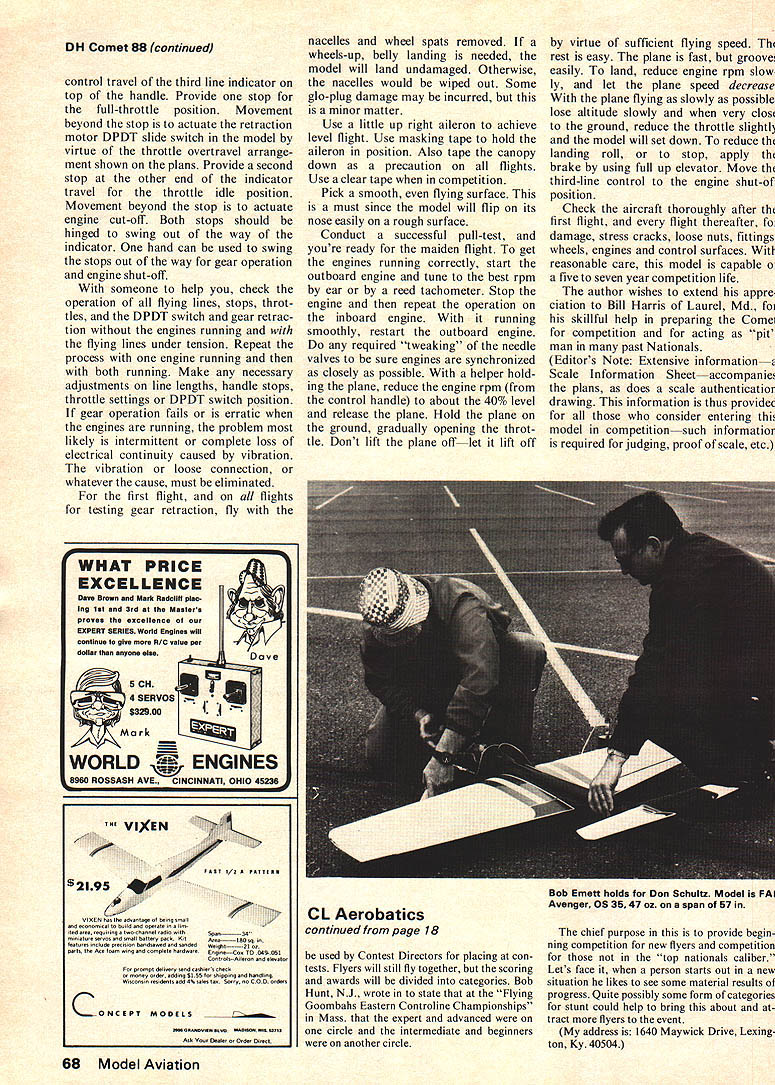
be used by Contest Directors for placing at contests. Flyers will still fly together, but the scoring and awards will be divided into categories. Bob Hunt, N.J., wrote in to state that at the "Flying Goombahs Eastern Controlline Championships" in Mass. that the expert and advanced were on one circle and the intermediate and beginners were on another circle.
The chief purpose in this is to provide beginning competition for new flyers and competition for those not in the "top national caliber." Let's face it, when a person starts out in a new situation he likes to see some material results in his progress. Quite possibly some form of categories for stunt could help to bring this about and attract more flyers to the event.
(My address is: 1640 Maywick Drive, Lexington, Ky. 40504.)
Transcribed from original scans by AI. Minor OCR errors may remain.

