
Control Line: Aerobatics
Wynn Paul
AFTER YEARS and years of speculation, stunt fliers now may have a method to try retractable landing gears that will be dependable enough for top level competition. Free flighter, stunt flier, kit manufacturer, and all-around toy airplane freak, Fast Richard Mathis writes in to say that he has successfully used the Seelig freeflight timer to activate retracts on a .35-engine stunt plane. He has used Adjusto-Jig 1/2A RC gears hooked up to a bellcrank; the bellcrank is activated by springs from the timer. The timer pulls the gears up about 10 seconds after the helper releases the catch; the timer lowers the gears about 20 seconds before engine cut off. The Seelig timer is a German device noted for its reliability; the timer can perform four separate functions.
Dick stated that the system added about three total ounces to his old airplane but that it would be about 1/2 ounce less in a plane designed from the ground up for retracts. He also says that for a dyed-in-the-wool stunt flier to trust the timer will take great faith, but that the Seelig timers are famous for being reliable.
How about performance? Dick states that the plane definitely handles better: less Dutch roll (defined by Dick as slight rolling with some yawing thrown in—caused by heavy wing tips and/or wide landing gear and/or wheel pants that act as forward fins), better penetration, better tracking and grooving, and better inside corners. He says it does not go faster in the wind and in wind-up situations (like the three inside loops). He also thinks that the plane looks a lot better in the air, but that this is something that will have to be given some time during next summer's campaign on the stunt trail. He is building a new Chizler around an H.P. 40 and retracts for this summer. Cost: the timer is about $17.50 and the basic retracts are about $10.00.
Next, I remember seeing this old magazine about a guy named Walker who had a control line airplane that did rolls.
PAMPA Classes: Try the PAMPA category system for your summer contest. It's not too late to arrange to use the PAMPA category system to separate fliers into four different flying classes for precision aerobatics at your contest. By using either a voluntary placing, or using the latest guide to stunt rankings from Stunt News, the novice, beginner, and intermediate fliers can fly against others of similar abilities.
Have your contest director add to the contest flyer or brochure the statement that the contest will have: Precision Aerobatics—four PAMPA classes. If the contest management is leary of going all the way, then try three PAMPA classes, which requires the same number of trophies as having a (J), (S), (O) type of contest. When using three PAMPA classes, you should set up with either Beginner, Intermediate and Advanced-Expert combined, or try Beginner-Intermediate combined, Advanced and Expert.
Remember the breakdown by classes is according to what the competitor's average scores are according to AMA scoring. The points are: PAMPA Beginner—300 and under average; PAMPA Intermediate—301-399; PAMPA Advanced—400-499; PAMPA Expert—500 and over.
By now, approximately 350 stunt fliers have been ranked and placed by Richard Byron, Omaha, Nebraska, who keeps the statistics on the PAMPA stunt rankings. There are still many people who have not had the chance to fly in the PAMPA categories. However, many of the major contests around the country have tried the category system more than once and the results are excellent: more participation, more fun, better flying, and only a little more paper work.
Al needs parts: FAI World Team member Al Rabe, Irving, Texas, sends out an urgent plea for anyone who may have one of the rare Alois-ST .51 engines that were put out last year. Al needs one or more of the crankshafts and will gladly rebuild your engine back to the ST .46 configuration at no cost to you. He plans to use the .51-size engine for his World Championship flying this summer in England and has only one engine. He needs at least one spare engine and crankshaft to get through the summer with the usual 500 flights. Write or call (collect) Al at 1904 Valley.
CL Aerobatics/Paul continued from page 36
Oaks, Irving, Texas, 75060, tel: 214 254 5096.
Foam Wings... one, two, three: We used to have Bob Hunt and Arnold Stott for foam wing supplies. Then Arnold retired, moved to Texas, and we haven't heard from him since. Then Bob announced in a typewritten letter to this writer, dated December 27, 1977, that he had to discontinue foam wings because of material shortages, namely balsa. Then, John T. Poynter and Kirk Mullinnix of Cypress, California, announced that they are entering the foam wing business. They will call themselves J. and K. Custom Foam Wings.
I have received one of the wings and it appears to be a competitive wing. The foam cutting is good; there is a 1/8-in. spar, and the covering is good. I would prefer a slightly thicker trailing edge, but then I have always been accused of building planes that could withstand one of Pappy Boyington's landings. The wing was pretty light: 135 grams for the left, 125 for the right. They plan to produce four .35-size wings (Genesis, Nobler, Gieseke Nobler, Stiletto); three .45-size wings (Genesis, Shark, Stiletto .46), and a Half-A wing.
Cost for the core only will be $15.00 postpaid; the core covered with balsa and spars, $36.00 postpaid; core covered with balsa, with spar, and with leading edge, $39.00 postpaid. The Half-A wing will go for $18.50 covered with balsa, postpaid. There will be a $5.00 template
Control Line: Aerobatics
After years of speculation, stunt fliers now may have a method to try: retractable landing gears will be dependable enough for top-level competition. Free‑fighter stunt flier and kit manufacturer Fast Richard Mathis writes he has successfully used a Seelig free‑flight timer to activate retracts on a .35‑engine stunt plane. He used Adjusto‑Jig RC gears hooked up to a bellcrank; the bellcrank activated springs. The timer pulls the gears up about 10 seconds after the helper releases the catch; the timer lowers the gears about 20 seconds before engine cut‑off. The Seelig timer is a German device noted for its reliability. The timer can perform four separate functions, Dick stated. The system added about three total ounces. A plane designed ground up for retracts, he also says, will perform even better. Dick said the stunt flier must have great faith in the timer, but Seelig timers are famous for being reliable in performance. Dick states the plane definitely handles better — less Dutch roll — defined as a slight rolling and some yawing thrown in, caused by heavy wingtips and/or wide landing gear and/or wheel pants. Fitting forward fins gives better penetration, better tracking, grooving and better inside corners, he says. The plane does go faster in wind and wind‑up situations like three inside loops. He also thinks the plane looks a lot better in the air. He hopes that, given some time during next summer's campaign, stunt fliers will be building new Chizler‑type ships around HP .40s with retracts by summer. Cost: the timer about $17.50; basic retracts about $10.00.
PAMPA Classes
Try the PAMPA category system at a summer contest. It's too late to arrange to use the PAMPA category system for this spring, but contest directors might adopt it for summer events. The PAMPA system separates fliers into four different flying classes for precision aerobatics contests, using either voluntary placing or the latest guide stunt rankings. Stunt News novice, beginner and intermediate fliers can fly against others of similar abilities. Have the contest director add a statement in the contest flyer/brochure that the contest will have Precision Aerobatics — four PAMPA classes. Contest management may be leary of going that way, but to try three PAMPA classes requires the same number of trophies. For a J‑50 type contest using three PAMPA classes, set up either Beginner, Intermediate, Advanced‑Expert combined, or try Beginner‑Intermediate combined and Advanced‑Expert combined. Remember breakdown of classes according to what competitors' average scores are using AMA scoring points: PAMPA Beginner 300 and under average; PAMPA Intermediate 301–399; PAMPA Advanced 400–499; PAMPA Expert 500 and over. Now approximately 350 stunt fliers have been ranked and placed; Richard Byron of Omaha, Nebraska keeps the statistics and PAMPA stunt rankings. This way people have a chance to fly PAMPA categories. Major contests around the country have tried the category system once, and the results were excellent — participation, fun, better flying and little extra paperwork.
Al needs parts
FAI World Team member Al Rabe of Irving, Texas sends out an urgent plea: anyone who may have rare Alois‑ST .51 engines put out last year, Al needs crankshafts. He will gladly rebuild the engine back to ST .46 configuration at no cost. Plans to use the .51‑size engine for World Championship flying in England this summer mean Al needs at least one spare engine crankshaft to get through the usual 500 flights. Write or call collect: Al Rabe, 1904 Valley 36.
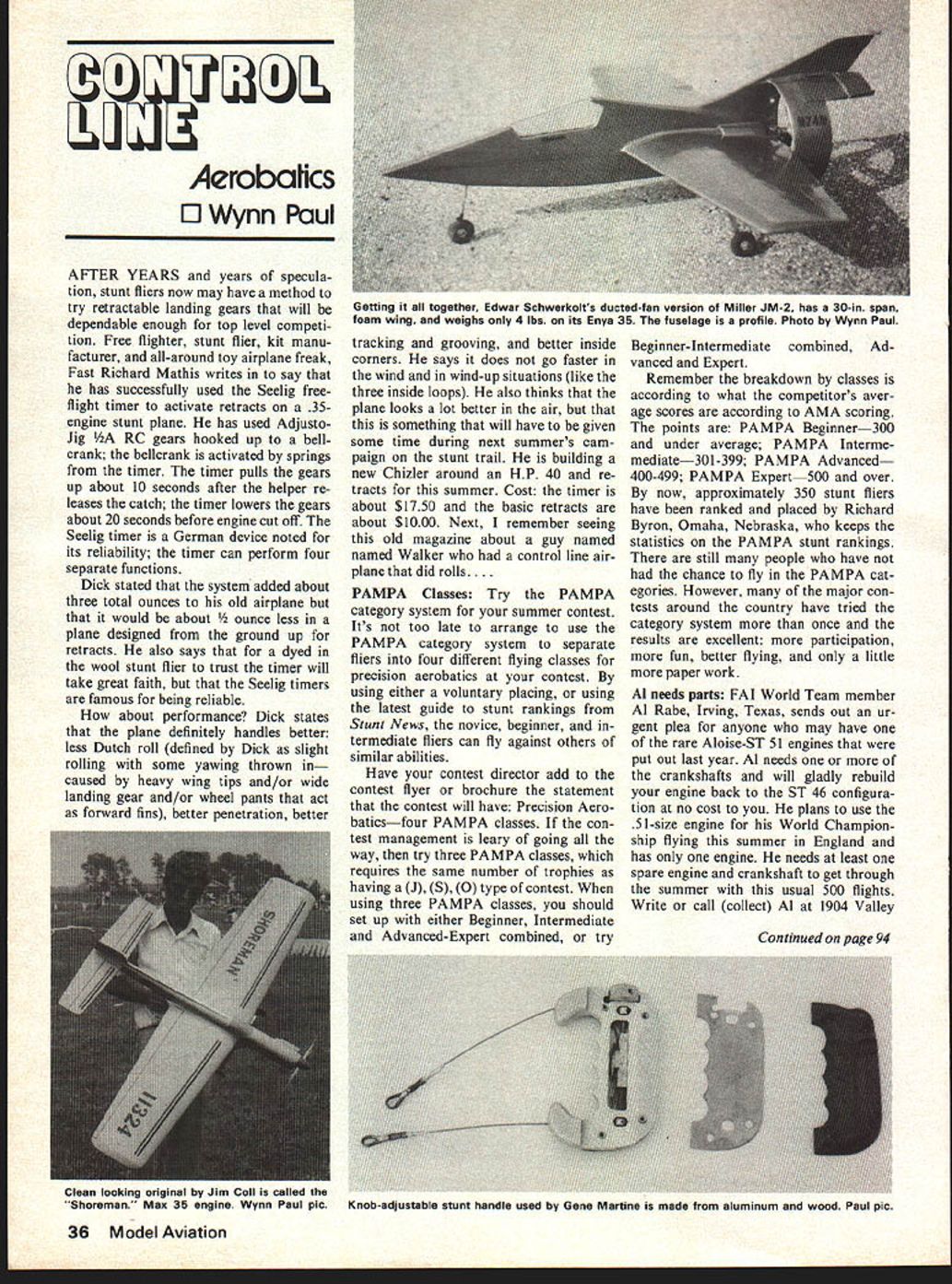
Getting together
Edwar Schwerkolts' ducted‑fan version of the Miller JM‑2 has a 30‑inch span foam wing and weighs about 4 lb; it uses an Enya .35 in a fuselage profile. (Photos and captions omitted)
Slow‑form items: Rich Brasher's Rotation Station kit‑type plane might start the Nemesis/Voodoo trend. Add longer motor mounts to make the 5‑inch minimum leading‑edge thrust washer; remember no prop extensions. Extra thick thrust washers are allowed. A boom‑type body can be made out of 1/8‑in. balsa capped with 3/16 spruce or bass top and bottom. Get the plane balanced properly; you might make the body extra long for the first attempt and cut length once the proper balance is achieved. Guys have used flaps — worth trying, especially using Mylar hinges since you could add or subtract flap movement.
Transcribed from original scans by AI. Minor OCR errors may remain.

