
Control Line: Aerobatics
Wynn Paul
Gieseke Nobler Notes
"Foam really flies after all," World Champion Bob Gieseke said shortly before a pushrod came out of his bellcrank on his new 1978 version of the Gieseke Nobler. Unfortunately, the pushrod came out during a pattern and the plane was totaled. However, Bob said it was flying better than any of his previous ones. Since the World Championships were only a month away, he returned to practicing with his 1977 ship—the one he used to win the FAI tryouts and place second in the 1977 Nationals.
Some of the slight modifications Bob tried on the 1978 plane:
- The wing measured a short 48.5 in. He shaped the tips so they roughly looked triangular—the widest part of the tip was approximately in the middle of the chord of the tip rib.
- The wing was slightly thinner than previous ones. (In earlier models Bob said he traced the kit Nobler wing rib with a ballpoint pen, which made the overall rib slightly thicker than the stock 18 percent rib.)
- He used a thicker stabilizer and elevator than on previous models.
- Flaps: instead of tapering the flaps so the cross section resembled a slice of pie, he used a 5/16-in. piece of balsa as-is and simply rounded off the trailing edge, giving a little more cross-sectional area than previous models. The flaps are almost full span, extending to about 3/4 to 1 in. from the wingtip.
- He is currently using 58-ft. lines for summer flying.
Half-A Stunt (continued)
Having settled in Salem, Oregon, Richard Porter—the king of "COPA" (Combat-precision aerobatics)—wrote in with more material. (How about naming the next creation Copa, Rich?) Rich emphasizes the value of a smaller, simpler, and virtually indestructible stunt machine for beginners and intermediate fliers. He feels that the Half-A stunter, and Half-A stunt at the local contest level, would help promote stunt for those who want to try the event. "If only I wasn't afraid of destroying my plane, I would fly stunt," is a common statement, according to Rich. An effective response is the combat-styled stunter.
Rich's recommendations for building such trainer/practice birds:
- Substitute lighter, thinner wood for tail sections and increase stabilizer area and/or moment length of current combat kits.
- Thin or otherwise lighten spars, leading edges, and trailing edges progressively toward the tips.
- Build in at least 10 degrees of engine offset for longer-line flying.
If one tires of such a machine, Rich suggests taking it to a combat match—a quick cure for that emotional state, he says.
Rich noted (as also mentioned in the March 1978 issue of Model Aviation) that he uses basically the VooDoo-type Half-A design, recommending at least 200 sq. in. of wing and 18 degrees of engine offset. He fits a tricycle landing gear; the finished model weighs about 8–9 oz.
Rich enclosed an unreproducible sketch and plan of a proposed "Blazing 50" Half-A stunter:
- Features a beautiful elliptical wing of 50-in. span and a matching stabilator.
- From the top view, the lines resemble Charley Mackey's Starlight (1967); the side view looks like a Starship from 2001 with a graceful fuselage and trike gear.
- Wing area about 415 sq. in.; estimated weight about 16 oz.
This could be a beautiful stunter if Rich can get it to fly.
Other hints from Rich:
- The new Glo Bees give around a 1,000 rpm increase on the Tee Dee in the air (from about 21,000 to about 22,200 rpm), but some smoothness of engine run is sacrificed.
- The unavailable Testor 6 x 4 prop gives identical lap speeds to the Cox competition 6 x 3 prop and doesn't tend to overheat the engine in maneuvers as sometimes occurs on Magnum fuel with the Cox 6 x 3 competition prop.
Fuel systems:
- Tatone makes small pen bladders that work well for Half-A's. The pen bladder requires about 12 lb. to start, then drops to about 6 lb., measured using a 2-oz. syringe and bathroom scales. The system is light, low-cost, consistent, simple, and offers extra power availability—especially good for smaller engines on light Half-A aircraft once understood.
On .008 lines for Half-A:
- Take care—they're fragile. Rich has more problems with people walking on them than with breaks or unravelling.
- Untwisting procedure: use the hand closest to the airplane to separate the lines with a wiping cloth. Use the other hand to twist and hold tension on the lines between the two hands to avoid kinks. This procedure prevents kinks and oil buildup.
- End-wrap technique: use what appears to be a quadruple wrap at the clip. Wrap 1/2 in. down the line from the clip, then back to the clip; loop the .008 line around the clip again and wrap 1/4 in. down and back. Finish the tapered end with epoxy or other glue.
- A good set of unkinked lines should easily take a 16-lb. pull test. .008 lines are adequate in winds up to 25 mph at current Half-A power levels. Rich recommends switching to .012 lines in winds above 20 mph and increasing line length to 50–52 ft.
Winston-Salem Control Line Championships
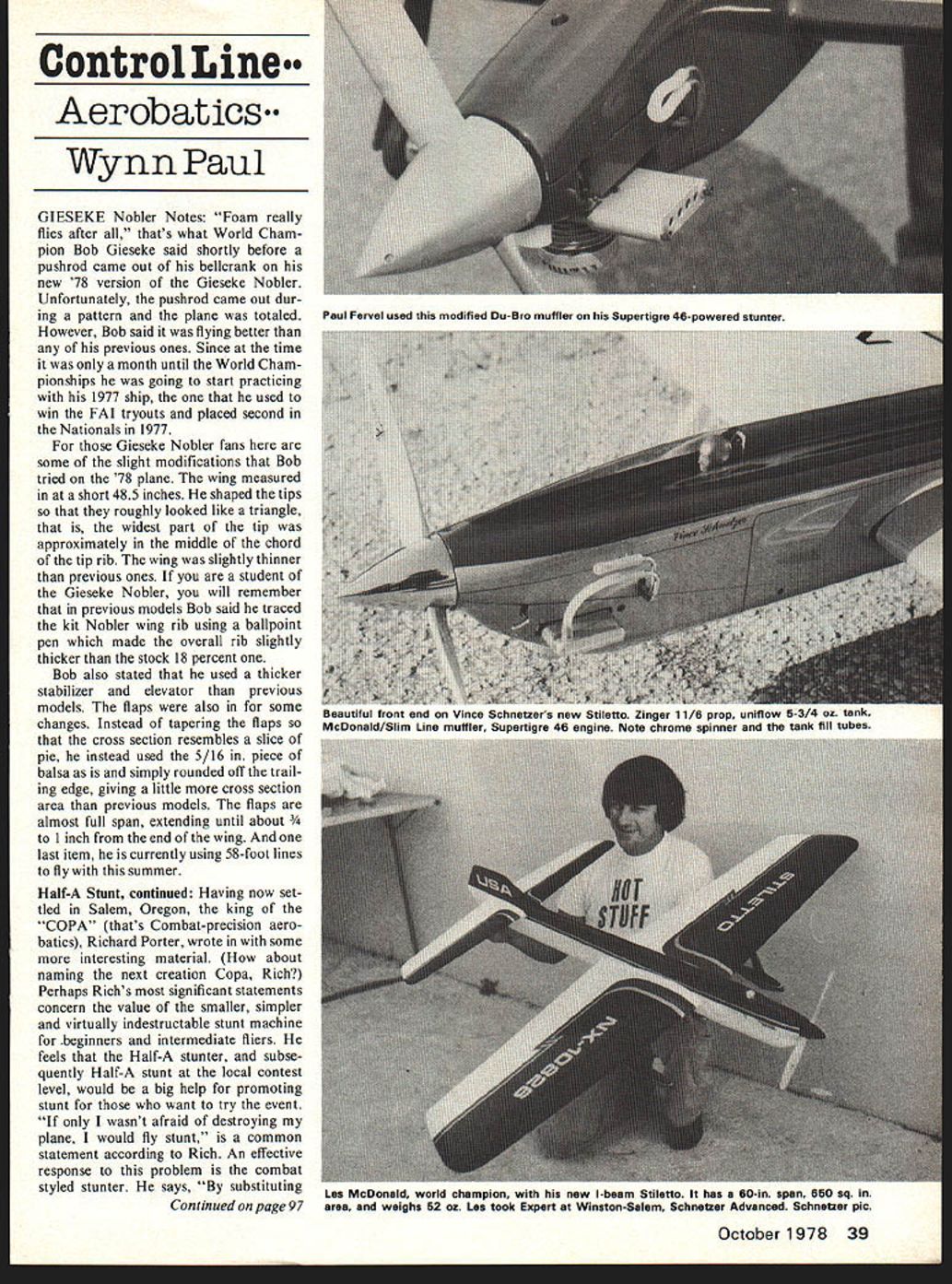
Les McDonald won the event held June 17–18, flying his new I-beam wing Stiletto. The new Stiletto specs:
- 60-in. span, about 650 sq. in. wing area
- Weight: 52 oz.
- Stabilizer: 32-in. span with a root chord 1 in. thick
- Very short flaps were used to improve turning ability
Results:
- 1st: Les McDonald — 494.5
- 2nd: Norm Whittle — 470.0
- 3rd: Bob Galle (now living in New Jersey)
Claus Maikis competed from West Germany and finished seventh after having some trouble with his plane. Advanced PAMPA stunt was won by Vince Schnetzer of Miami, Florida, with a Stiletto that beat Les' for best appearance points.
For information on stunt or PAMPA, write: Wynn Paul 1640 Maywick Drive Lexington, KY 40504
Transcribed from original scans by AI. Minor OCR errors may remain.

