
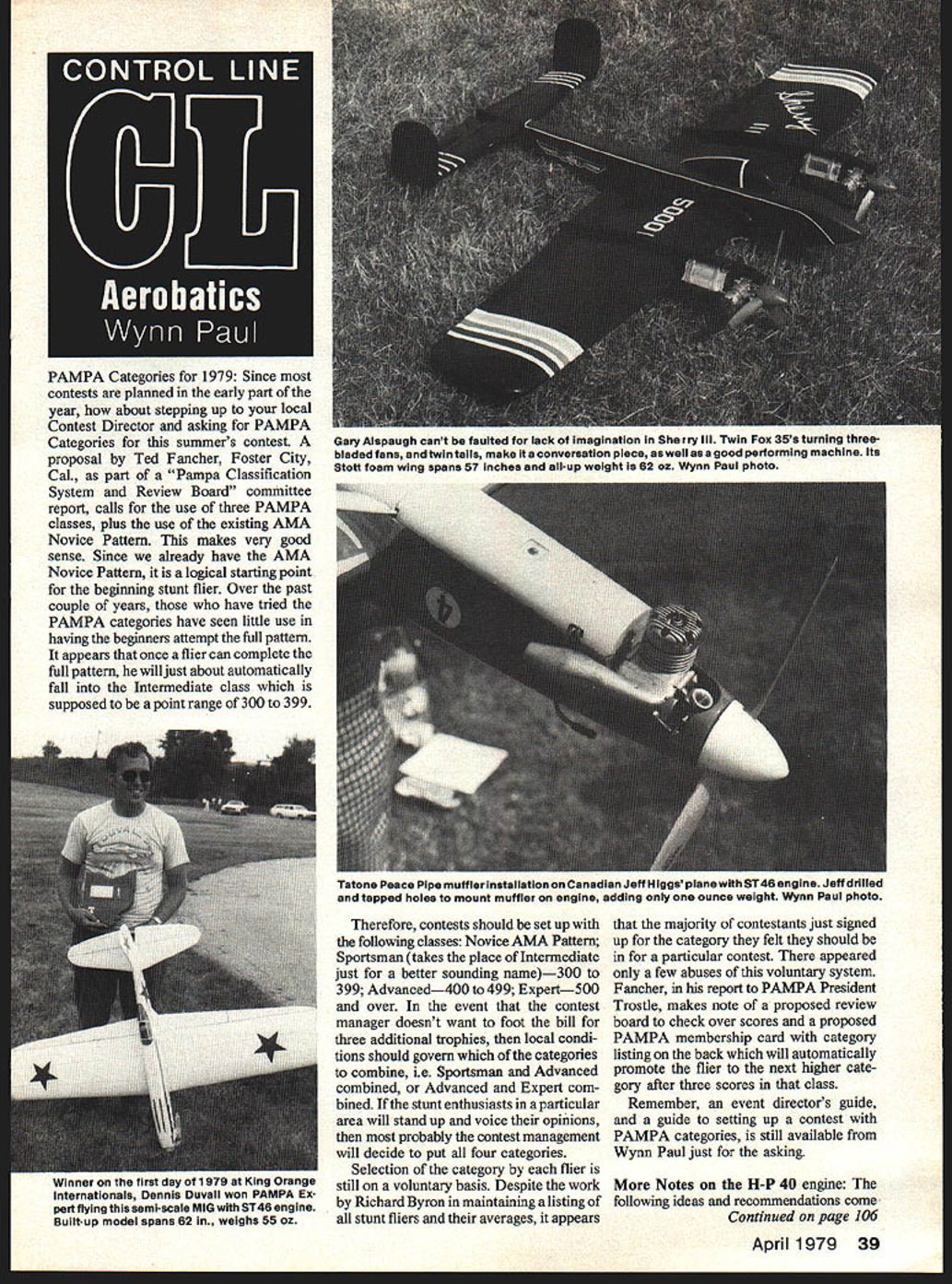
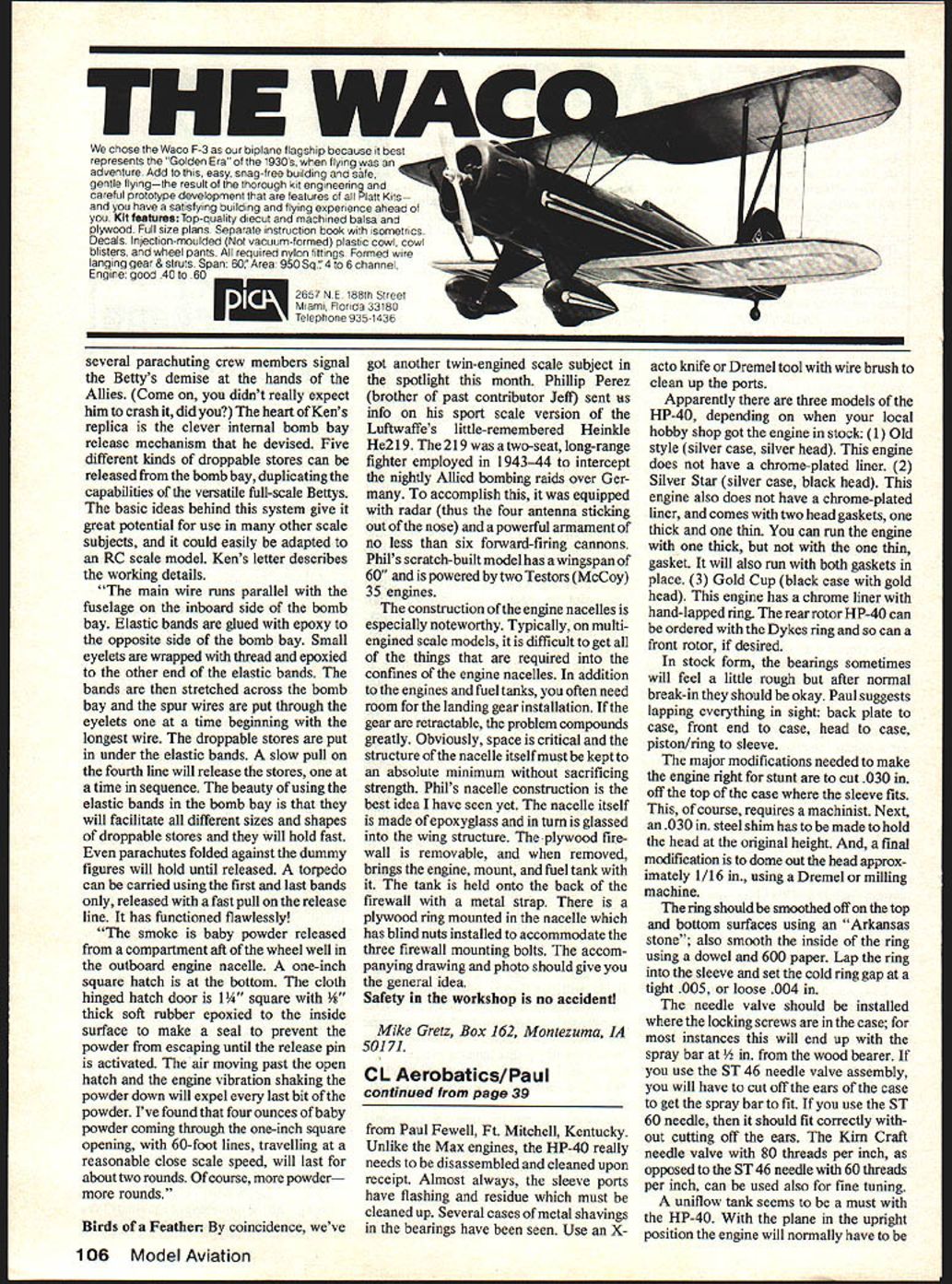
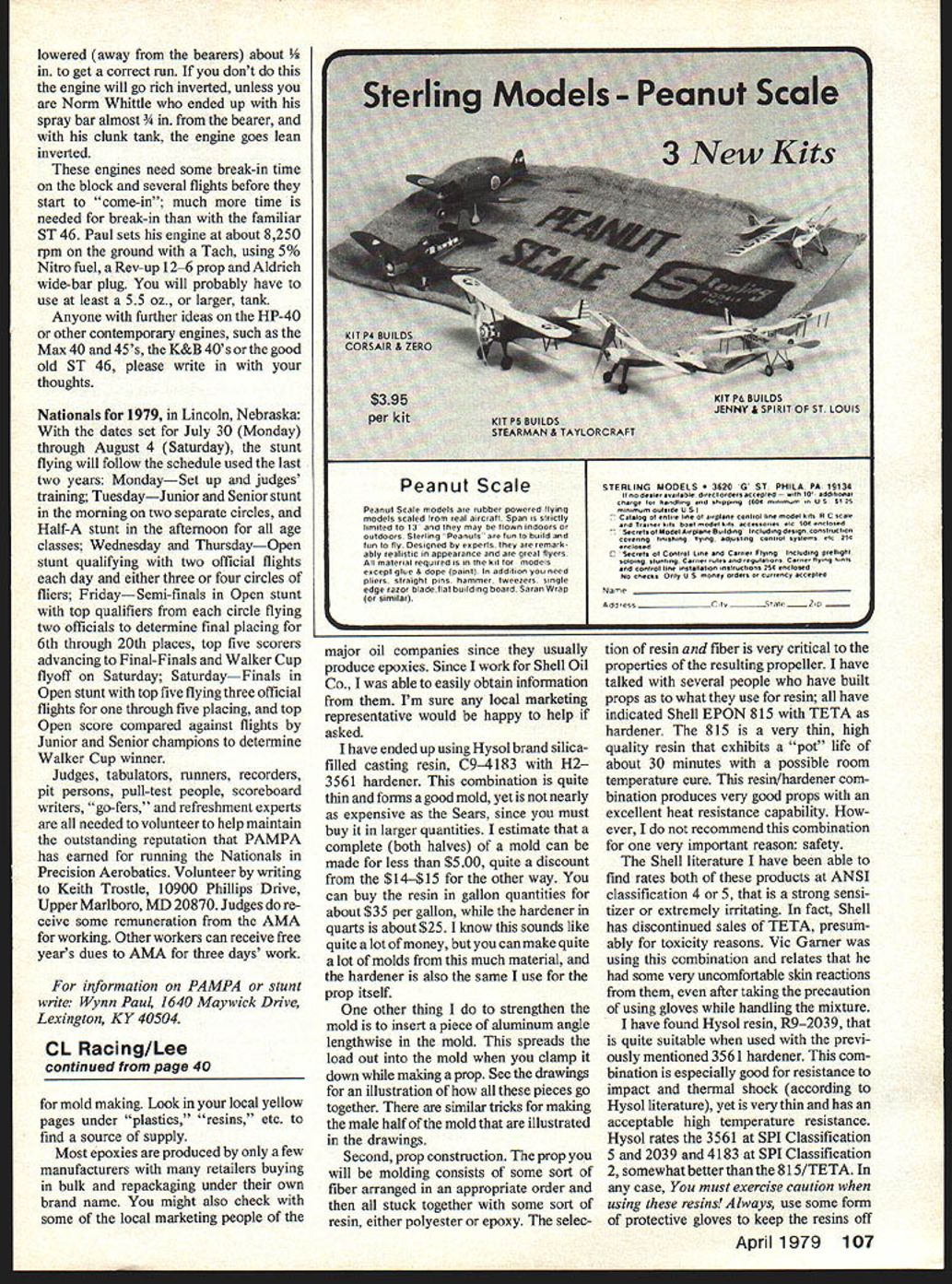
Control Line: Aerobatics
Wynn Paul
PAMPA Categories for 1979
Since most contests are planned in the early part of the year, how about stepping up to your local contest director and asking for PAMPA categories for this summer's contest? A proposal by Ted Fancher, Foster City, Calif., as part of a "PAMPA Classification System and Review Board" committee report, calls for the use of three PAMPA classes, plus the use of the existing AMA Novice Pattern. This makes good sense. Since we already have the AMA Novice Pattern, it is a logical starting point for the beginning stunt flier.
Over the past couple of years, those who have tried the PAMPA categories have seen little use in having beginners attempt the full pattern. It appears that once a flier can complete the full pattern, he will just about automatically fall into the Intermediate class, which is supposed to be a point range of 300 to 399.
Contests should be set up with the following classes:
- Novice — AMA Pattern
- Sportsman (takes the place of Intermediate for a better-sounding name) — 300 to 399
- Advanced — 400 to 499
- Expert — 500 and over
If the contest manager doesn't want to provide trophies for all four categories, local conditions should govern which categories to combine (for example, Sportsman and Advanced combined, or Advanced and Expert combined). If stunt enthusiasts in a particular area will voice their opinions, most probably contest management will decide to put all four categories.
Selection of the category by each flier is still voluntary. Despite Richard Byron's work in maintaining a listing of all stunt fliers and their averages, the majority of contestants sign up for the category they feel they should be in for a particular contest. There have been only a few abuses of this voluntary system. Fancher, in his report to PAMPA President Keith Trostle, notes a proposed review board to check scores and a proposed PAMPA membership card with the category listing on the back, which would automatically promote the flier to the next higher category after three scores in that class.
An event director's guide and a guide to setting up a contest with PAMPA categories are still available from Wynn Paul upon request.
More Notes on the H-P 40 Engine
The following ideas and recommendations come from Paul Fewell, Ft. Mitchell, Kentucky.
Unlike the Max engines, the H-P 40 really needs to be disassembled and cleaned upon receipt. Almost always, the sleeve ports have flashing and residue that must be removed. Several cases of metal shavings in the bearings have been seen. Use an X-Acto knife or a Dremel tool with a wire brush to clean up the ports.
Apparently there are three models of the H-P 40, depending on when your local hobby shop got the engine in stock:
- Old style — silver case, silver head. This engine does not have a chrome-plated liner.
- Silver Star — silver case, black head. This engine also does not have a chrome-plated liner and comes with two head gaskets, one thick and one thin. You can run the engine with the thick gasket, but not with the thin one alone. It will also run with both gaskets in place.
- Gold Cup — black case with gold head. This engine has a chrome liner with a hand-lapped ring.
The rear-rotor H-P 40 can be ordered with the Dykes ring, and a front-rotor can be ordered the same way if desired.
In stock form, the bearings sometimes feel a little rough but should be okay after normal break-in. Paul suggests lapping everything in sight: back plate to case, front end to case, head to case, and piston/ring to sleeve.
Major modifications recommended to make the engine suitable for stunt:
- Cut 0.030 in. off the top of the case where the sleeve fits (requires a machinist).
- Make a 0.030 in. steel shim to hold the head at the original height.
- Close out the head approximately 1/16 in. using a Dremel or milling machine.
The ring should be smoothed off on the top and bottom surfaces using an Arkansas stone; also smooth the inside of the ring using a dowel and 600-grit paper. Lap the ring into the sleeve and set the cold ring gap at a tight 0.005 in., or a loose 0.004 in.
Needle valve installation and tank notes:
- The needle valve should be installed where the locking screws are in the case; in most instances this will place the spray bar about 1/2 in. from the wood bearer.
- If you use the ST-46 needle valve assembly, you will have to cut off the ears of the case to get the spray bar to fit.
- If you use the ST-60 needle, it should fit correctly without cutting off the ears.
- The Kim-Craft needle valve (80 threads per inch) can also be used for finer tuning compared to the ST-46 (60 t.p.i.).
A uniflow tank seems to be a must with the H-P 40. With the plane in the upright position the engine will normally have to be lowered (away from the bearers) about 1/8 in. to get a correct run. If you don't do this the engine will go rich inverted, unless you have an unusual setup — for example, Norm Whittle ended up with his spray bar almost 3/4 in. from the bearer and, with his clunk tank, the engine runs lean inverted.
These engines need break-in time on the bench and several flights before they start to "come in"; much more time is needed for break-in than with the familiar ST-46. Paul sets his engine at about 8,250 rpm on the ground with a tach, using 5% nitro fuel, a rev-up 12x6 prop, and an Aldrich wide-bar plug. You will probably have to use at least a 5.5 oz. (or larger) tank.
Anyone with further ideas on the H-P 40 or other contemporary engines — such as the Max 40 and 45, the K&B 40s, or the ST-46 — please write in with your thoughts.
Nationals for 1979 — Lincoln, Nebraska
With the dates set for July 30 (Monday) through August 4 (Saturday), the stunt flying will follow the schedule used the last two years:
- Monday — Set up and judges' training.
- Tuesday — Junior and Senior stunt in the morning on two separate circles, and Half-A stunt in the afternoon for all age classes.
- Wednesday and Thursday — Open stunt qualifying with two official flights each day and either three or four circles of fliers.
- Friday — Semi-finals in Open stunt with top qualifiers from each circle flying two officials to determine final placing for 6th through 20th places; top five scorers advance to Final-Finals and Walker Cup flyoff on Saturday.
- Saturday — Finals in Open stunt with the top five flying three official flights for first through fifth placing; the top Open score is compared against flights by Junior and Senior champions to determine the Walker Cup winner.
Volunteers are needed for judges, tabulators, runners, recorders, pit persons, pull-test people, scoreboard writers, go-fers, and refreshment helpers to maintain the outstanding reputation that PAMPA has earned for running the Nationals in precision aerobatics. Volunteer by writing to Keith Trostle, 10900 Phillips Drive, Upper Marlboro, MD 20870. Judges do receive some remuneration from the AMA for working. Other workers can receive a free year's AMA dues for three days' work.
For information on PAMPA or stunt, write: Wynn Paul, 1640 Maywick Drive, Lexington, KY 40504.
Transcribed from original scans by AI. Minor OCR errors may remain.

