
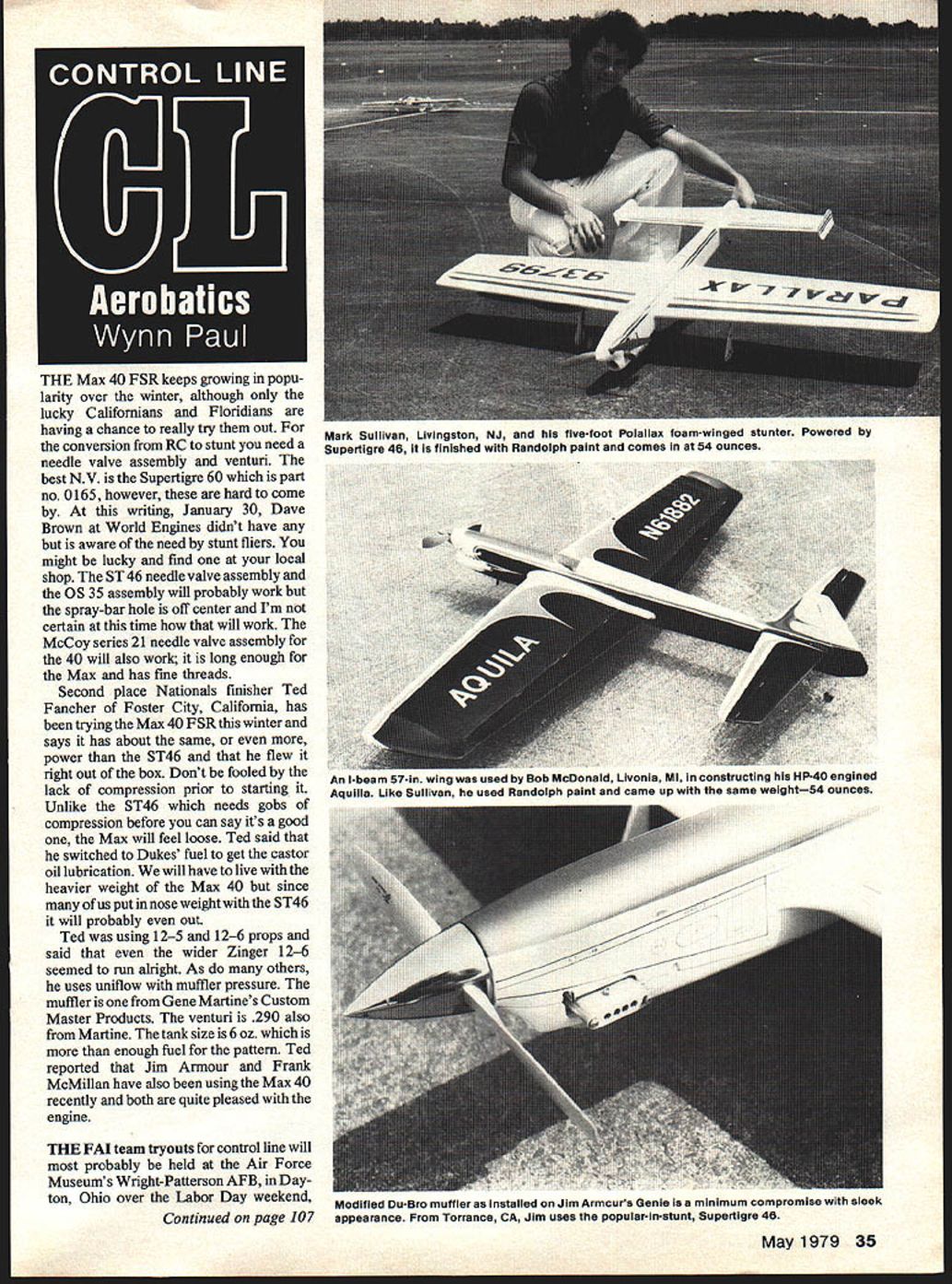
Control Line: Aerobatics
Wynn Paul
Max 40 FSR
The Max 40 FSR kept growing in popularity over the winter, although only the lucky Californians and Floridians have had a chance to really try them out. For conversion from RC to stunt you need a needle-valve assembly and venturi. The best needle valve is the Supertigre 60 (part no. 0165), but these are hard to come by. At this writing (January 30) Dave Brown at World Engines didn't have any but is aware of the need by stunt fliers. You might be lucky and find one at your local shop.
The ST46 needle-valve assembly and the OS35 assembly will probably work, but the spray-bar hole is off-center and it's uncertain how that will affect performance. The McCoy Series 21 needle-valve assembly for the .40 will also work; it is long enough for the Max and has fine threads.
Second-place Nationals finisher Ted Fancher of Foster City, California, has been trying the Max 40 FSR this winter and says it has about the same, or even more, power than the ST46 and that he flew it right out of the box. Don't be fooled by the lack of compression prior to starting it. Unlike the ST46, which needs gobs of compression before you can say it's a good one, the Max will feel loose. Ted said he switched to Dukes' fuel to get the castor oil lubrication. We will have to live with the heavier weight of the Max 40, but since many of us add nose weight to the ST46 it will probably even out.
Ted was using 12-5 and 12-6 props and said that even the wider Zinger 12-6 seemed to run alright. Like many others, he uses uniflow with muffler pressure. The muffler is one from Gene Martine's Custom Master Products. The venturi is .290 (also from Martine). The tank size is 6 oz, which is more than enough fuel for the pattern. Ted reported that Jim Armour and Frank McMillan have also been using the Max 40 recently and both are quite pleased with the engine.
FAI Team Tryouts (Control Line)
The FAI team tryouts for control line will most probably be held at the Air Force Museum's Wright-Patterson AFB in Dayton, Ohio, over the Labor Day weekend, according to PAMPA President Keith Trostle. The museum's 7,000-foot runway will accommodate most anybody's line length and will be available all week for practice. For those who remember the '76 Nats, this was the runway used by CL racing events and RC pylon. This will be the first combined tryouts for stunt, speed, and team race since 1971. Some of the Precision Aerobatics judges have already been lined up by event director Keith Trostle, and World Champion Bob Hunt is scheduled to be the assistant event director.
Aerodynamics Question
Doug McGinnis of Fawn Grove, PA 17321, has written asking how our stunt planes can fly when we have a symmetrical airfoil which should create reduced air pressure on both top and bottom of the wing. Perhaps some of you theoretical types could help clear this up.
Finishing Method (Lou Dudka)
From Lou Dudka of New Jersey comes a method of finishing a stunt plane using Hobbypoxy white undercoater H-19:
- Apply two coats of clear dope over the bare wood. Sand lightly with 220 grit.
- Mix Hobbypoxy white undercoater 2½ parts white to 1 part hardener.
- Allow the mixture to sit for two days in an open jar after mixing for "precuring."
- Apply the undercoater using the "playing card" method: brush it on thickly, then use a playing card or other stiff cardboard to scrape it off.
- Apply a second coat of undercoater quite lightly.
- Sand these coats dry with 150–220 grit paper. This should fill the wood completely.
- Spray a base coat of Acro-gloss clear (two coats is best) to give the paint a good base to adhere to.
- Apply your favorite paint for a durable, "dynamite" finish.
According to Lou, this method will not shrink upon final drying.
1979 Nationals — Volunteers Needed
It is still not too late to volunteer to work at the 1979 Nationals in Lincoln, Nebraska, July 30–August 4. Event director Lanny Shorts still needs:
- Judges
- Recorders
- Circle engineers (set up and point lines)
- Assistants
- Pit bosses
- Score tabulator couriers (runners)
- Sanitary engineers (clean up at end of the day)
- Half-A judges
- Test pilots (for judging practice on Monday, July 30)
Contact Lanny Shorts at: 661 Louie Avenue, Lodi, CA 95240 Tel.: (209) 368-9492
The Cobra, Argus, and Ares (Steve Wooley / Bill Werwage history)
A request has been made for information on the Cobra originally designed by Steve Wooley. This was a .35-size ship of the "classic style" with a turtle deck and long slim fuselage similar to the Ares. Steve built the Cobra sometime in 1969 or 1970, but the magazine article did not appear in the now-defunct American Aircraft Modeler until February 1971. Steve built few airplanes, preferring to race sports cars, which unfortunately was the cause of his death in a racing accident in 1970. He was a talented flier who professed dislike for practicing; however, he managed to finish fourth in the World Championships in 1960, 1966, and 1968. He had a third place in the 1962 Nats in open and a second in the 1958 Nats in senior division.
The Cobra was a modernization of Wooley's Argus, which he used in the 1960 World Champs. The Cobra had approximately 580 sq. in. of wing with a 10.375 in. root chord. The front moment arm was 9.35 in. and the rear moment arm was 13.75 in. The stabilizer was approximately 25 in. span. Steve stated in the Cobra article that the plane was slightly larger in wing area and flap area than the earlier Argus and that the stabilizer was also larger.
The Argus, built in the late '50s, is very similar to Bill Werwage's Ares, which is not surprising since Bill and Steve were close friends. The Argus and Cobra built by Steve had I-beam wings, large wheel pants, and the slim fuselages characteristic of the "Detroiter" style of stunt ships of the '50s and early '60s.
Plans for the Cobra are probably non-existent since American Aircraft Modeler went out of business; you could obtain an old copy of the magazine article for the plans that appeared with the article. The same applies for the Argus, which appeared in American Modeler in August 1961. Plans for the Ares of Bill Werwage are still available through Hobby Helpers:
Hobby Helpers 1543 Stillwell Avenue Bronx, NY 10461 Plan Group 560
Mike Ditrich, 2402 Penna Avenue, Erie, PA 16503, has built a succession of .46-size Cobras with I-beam wings which are very good airplanes and will fly with anything. They turn very well—an improvement over the original Cobra. You might contact Mike for some basic dimensions. Unfortunately, no picture of one of Mike's airplanes was available at the time of this writing.
Contacts
- For information on stunt or PAMPA, write Wynn Paul:
Wynn Paul 1640 Maywick Dr. Lexington, KY 40504
Transcribed from original scans by AI. Minor OCR errors may remain.

