
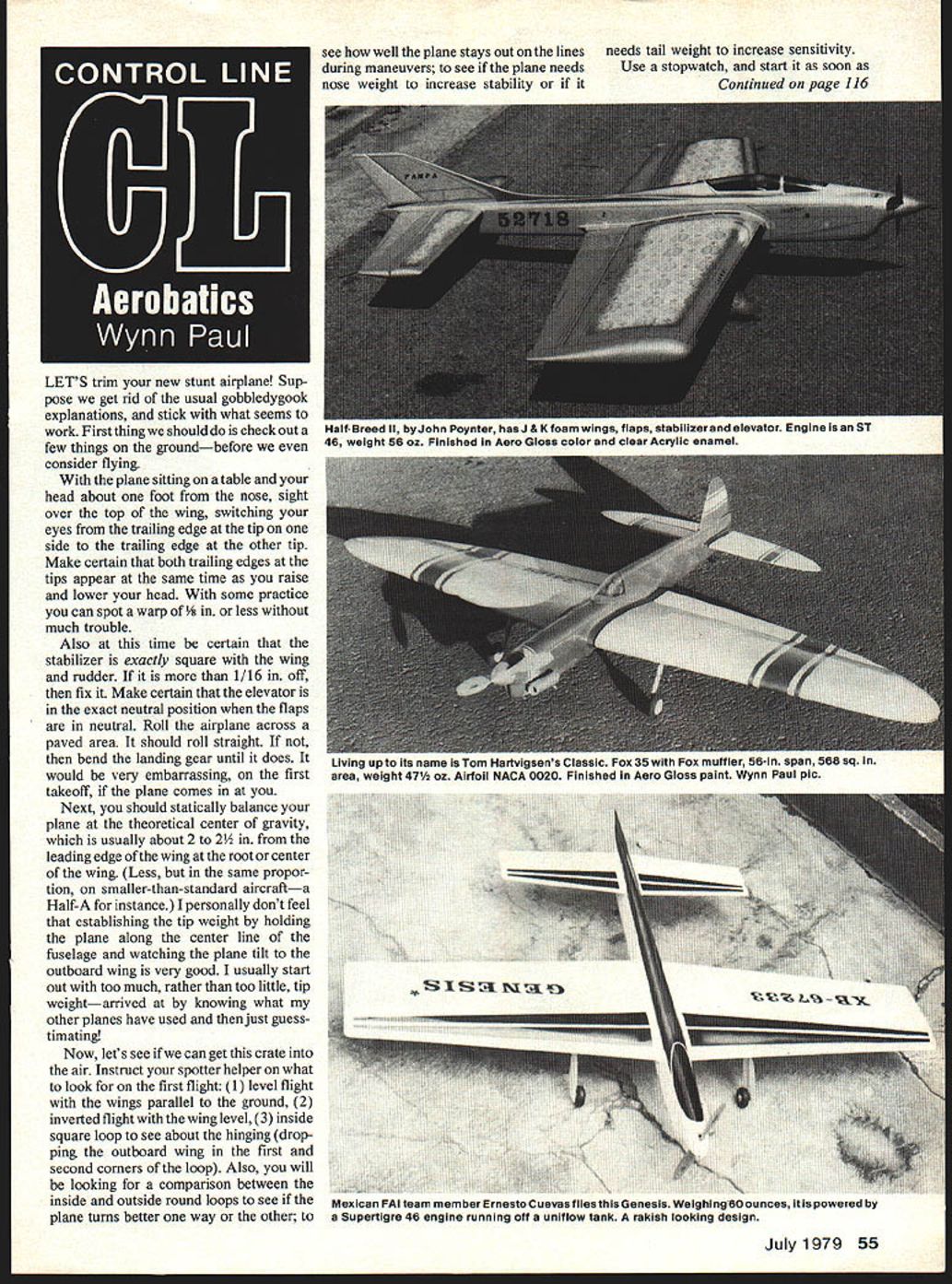
Control Line: Aerobatics
Wynn Paul
Preflight checks — on the bench
- With the plane sitting on a table and your head about one foot from the nose, sight over the top of the wing. Switch your eyes from the trailing edge at the tip on one side to the trailing edge at the other tip. Both trailing edges at the tips should appear at the same time as you raise and lower your head. With practice you can spot a warp of 1/8 in. or less.
- Make certain the stabilizer is exactly square with the wing and rudder. If it is more than 1/16 in. off, fix it.
- Make certain the elevator is exactly neutral when the flaps are neutral.
- Roll the airplane across a paved area. It should roll straight. If not, bend the landing gear until it does — it would be embarrassing if the plane came in at you on the first takeoff.
- Statically balance the plane at the theoretical center of gravity, usually about 2 to 2-1/2 in. from the leading edge at the wing root (less, in the same proportion, on smaller models such as Half-A ships). Tip-weight checking by holding the plane along the fuselage centerline and watching the outboard wing tilt is not very precise; many fliers guesstimate tip weight from what has worked on other ships.
First flight — what to do and what to watch
Instruct your spotter(s)
- Look for level flight with the wings parallel to the ground.
- Look for inverted flight with the wing level.
- Watch an inside square loop for hinging — check whether the outboard wing drops in the first and second corners.
- Compare inside and outside round loops to see if the plane turns better one way or the other.
- Watch how well the plane stays out on the lines during maneuvers.
- Observe whether the plane needs nose weight (for stability) or tail weight (for sensitivity).
Use a stopwatch and start it as soon as the engine catches. After takeoff, fly at eye level, approximately five feet off the ground while your spotter checks the outboard wing (up, down, or level).
Spotter positioning and movement
- Have the spotter stand downwind facing you so he can see the plane coming and going.
- Then have the spotter move counterclockwise 90 degrees around the circle (from downwind toward upwind) to watch the plane’s appearance coming and going from that angle. From this position the spotter can see if the inboard gear appears in front of the outboard gear (a sign of excessive yaw or leadout/engine offset).
Initial maneuvers
- Begin with a couple of large inside loops (downwind) to warm up.
- Try an elongated, round inside loop with a long inverted part at the top.
- Attempt going straight from the start of an inside loop into inverted flight; get the spotter to check for outboard tip high/low.
- If something seems wrong, re-check level upright flight and inverted flight immediately to get the spotter’s impressions.
- Perform a series of climbs and dives to evaluate nose- or tail-heaviness: if the plane climbs and dives very easily or jerks, it may be tail-heavy and require nose weight; if it’s locked into a groove on level flight, you probably have too much nose weight.
- Try three inside round loops followed by three outside round loops and compare feel. The inside/outside “square” is the ultimate test of turnability.
- If time remains on the stopwatch, try an inside square. Have the spotter stand about 20 feet off the circle tangent to the downwind side facing the front of the plane to watch the outboard wing in the first corner. Check that line tension is maintained throughout the maneuver and that tension at the top equals tension at the bottom.
Observe the engine-cut glide
- Maintain level flight about seven feet off the ground until the engine cuts.
- Immediately note the glide response: does the plane climb or dive, groove into a descent, stall slightly, or get very light on the lines?
- Can you fly it on to the ground? Does it bounce or stick on landing?
First-flight checklist (items to note)
- Level flight
- A. Wing up or down
- B. Excessive yaw
- C. Tendency (climb/dive)
- D. Groove or touchy response
- E. Hunting (constant small corrections needed)
- Inverted flight — wing up or down
- Inside and outside round loops
- A. Which turns easier
- B. Line tension
- Climbs and dives — nose-heavy or tail-heavy
- Inside square
- A. Hinging
- B. Line tension at the top
- Glide path
- A. Touchy controls or smooth descent
- B. Landing ability — bounce or settle
Trimming philosophy
- Make one change per flight. Example: if you move leadouts back 1/4 in., do nothing else that flight. Don’t change props, line lengths, or add tip weight at the same time. This takes time but is necessary, especially with new designs.
How to diagnose and correct common trim problems
Wing up in level, down inverted (or vice versa)
- If the wing is up in level flight and the same outboard wing is down in inverted flight, you have a warp: the outboard trailing edge/flap is down relative to the inboard trailing edge/flap. Bend the outboard flap up relative to the inboard flap.
- If the wing is down in level flight and up in inverted flight, the outboard flap needs to be bent down relative to the inboard flap.
- Chris Della suggested lowering the leadouts, but this is impractical on many ships. Many stunt planes fly well with slightly “tweaked” flaps.
Wing down in both upright and inverted flight
- Probably too much tip weight. Remove at least 1/2 oz and try again. It usually takes about 1/2 oz extra to make the wing noticeably drop.
Wing up in both upright and inverted flight
- Add tip weight in 1/4 or 1/2 oz increments.
Inboard or outboard roll and vertical CG
- Inboard/outboard roll can be affected by vertical center-of-gravity and compounded by dihedral. You can’t do much to change vertical CG after the plane is built without major surgery to leadouts.
Excessive yaw
- If the inboard gear looks to be in front of the outboard gear as the plane goes around the circle (especially approaching the upwind side), you may have too much yaw. Move the leadouts forward and/or reduce engine offset.
Line tension
- Line tension is partly personal preference. Prop selection and leadout placement affect tension. Some fliers prefer heavy tension, others slight tug.
Plane hard to break from level (grooves)
- Too much nose weight. Remove some nose weight, try a lighter muffler, or use a plastic spinner instead of a metal one.
Plane very touchy in level flight
- Tail-heavy. Add nose weight in 1/8 or 1/4 oz increments.
Hunting in level flight
- “Hunting” means the ship wants to climb or dive slowly and requires constant tiny corrections. This is often due to slop in elevator movement relative to the flaps. Older stunt planes often have worn elevator-horn bushings that provide a bit of free play (as much as 3/16 in.) and eliminate hunting.
- To intentionally add slop, ream the elevator-flap horn bushing with a larger drill or file until the elevator has some play while flaps remain motionless.
- If the push-rod or washer is hard to remove while servicing the horn, you may need to make a small incision under the elevator on the side where the washer is soldered to the push-rod to free it. (Many insert the push-rod from the left inboard side so centrifugal force will tend to keep it in place if the washer falls off.)
Inside/outside turn preference
- If the plane favors one direction, try shims under the engine (washers are easiest) to alter thrust or offset. But first confirm behavior on inside and outside squares before deciding.
Glide path and landing adjustments
- If the plane drops the tail as soon as the engine cuts, it’s likely tail-heavy.
- If it continues to groove and flies straight to the ground, it may be nose-heavy.
- If the plane gets extremely light on the lines after the engine cuts, the leadouts may be too far forward or there may be insufficient tip weight.
- If the plane bounces after a good glide, the gear may be too springy or mounted too far forward. From directly overhead, try aligning the axle of the main gear with the wing leading edge.
Final notes
- Prop selection, line tension, and many other subtle items can affect performance (Les McDonald has written on prop selection and its effects on line feel).
- Be patient: trimming a new design often requires many small, single changes and test flights.
For information on PAMPA or stunt, write Wynn Paul, 1640 Maywick Dr., Lexington, KY 40504.
Transcribed from original scans by AI. Minor OCR errors may remain.

