
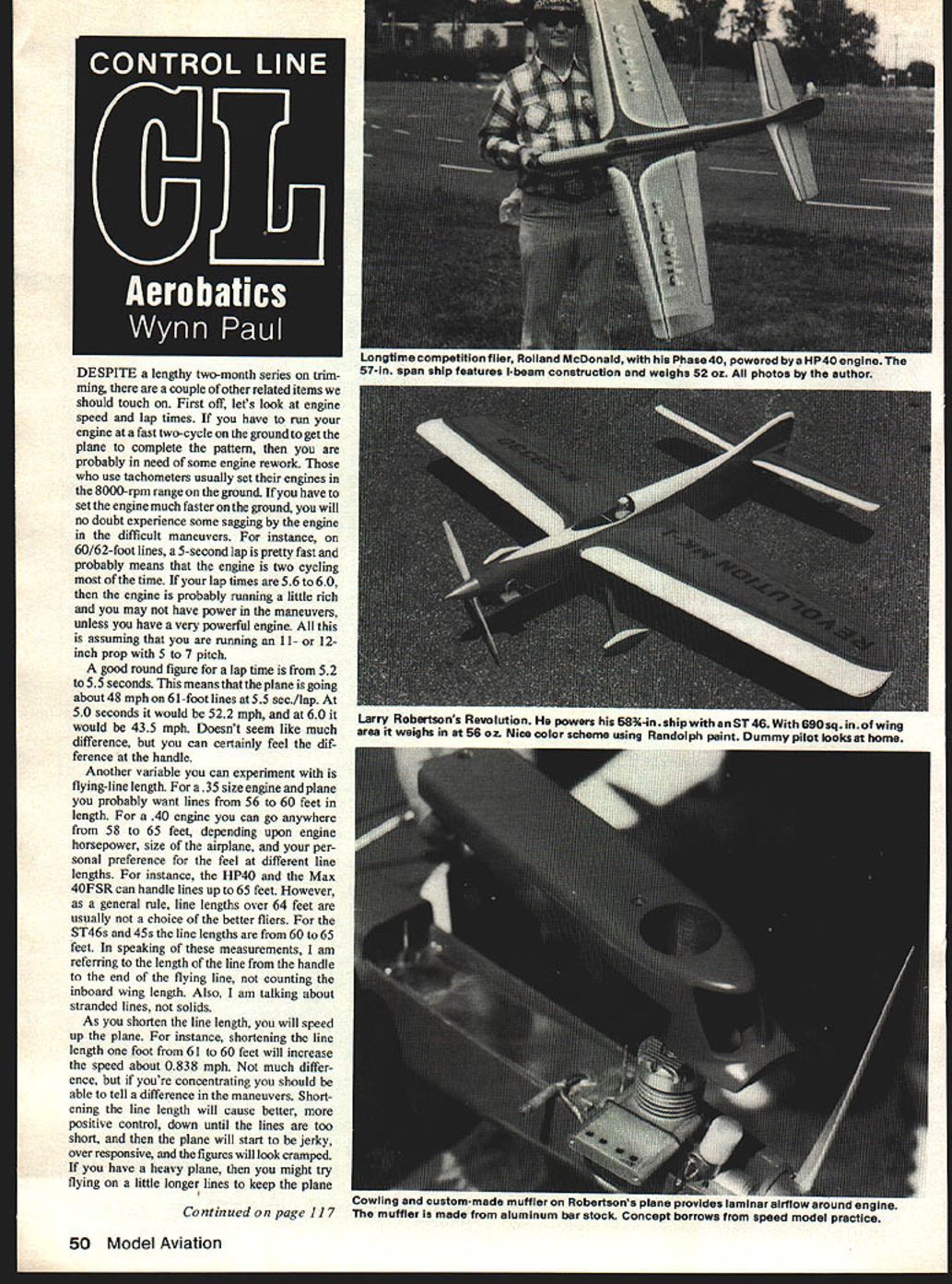
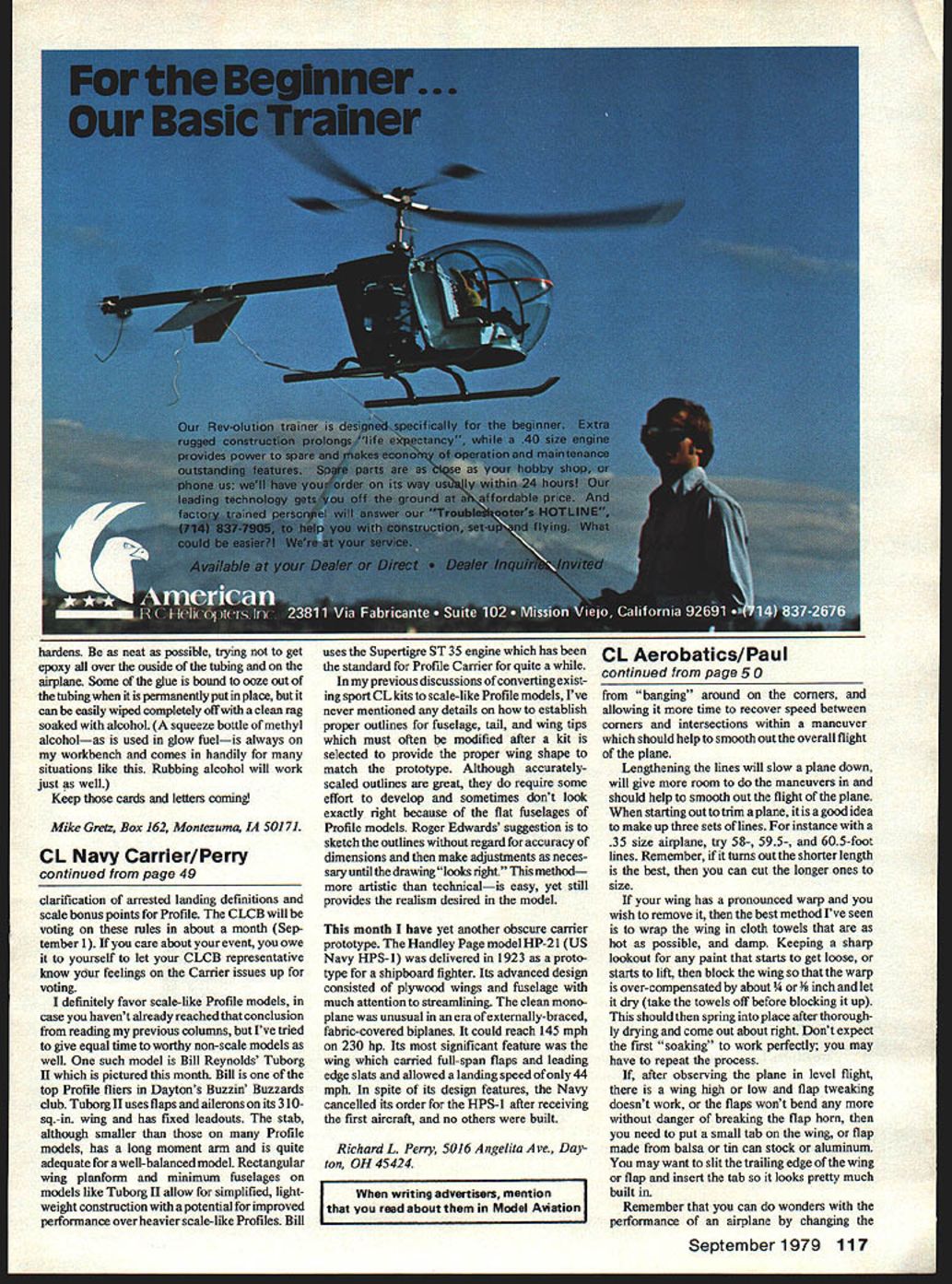
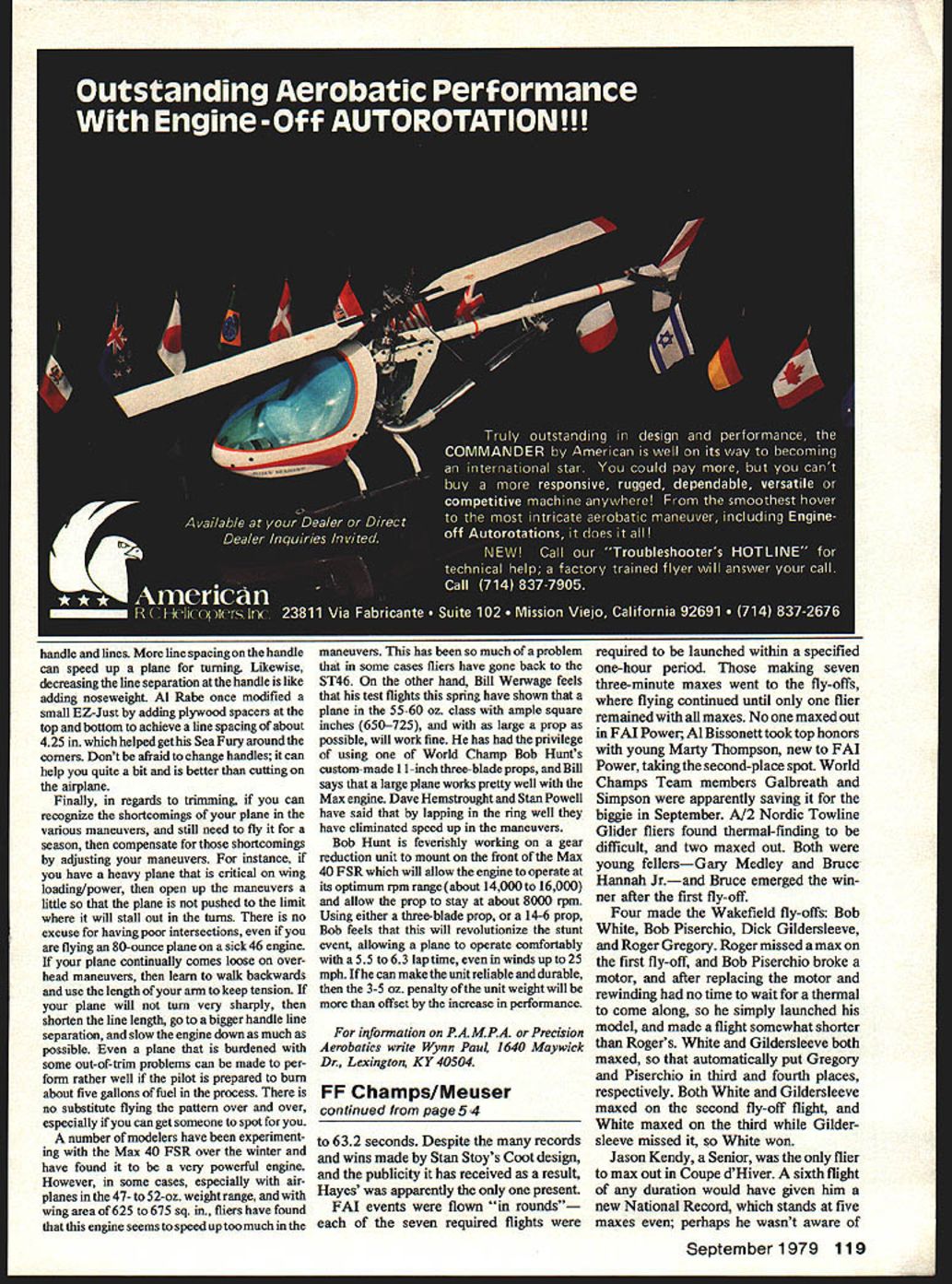
Control Line: Aerobatics
Wynn Paul
Engine speed and lap times
Despite a lengthy two-month series on trimming, there are a couple of other related items we should touch on. First, let's look at engine speed and lap times.
- If you have to run your engine at a fast two-cycle on the ground to get the plane to complete the pattern, you are probably in need of some engine rework.
- Those who use tachometers usually set their engines in the 8,000 rpm range on the ground. If you have to set the engine much faster on the ground, you will likely experience sagging by the engine in the difficult maneuvers.
- For instance, on 60–62-foot lines a 5-second lap is pretty fast and probably means the engine is two-cycling most of the time. If your lap times are 5.6 to 6.0 seconds, then the engine is probably running a little rich and you may not have enough power in the maneuvers unless you have a very powerful engine.
This assumes you are running an 11- or 12-inch prop with a 5- to 7-inch pitch.
A good round figure for a lap time is 5.2 to 5.5 seconds. On 61-foot lines, these lap times correspond to roughly:
- 5.5 sec/lap ≈ 48 mph
- 5.0 sec/lap ≈ 52.2 mph
- 6.0 sec/lap ≈ 43.5 mph
The numerical differences may seem small, but you can certainly feel the difference at the handle.
Flying-line length
Another variable to experiment with is flying-line length.
- For a .35-size engine and plane, you probably want lines 56 to 60 feet long.
- For a .40 engine you can go anywhere from 58 to 65 feet, depending on engine horsepower, airplane size, and your personal preference for feel.
- The HP40 and the Max 40FSR can handle lines up to 65 feet, but as a general rule line lengths over 64 feet are usually not chosen by the better fliers.
- For the ST46s and .45s, recommended line lengths are 60 to 65 feet.
When I refer to line length I mean the length from the handle to the end of the flying line, not counting the inboard wing length. I am referring to stranded lines, not solids.
As you shorten the line length you will speed up the plane. For example, shortening the line one foot from 61 to 60 feet will increase the speed by about 0.838 mph. Shortening the line tends to give better, more positive control, until the lines are too short—then the plane becomes jerky, over-responsive, and the figures look cramped. If you have a heavy plane, try flying on a little longer lines to keep the plane from "banging" around the corners and to allow it more time to recover speed between corners and intersections, which helps smooth the overall flight.
Lengthening the lines will slow a plane down, give more room to do the maneuvers, and should help smooth out the flight.
When starting to trim a plane, make up three sets of lines. For example, with a .35 airplane try:
- 58.0 ft
- 59.5 ft
- 60.5 ft
If the shorter length turns out to be best, you can cut the longer ones to that size.
Fixing wing warp
If your wing has a pronounced warp and you wish to remove it, try this method:
- Wrap the wing in cloth towels that are as hot as possible and clamp.
- Keep a sharp lookout for any paint that starts to get loose or lift.
- Take the towels off before blocking the wing.
- Block the wing so that the warp is over-compensated by about 1/8 to 3/16 inch and let it dry.
Don't expect the first soaking to work perfectly; you may have to repeat the process.
Small tab correction
If, after observing the plane in level flight, one wing is high or low and the flap cannot be bent further without danger of breaking, put a small tab on the wingtip or flap made from balsa, tin can stock, or aluminum. You may want to slit the trailing edge of the wing or flap and insert the tab so it looks built in.
Handle and line spacing
You can do wonders with an airplane's performance by changing the handle and lines.
- More line spacing on the handle can speed up a plane for turning.
- Decreasing the line separation at the handle acts like adding noseweight.
Al Rabe once modified a small EZ-Just by adding plywood spacers at the top and bottom to achieve a line spacing of about 4.25 inches, which helped get his Sea Fury around the corners. Don't be afraid to change handles; it can help you quite a bit and is better than cutting on the airplane.
Trimming and compensating in flight
If you can recognize the shortcomings of your plane in the various maneuvers but still need to fly it for a season, compensate for those shortcomings by adjusting your maneuvers.
- If you have a heavy plane that is critical on wing loading/power, open up the maneuvers a little so the plane is not pushed to the limit where it will stall in the turns.
- There is no excuse for having poor intersections, even if you are flying an 80-ounce plane on a weak .46 engine.
- If your plane continually comes loose on overhead maneuvers, learn to walk backwards and use the length of your arm to keep tension.
- If your plane will not turn very sharply, then shorten the line length, increase the handle line separation, and slow the engine down as much as possible.
Even a plane with some out-of-trim problems can perform well if the pilot is prepared to fly the pattern repeatedly and burn a lot of fuel in the process. There is no substitute for flying the pattern over and over, especially if you can get someone to spot for you.
Max 40 FSR observations
A number of modelers have been experimenting with the Max 40 FSR over the winter and have found it to be a very powerful engine. However, in some cases—especially with airplanes in the 47- to 52-ounce weight range and wing area of 625 to 675 sq. in.—fliers have found that this engine seems to speed up too much in the maneuvers. This has been such a problem that some have gone back to the ST46.
On the other hand, Bill Werwage reports that his test flights show a plane in the 55–60 oz. class with ample wing area (650–725 sq. in.) and as large a prop as possible will work fine. He has flown with one of World Champ Bob Hunt's custom-made 11-inch three-blade props and says a large plane works pretty well with the Max engine. Dave Hemstrung and Stan Powell have said that by lapping the ring well they have eliminated speed-up in the maneuvers.
Gear reduction unit
Bob Hunt is working on a gear reduction unit to mount on the front of the Max 40 FSR that will allow the engine to operate at its optimum rpm range (about 14,000 to 16,000) while keeping the prop at about 8,000 rpm. Using either a three-blade prop or a 14x6 prop, Bob feels this will revolutionize the stunt event, allowing a plane to operate comfortably with a 5.5 to 6.3 lap time, even in winds up to 25 mph. If he can make the unit reliable and durable, the 3.5-ounce weight penalty will be more than offset by the increase in performance.
Contact
For information on P.A.M.P.A. or Precision Aerobatics write: Wynn Paul 1640 Maywick Dr. Lexington, KY 40504
Transcribed from original scans by AI. Minor OCR errors may remain.

