
Control Line: Aerobatics
Wynn Paul
Max .40 FSR observations
Some more suggestions on the Max .40 FSR. According to two-time World Champ Bill Werwage, after several gallons of testing in the spring and summer, it seems that with conventional props (i.e., 12-6, cut down 13-5, etc.) the Max may work better on a larger airplane (i.e., 675 sq. in. and over) that weighs in the 58 oz. area and over. According to Bill, this taxes the engine's power and helps to tame it down. Unfortunately, at the time of this writing, some top fliers have abandoned the Max for this summer in favor of the old reliable ST 46; for instance Whiteley, Les McDonald, Fancher, Werwage, Jim Armour and Dave Hemstrought.
Dave Hemstrought has additional comments on the Max. He and Stan Powell were using Max in the spring and came up with two modifications that seemed to help:
- Use an .005 in. head gasket to lower the compression.
- Carefully remove the glaze from the chromed cylinder liner with an automobile brake cylinder hone by hand. This allows the ring to seat better in the liner and reduced the tendency for the engine to run away in round maneuvers, the most common problem among users of this engine.
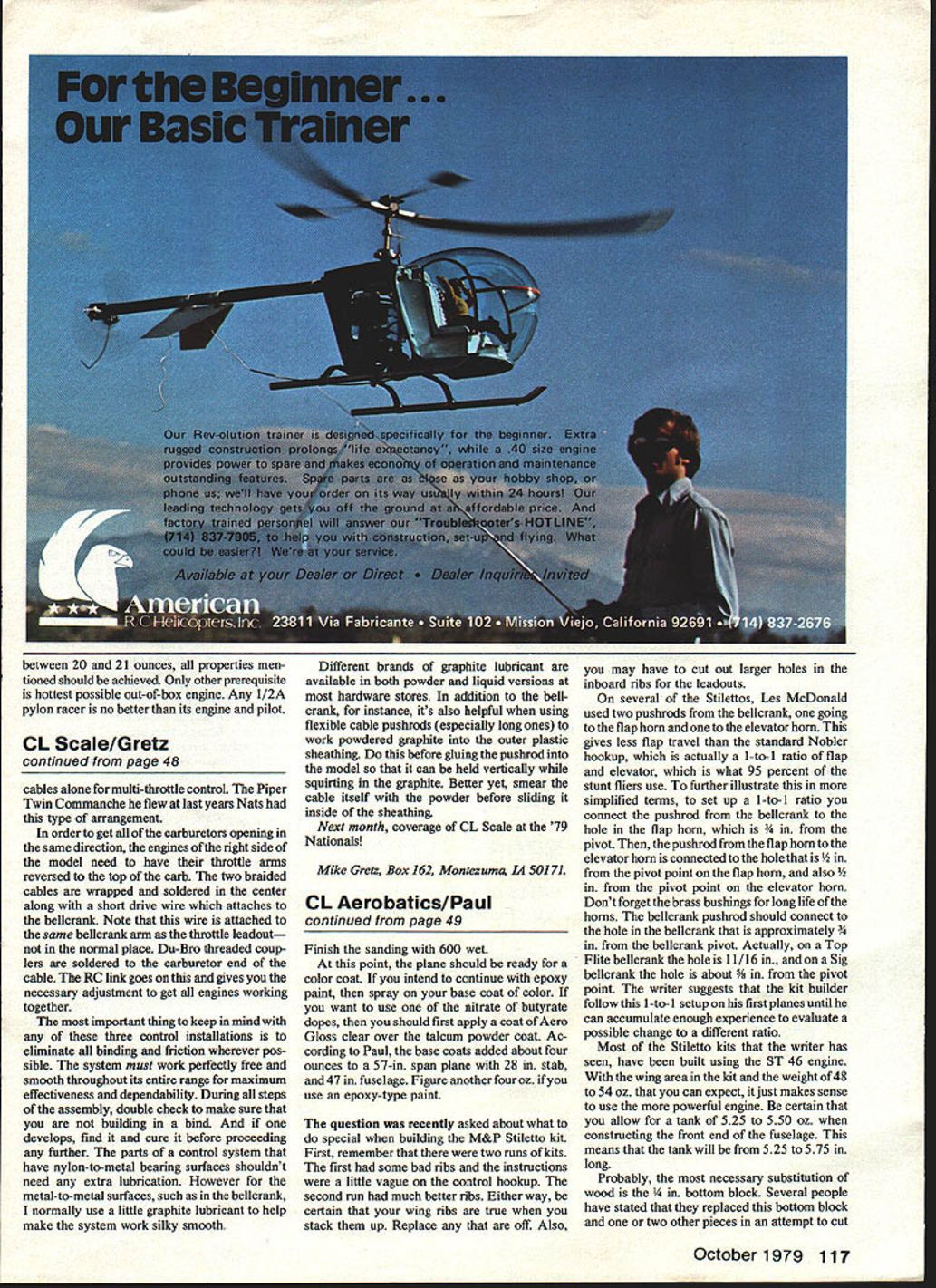
Another 40-size engine to consider is the Max .40 H, available from the Hobby Market. The engine is converted to U.C.; Hobby Market will give a trade-in on the RC carb; ready to run it comes in for $45.00 (information supplied by Doug Dahlke, Oshkosh, WI). Also, Doug would like to contact Robert K. Howard, designer of the Pegasus and originally from Texas. Anyone knowing of Howard's whereabouts should contact Doug at:
- 1037 Eastman Street, Oshkosh, Wisconsin 54901.
At the Winston-Salem contest in June, Elwood Bell had a plane featuring a retract system very similar to the one explained by Dick Mathis in the August 1978 issue of Model Aviation. According to Hemstrought, the retracts utilized the "tick off timer" and were very reliable. Lap times went from 5.4 to 5.1 when the retracts were activated.
Fuel tanks and suppliers
If you are still having trouble getting fuel tanks for your planes there are a couple of breakthroughs:
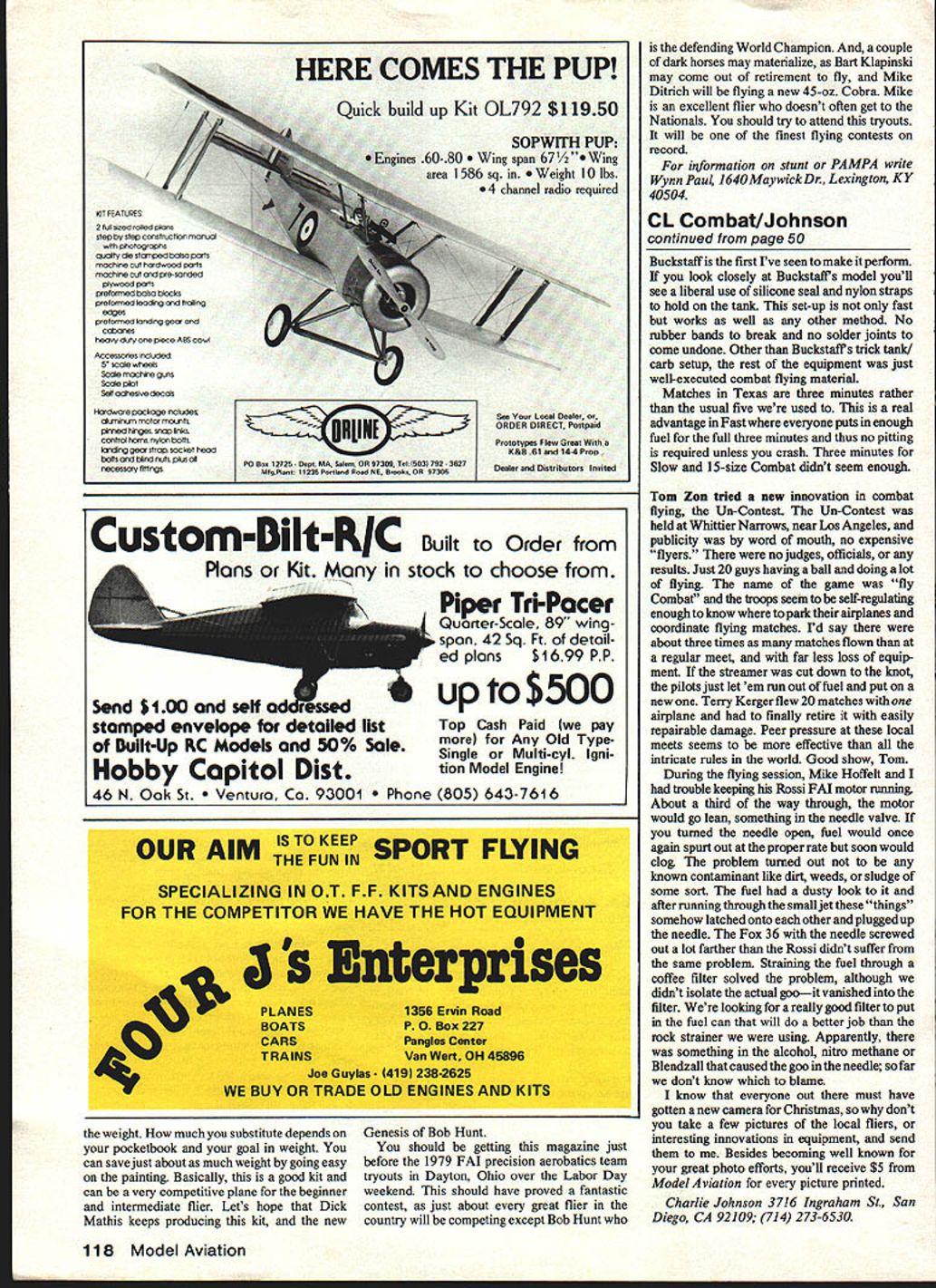
- Randy Dick of Randy's Aeronautics (515 Coleman Blvd., Mt. Pleasant, SC 29464) is back in operation and can supply tanks. (Telephone: 803-884-7411.) Write for further details. (Reported by Les McDonald of Orange Blossom Hobbies, Miami.)
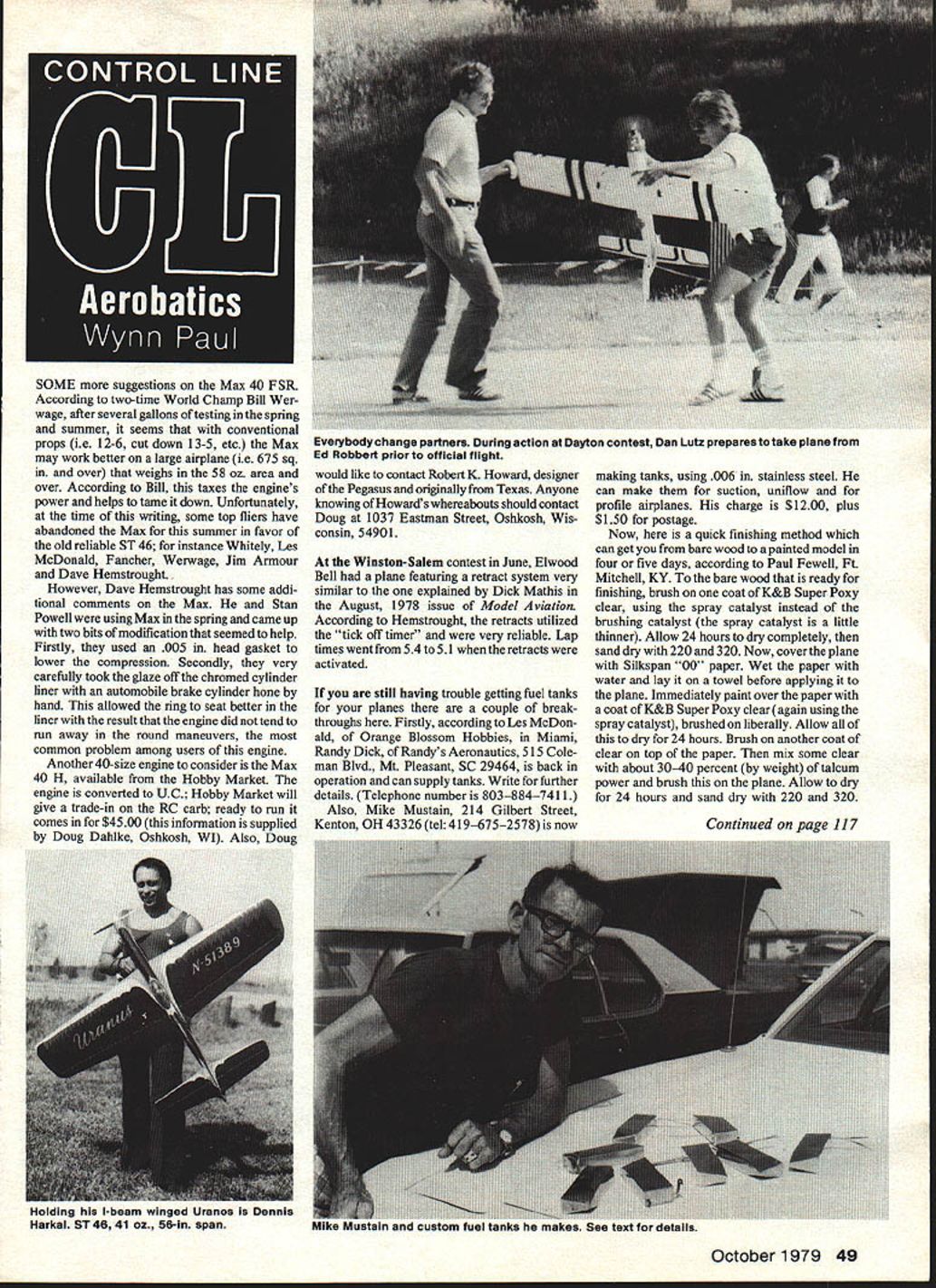
- Mike Mustain, 214 Gilbert Street, Kenton, OH 43326 (tel: 419-675-2578) is now making tanks using .006 in. stainless steel. He can make them for suction, uniflow and for profile airplanes. Charge is $12.00, plus $1.50 postage.
Finishing method (Paul Fewell)
Here is a quick finishing method which can get you from bare wood to a painted model in four or five days, according to Paul Fewell, Ft. Mitchell, KY.
- Prepare the bare wood so it is ready for finishing.
- Brush on one coat of K&B Super Poxy clear, using the spray catalyst instead of the brushing catalyst (the spray catalyst is a little thinner). Allow 24 hours to dry completely.
- Sand dry with 220 and 320 grit sandpaper.
- Cover the plane with Silkspan "00" paper. Wet the paper with water and lay it on a towel before applying it to the plane.
- Immediately paint over the paper with a coat of K&B Super Poxy clear (again using the spray catalyst), brushed on liberally. Allow all of this to dry for 24 hours.
- Brush on another coat of clear on top of the paper.
- Mix some clear with about 30–40 percent (by weight) talcum powder and brush this on the plane. Allow to dry for 24 hours.
- Sand dry with 220 and 320 grit. Finish the sanding with 600 wet.
At this point, the plane should be ready for a color coat:
- If you intend to continue with epoxy paint, spray on your base coat of color.
- If you want to use nitrate or butyrate dopes, first apply a coat of Aero Gloss clear over the talcum powder coat.
According to Paul, the base coats added about four ounces to a 57-in. span plane with a 28-in. stab and 47-in. fuselage. Figure another four ounces if you use an epoxy-type paint.
M&P Stiletto kit — build notes and setup
A question was recently asked about what to do special when building the M&P Stiletto kit. First, remember that there were two runs of this kit. The first had some bad ribs and the instructions were a little vague on the control hookup. The second run had much better ribs. Either way, be certain that your wing ribs are true when you stack them up. Replace any that are off. Also, you may have to cut out larger holes in the inboard ribs for the leadouts.
On several of the Stilettos, Les McDonald used two pushrods from the bellcrank — one going to the flap horn and one to the elevator horn. This gives less flap travel than the standard Nobler hookup, which is actually a 1-to-1 ratio of flap and elevator, used by about 95 percent of stunt fliers. To set up a 1-to-1 ratio:
- Connect the pushrod from the bellcrank to the hole in the flap horn that is 3/16 in. from the pivot.
- Connect the pushrod from the flap horn to the elevator horn using the hole that is 1/8 in. from the pivot point on the flap horn, and also 1/8 in. from the pivot point on the elevator horn.
- Use brass bushings in the horns for long life.
- The bellcrank pushrod should connect to the hole in the bellcrank that is approximately 1/4 in. from the bellcrank pivot. (On a Top Flite bellcrank the hole is 11/16 in. from the pivot; on a Sig bellcrank the hole is about 3/8 in. from the pivot point.)
The writer suggests that the kit builder follow this 1-to-1 setup on the first planes until gaining enough experience to evaluate a possible change to a different ratio.
Most of the Stiletto kits the writer has seen were built using the ST 46 engine. With the wing area in the kit and the expected weight of 48 to 54 oz., it makes sense to use the more powerful engine. Be certain to allow for a tank of 5.25 to 5.50 oz. when constructing the front end of the fuselage. This means the tank will be from 5.25 to 5.75 in. long.
Probably the most necessary substitution of wood is the 1/8 in. bottom block. Several people have replaced this bottom block and one or two other pieces in an attempt to cut weight. How much you substitute depends on your pocketbook and your goal in weight. You can save about as much weight by going easy on the painting. Basically, this is a good kit and can be a very competitive plane for the beginner and intermediate flier. Let's hope that Dick Mathis keeps producing this kit, and the new Genesis of Bob Hunt.
Events and tryouts
You should be getting this magazine just before the 1979 FAI precision aerobatics team tryouts in Dayton, Ohio over the Labor Day weekend. This should prove a fantastic contest and, as just about every great flier in the country will be competing except Bob Hunt who is the defending World Champion. A couple of dark horses may materialize: Bart Klapinski may come out of retirement to fly, and Mike Dietrich will be flying a new 45-oz. Cobra. Mike is an excellent flier who doesn't often get to the Nationals. You should try to attend these tryouts — it will be one of the finest flying contests on record.
For information on stunt or PAMPA, write Wynn Paul:
- 1640 Maywick Dr., Lexington, KY 40504.
Transcribed from original scans by AI. Minor OCR errors may remain.

