
CONTROL LINE CL Aerobatics
Wynn Paul
AFTER several requests for information on adapting available kits to "real competition" machines, I will present the following data on the Sig Chipmunk and the Top Flite Gieseke Nobler. Next month I'll continue on some other kits.
Sig Chipmunk
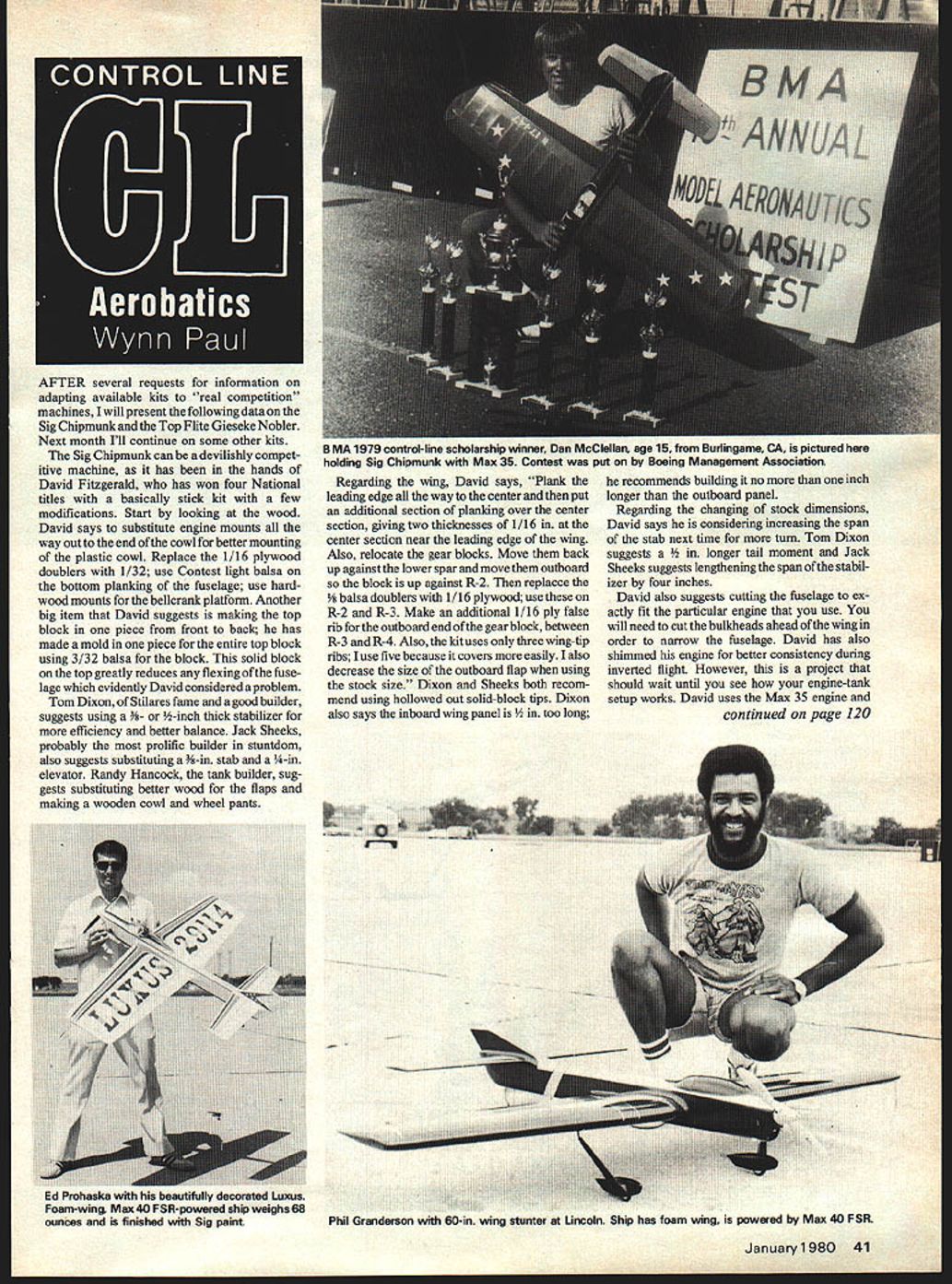
The Sig Chipmunk can be a devilishly competitive machine, as it has been in the hands of David Fitzgerald, who has won four National titles with a basically stock kit with a few modifications.
#### Wood and fuselage
- Substitute engine mounts all the way out to the end of the cowl for better mounting of the plastic cowl.
- Replace the 1/16-inch plywood doublers with 1/32-inch plywood.
- Use Contest light balsa on the bottom planking of the fuselage.
- Use hardwood mounts for the bellcrank platform.
- Make the top block in one piece from front to back. David made a one-piece mold for the entire top block using 3/32-inch balsa. This solid top block greatly reduces fuselage flexing.
Tom Dixon (of Stilares fame) suggests:
- Use a 3/8-inch or 1/2-inch thick stabilizer for more efficiency and better balance.
- Use hollowed out solid-block tips for the wings.
- Build the inboard wing panel no more than 1/2 inch longer than the outboard panel (he feels the inboard panel is about 1/2 inch too long in the kit).
Jack Sheeks suggests:
- Substitute a 3/8-inch stabilizer and a 1/4-inch elevator.
Randy Hancock suggests:
- Substitute better wood for the flaps and make a wooden cowl and wheel pants.
- Build the front of the fuselage to accept a removable tank (strongly recommended).
#### Wing David Fitzgerald recommends:
- Plank the leading edge all the way to the center, then add an additional section of planking over the center section to give two thicknesses of 1/16-inch at the center near the leading edge.
- Relocate the gear blocks: move them back up against the lower spar and move the outboard block so it is up against R-2.
- Replace the 3/32-inch balsa doublers with 1/16-inch plywood; use these on R-2 and R-3.
- Make an additional 1/16-inch ply false rib at the outboard end of the gear block, between R-3 and R-4.
- Use five wing-tip ribs instead of the kit's three to make covering easier.
- Decrease the size of the outboard flap when using the stock flap size.
Dixon and Sheeks both recommend hollowed block tips. Dixon also says the inboard wing panel is about 1/2 inch too long and recommends building it no more than one inch longer than the outboard panel.
#### Dimensions and engine installation
- David is considering increasing the span of the stabilizer next time for more turn.
- Tom Dixon suggests a 1/2-inch longer tail moment.
- Jack Sheeks suggests lengthening the stabilizer span by four inches.
- David suggests cutting the fuselage to exactly fit the particular engine you use (cut the bulkheads ahead of the wing to narrow the fuselage if needed).
- David has shimmed his engine for better consistency during inverted flight; this is best done after you see how your engine-tank setup works. David uses the Max 35 engine.
All of the fliers strongly recommended adjustable leadouts and an adjustable tip-weight box.
#### Cowl, cooling and tanks Tom Dixon said, "I'd suggest completely redoing the fuselage/cowl from the rear former by the wing forward, more like the first Chipmunk kit or Jim Van Loo's plans. Throw away the plastic cowl and build a wooden cowl like any other stunter." Tom also insists the kit rudder is not close to the scale shape; he refers the builder to RC kits or one of the many plans published in magazines.
If you use the kit plastic cowl, David suggests enlarging the holes in front for additional cooling — he had to do this at the 1979 Nats because of engine heating problems.
Randy Hancock strongly suggests building the front of the fuselage so you can use a removable tank; the writer agrees — a removable tank makes sense for working on or substituting tanks.
#### References For background reading:
- Jack Sheeks had a kit review of the Chipmunk in Flying Models, August 1974, p. 28.
- He modified a kit calling it the "Squirrel" in Flying Models, April 1976, p. 40, and used an ST-46 with it.
Utilizing some or all of these ideas — and most importantly building a straight wing — will give you a very competitive plane.
---
Gieseke Nobler (Top Flite Nobler)
Now, switching planes and manufacturers, let's look at the Nobler kit, or Gieseke Nobler, as it is now known. You may want to refer to the writer's two full columns on the Gieseke Nobler that were checked by Bob Gieseke before publication (Model Aviation, December 1976 and January 1977). Bob has built more than a baker's dozen of these airplanes and has used wingspans from 48 to 53 inches. His 1974 Nationals/FAI tryouts plane had a 52.5-inch span.
For the average stunt flier relying on a kit airplane, any of these spans will fly well — build it to the stock kit plan if you prefer simplicity.
Tank and fuselage notes
- You will probably need a four-ounce tank for today's engines, so make a removable tank compartment to adjust the engine and fuel. Bob Gieseke doesn't like removable tanks, but many great fliers do, and it is a good idea for novices.
- Tom Dixon has completed a couple of very good Gieseke Noblers and recommends substituting fuselage sides, flaps, and wing planking. Make new fuselage sides without the notches for the formers.
Wings and tips
- As far as the wings go, build them as on the plans.
- Make the trailing edge cap from 1/4 x 2 stock, then trim after the trailing-edge planking is installed to keep the TE straight.
- Make the flaps from 1/8-inch straight stock.
- Make hollowed block tips.
Tom also advises:
- Use 1/32-inch ply doublers around the trailing edge of the wing on the fuselage sides.
- Replace the sheeted top front of the fuselage with 1/8-inch sheet from spinner to cockpit — do not hollow this area; it helps absorb vibration and stress.
- Use an 8-inch Sig canopy cut to fit.
- Change the cowling separation line when substituting fuselage sides so there is a straight separation line from the middle of the spinner to a point approximately five inches from the nose ring. This makes tank and muffler installation easier.
Tom states the best Nobler he ever had was built from stock dimensions except for a foam wing with squared-off tips at 50.5 inches span. Bob Gieseke assures everyone he uses the exact tail moment arm shown on the plans.
Using the new Top Flite kit modified by Gieseke and, again, building a straight wing, the novice should be able to come up with a very competitive plane.
Next month we'll take up some more kits on the market that can be used for stunt.
For more information on stunt or PAMPA write Wynn Paul, 1640 Maywick Dr., Lexington, KY 40504.
Transcribed from original scans by AI. Minor OCR errors may remain.

