
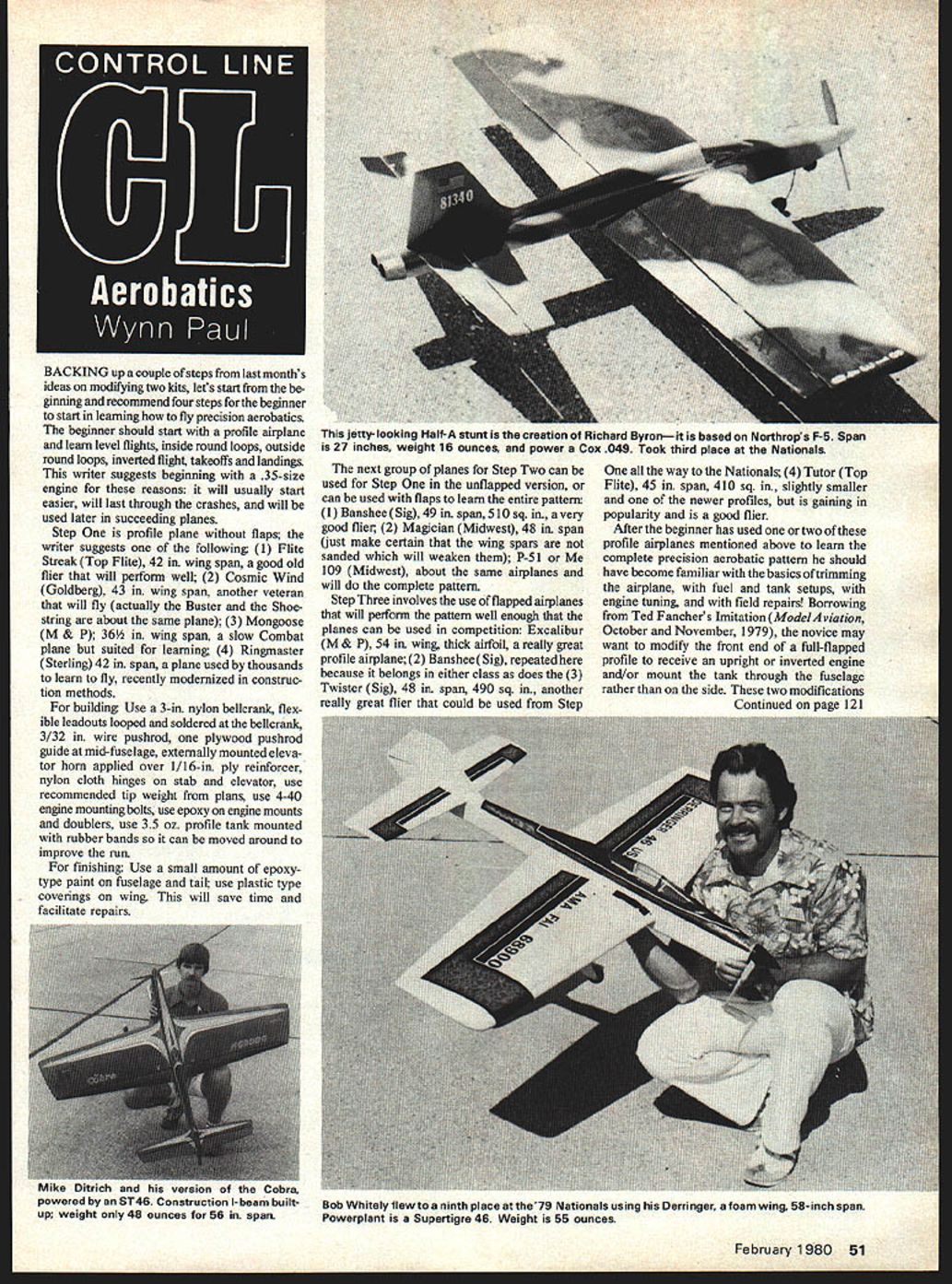
Control Line: Aerobatics
Wynn Paul
Backing up a couple of steps from last month's ideas on modifying two kits, let's start from the beginning and recommend four steps for the beginner to learn precision aerobatics. The beginner should start with a profile airplane and learn level flight, inside round loops, outside round loops, inverted flight, takeoffs and landings. The writer suggests beginning with a .35-size engine for these reasons: it will usually start easier, will survive the crashes, and will be used later in succeeding planes.
Step One: Profile Plane (No Flaps)
The beginner should start with a profile plane without flaps. Suggested models:
- Flite Streak (Top Flite), 42 in. wingspan — a good old flier that will perform well.
- Cosmic Wind (Goldberg), 43 in. wingspan — another veteran that will fly (the Buster and the Shoestring are about the same plane).
- Mongoose (M & P), 36½ in. wingspan — a slow Combat plane but suited for learning.
- Ringmaster (Sterling), 42 in. wingspan — used by thousands to learn to fly, recently modernized in construction methods.
Building recommendations
- Use a 3-in. nylon bellcrank.
- Use flexible leadouts looped and soldered at the bellcrank.
- Use 3/32 in. wire pushrod and one plywood pushrod guide at mid-fuselage.
- Use an externally mounted elevator horn applied over 1/16-in. plywood reinforcer.
- Use nylon cloth hinges on stab and elevator.
- Use recommended tip weight from plans.
- Use 4-40 engine mounting bolts.
- Use epoxy on engine mounts and doublers.
- Use a 3.5 oz. profile tank mounted with rubber bands so it can be moved to improve the run.
Finishing recommendations
- Use a small amount of epoxy-type paint on fuselage and tail.
- Use plastic-type coverings on the wing to save time and facilitate repairs.
Step Two: Larger Profiles or Flapped Versions
The next group of planes can be used unflapped for Step One or with flaps to learn the entire pattern:
- Banshee (Sig), 49 in. span, 510 sq. in. — a very good flier.
- Magician (Midwest), 48 in. span — ensure the wing spars are not sanded thin, which will weaken them.
- P-51 or Me 109 (Midwest), about the same airplanes — will do the complete pattern.
Step Three: Competition-Ready Flapped Airplanes
Step Three involves flapped airplanes that will perform the pattern well enough for competition:
- Excalibur (M & P), 54 in. wing, thick airfoil — a really great profile airplane.
- Banshee (Sig) — included here because it belongs in either class.
- Twister (Sig), 48 in. span, 490 sq. in. — a great flier that could be used from Step One all the way to the Nationals.
- Tutor (Top Flite), 45 in. span, 410 sq. in. — slightly smaller, newer profile gaining popularity and a good flier.
After using one or two of these profile airplanes to learn the complete precision aerobatic pattern, the beginner should be familiar with trimming the airplane, fuel and tank setups, engine tuning, and field repairs.
Borrowing from Ted Fancher's "Imitation" (Model Aviation, October–November 1979), the novice may want to modify the front end of a full-flapped profile to accept an upright or inverted engine and/or mount the tank through the fuselage rather than on the side. These modifications have been used for years and usually result in better engine performance. Ted's "Imitation" makes use of a K/H R.C. engine mount, or the novice may use conventional maple engine bearers and 1/8-in. plywood bulkheads mounted on a modified fuselage.
Step Four: Full Fuselage, Built-Up Airplanes
The novice is now ready to move on to full fuselage, built-up airplanes. The .35 engine used earlier can still be used with some kits, but the novice may want to consider engines such as the Max .40 FSR, the Super Tigre 46, the H.P. .40, and the Max .45 FSR for some larger, heavier airplanes.
As a further refinement, consider ordering a foam wing as a replacement for the kit wing. A foam wing will help ensure the end result is straight and without warp, which is the downfall of many novice fliers. At the time of writing, the only producer of foam wings is John Poynter, 10261 Janice Lynn, Cypress, CA 90630 (telephone 213-596-9053). Assuming the novice knows the basics of the pattern at this stage, investing approximately $40 for a foam wing is reasonable since the days of multiple crashing should be over by the time the novice graduates to the full fuselage stunter.
Built-Up Kits — Brief Rundown
- Gieseke Nobler (Top Flite), 50 in. wing, 510 sq. in. — modernized version of George Aldrich's 1951–52 original. You can still use a .35-size engine even if the finished weight is as much as 48 oz. The kit takes time to build but will certainly fly.
- Sig Chipmunk, 53.5 in. wing, 570 sq. in. — an outstanding kit. You can build it right off the plans or use suggested modifications. Use a good .35-size engine with a 4-oz. tank. If you build the wing straight and align all parts (wing, stabilizer, fuselage), this plane will perform well.
- Stiletto (Les McDonald), kitted by M & P — still available. This plane flies much better with a .40 or .45–.46 engine than with a .35 unless you can build it to about 43 oz. or less, which is difficult. You will probably want to replace some heavy wood.
- Sig Akrobat, 51 in. wingspan, 550 sq. in. — not as popular as the Chipmunk but a really good plane that will fly with the best. Slightly smaller than the Chipmunk; aim to keep weight to 42–44 oz. or less with a .35–.45 engine.
- Genesis (M & P) — foam-core wing model of Bob Hunt's World Championship plane, in a slightly smaller version. Foam cores are cut for the kit, giving a great start for a wing; you must cover the wing with balsa. Instructions are very complete and, if you take your time, even a novice can produce a good wing. Key: don't over-apply glue to the foam wing — not peanut-butter thickness. This plane flies best with a .40-size engine or a ST46.
- Sig Mustang — comes with a foam wing. At 50 in. wingspan with 480 sq. in., this is a small plane; keep weight to 40 oz. or less for competitive flying.
- Jetro Dolphin — plan on a good .40 or the ST46 engine. Take pains to get the wing straight and true. Keep weight under 50 oz. and ensure the wing is straight.
Comparing the current selection to August 1975, when the writer had a similar column, there are five new kits available — pretty good for control line.
Contact
For information on Shum or P.A.M.P.A., write Wynn Paul, 1640 Maywick Dr., Lexington, KY 40504.
Transcribed from original scans by AI. Minor OCR errors may remain.

