
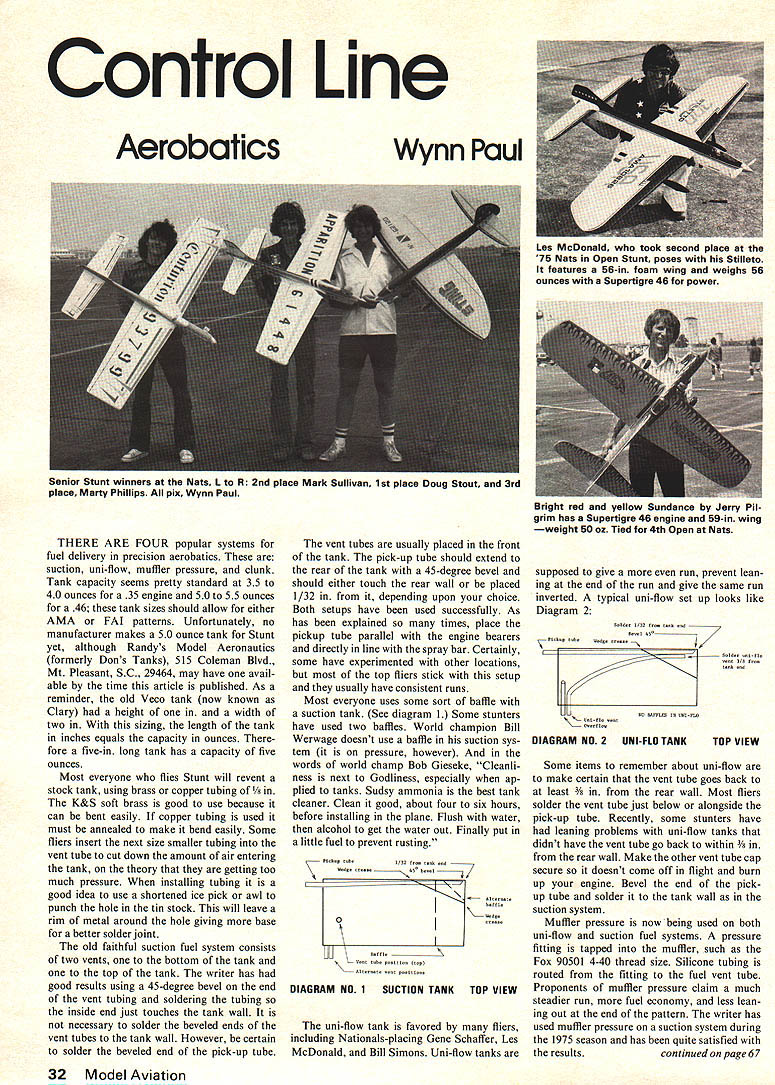
Control Line: Aerobatics
Wynn Paul
THERE ARE FOUR popular systems for fuel delivery in precision aerobatics. These are: suction, uni-flow, muffler pressure, and clunk. Tank capacity seems pretty standard at 3.5 to 4.0 ounces for a .35 engine and 5.0 to 5.5 ounces for a .46; these tank sizes should allow for either AMA or FAI patterns. Unfortunately, no manufacturer makes a 5.0 ounce tank for Stunt yet, although Randy's Model Aeronautics (formerly Don's Tanks), 515 Coleman Blvd., Mt. Pleasant, S.C., 29464, may have one available by the time this article is published. As a reminder, the old Veco tank (now known as Clary) had a height of one in. and a width of two in. With this sizing, the length of the tank in inches equals the capacity in ounces. Therefore a five-in. long tank has a capacity of five ounces.
Most everyone who flies Stunt will revent a stock tank, using brass or copper tubing of 1/8 in. The K & S soft brass is good to use because it can be bent easily. If copper tubing is used it must be annealed to make it bend easily. Some fliers insert the next size smaller tubing into the vent tube to cut down the amount of air entering the tank, on the theory that they are getting too much pressure. When installing tubing it is a good idea to use a shortened ice pick or awl to punch the hole in the tin stock. This will leave a rim of metal around the hole giving more base for a better solder joint.
The old faithful suction fuel system consists of two vents, one to the bottom of the tank and one to the top of the tank. The writer has had good results using a 45-degree bevel on the end of the vent tubing and soldering the tubing so the inside end just touches the tank wall. It is not necessary to solder the beveled ends of the vent tubes to the tank wall. However be certain to solder the beveled end of the pick-up tube. The vent tubes are usually placed in the front of the tank. The pick-up tube should extend to the rear of the tank with a 45-degree bevel and should either touch the rear wall or be placed 1/32 in. from it, depending upon your choice. Both setups have been used successfully. As has been explained so many times, place the pick-up tube parallel with the engine bearers and directly in line with the spray bar. Certainly, some have experimented with other locations, but most of the top fliers stick with this setup and they usually have consistent runs.
Most everyone uses some sort of baffle with a suction tank. Some stunters have used two baffles. World champion Bill Werwage doesn't use a baffle in such a suction system (it is on pressure, however). And in the old world champ Bob Gieseke, "Cleanliness is next to Godliness," especially when applied to tanks. Sudsy ammonia is the best tank cleaner. Clean good about four to six hours before installing in the plane. Flush with water, then alcohol to get the water out. Finally put a little fuel to prevent rusting.
DIAGRAM NO. 1 SUCTION TANK TOP VIEW
The uni-flow tank is favored by many fliers, including Nationals-placing Gene Schaffer, Les McDonald, and Bill Simons. Uni-flow tanks are supposed to give a more even run, prevent leaning at the end of the run and give the same run inverted. A typical uni-flow set up looks like Diagram 2.
DIAGRAM NO. 2 UNI-FLO TANK TOP VIEW
Some items to remember about uni-flow are to make certain that the vent tube goes back at least 3/8 in. from the rear wall. Most fliers solder the vent tube just below or alongside the pick-up tube. Recently some stunters have had leaning problems with uni-flow tanks that didn't have the vent tube go back within 3/8 in. from the rear wall. Make the other vent tube cap secure so it doesn't come off in flight and burn up in the muffler system. Bevel the end of the pick-up tube and solder it to the tank wall as in the suction system.
Muffler pressure is now being used on both uni-flow and suction fuel systems. A pressure fitting is tapped into the muffler, such as the Fox 905-01 4-40 thread size. Silicone tubing is routed to the fitting to the fuel vent tube. Proponents of muffler pressure claim much steadier run, more fuel economy, and less leaning out at the end of the pattern. The writer has used muffler pressure on a suction system during the 1975 season and has been quite satisfied with the results.
CL Aerobatics/Paul
It is important when using pressure to cap off the other vent securely during flight so that the engine will not lean out and burn up. The silicone tubing should be wired to the pressure fitting on the muffler. When filling remove the silicone tubing from the tank vent, not the pressure fitting.
Clunk stunt tanks have a small but vociferous following who swear by the plastic bottles. Glen Alison, from England, uses silicone tubing with 2-1/2 in. length of copper tubing for the vent and pick-up lines. Both Jim Lynch, Memphis, and Jim Murphy, Metairie, La., agree that clunk tanks run richer inverted (with an inverted engine) so they mount their clunkers 1/8 in. higher than the spray bar center line. Other points to remember are to allow for shimming the clunk tank to adjust the run, and muffler-pressure clunk tanks seem to work better than non-pressure. Some stunters have found that clunk tanks work better if a larger size tank is used than normally needed; that is, installing a six-ounce tank and drawing off fuel to the required five ounces for a .46. The theory behind this is that a more consistent run will result, although the writer would think that a bigger tank would cause more sloshing around of the fuel. Try it, it may work.
In parting, the writer urges that stunters make their tanks removable, clean and with very secure mounting. Seek advice and help from a knowledgeable stunt flier when setting up a stunt tank, the airplane you save may be your own.
(My address is: 1640 Maywick Dr., Lexington, Ky., 40504.)
Transcribed from original scans by AI. Minor OCR errors may remain.

