
Control Line: Aerobatics
Wynn Paul
Line tension problem
Bob Green, Boyertown, PA, writes in with a problem of line tension on a profile airplane using a Fox .35 engine, a 10-6 prop, five percent nitro fuel, 60 ft. lines, and engine offset as shown on the plans. He says that his plane loses line tension especially on the vertical eights and the overhead eights.
The solution is not simple. First, Bob should make certain that he has enough tip weight. Most .35-size profiles require at least 1/2 oz., but try one ounce or even 1.25 oz. to see if it helps. While we are talking about the wing, Bob had better make certain that his wing is not warped. The outboard wing may be twisted down relative to the inboard panel, or it may be the flap (if his plane has them) with the same problem.
He could try shorter lines, which would make the plane more responsive and cause it to fly each lap faster for the same rpm of the engine, which could help with line tension. Actually, 60-foot lines on a profile are a little long, unless he is measuring from the handle to the center of the airplane; then the line length is the same as slow combat, but he is trying to fly the plane about 30 mph slower than slow combat. Make certain that the lines are .015 diameter; if .018s are used, more tip weight will definitely be needed.
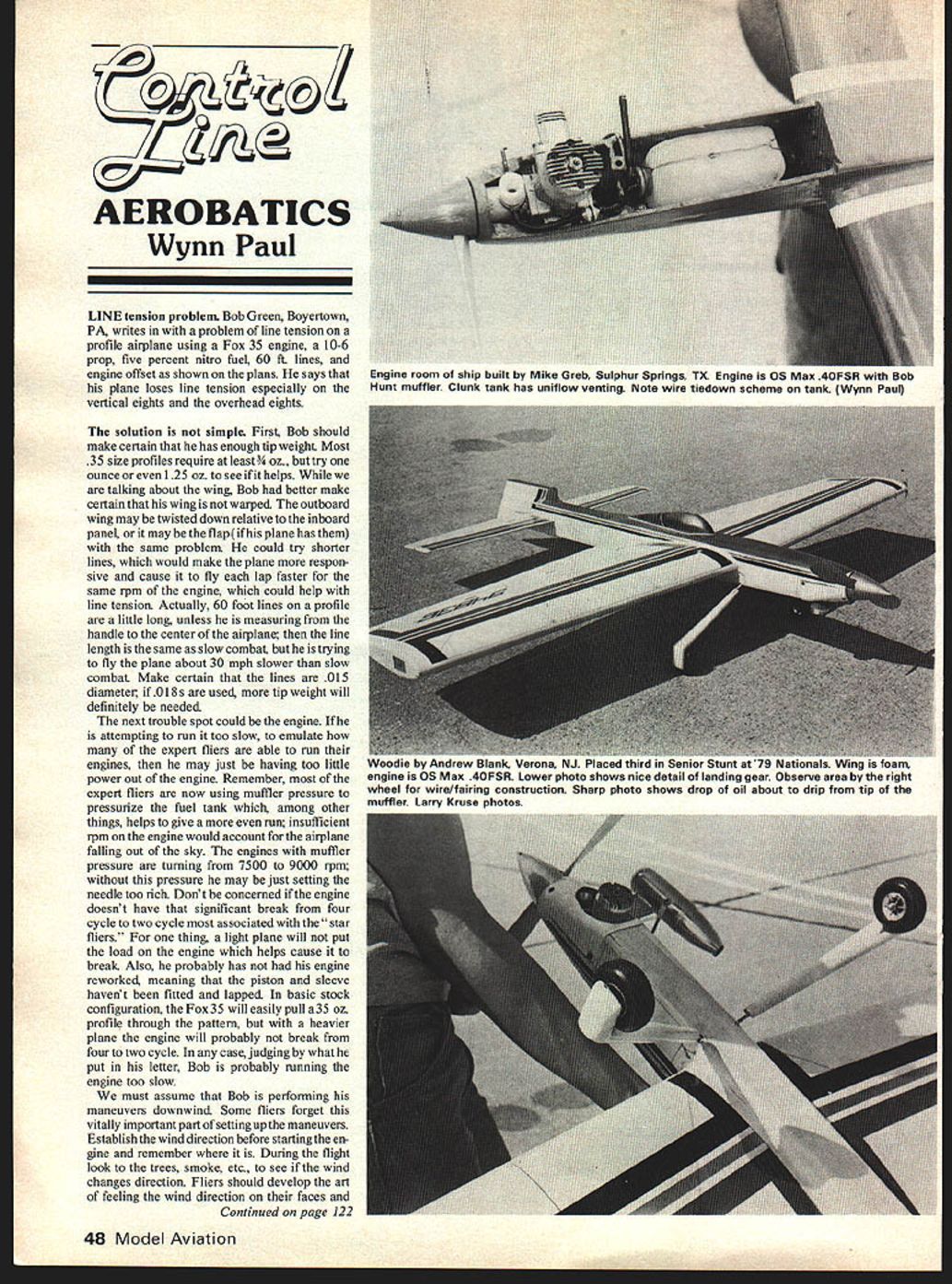
The next trouble spot could be the engine. If he is attempting to run it too slow, to emulate how many of the expert fliers are able to run their engines, then he may just be having too little power out of the engine. Remember, most of the expert fliers are now using muffler pressure to pressurize the fuel tank which, among other things, helps to give a more even run; insufficient rpm on the engine would account for the airplane falling out of the sky. The engines with muffler pressure are turning from 7,500 to 9,000 rpm; without this pressure he may be just setting the needle too rich. Don't be concerned if the engine doesn't have a significant break from four-cycle to two-cycle most associated with the "star" fliers. For one thing, a light plane will not put the load on the engine which helps cause it to break. Also, he probably has not had his engine reworked, meaning that the piston and sleeve haven't been fitted and lapped. In basic stock configuration, the Fox .35 will easily pull a 35 oz. profile through the pattern, but with a heavier plane the engine will probably not break from four to two cycle. In any case, judging by what he put in his letter, Bob is probably running the engine too slow.
We must assume that Bob is performing his maneuvers downwind. Some fliers forget the vitally important part of setting up the maneuvers. Establish the wind direction before starting the engine and remember where it is. During the flight look to the trees, smoke, etc., to see if the wind changes direction. Fliers should develop the art of feeling the wind direction on their faces and adjusting their setup accordingly.
Lastly, Bob said that he had the engine offset called for on the plans, but he might try some more shims under the front of the engine to see if this helps with line tension. He might also have to move the leadouts back, or forward, to change the amount of line tension. Most profile kits are built with leadouts in only one position, but Bob may have to move them around to see if this helps.
In summary, a good order of troubleshooting in this case would be:
- Wing alignment, including flaps; also see that the stabilizer is machined in line with the wing.
- Wind direction.
- Tip weight.
- Engine. Bob might even want to try an entirely different engine or the same make or another make to see if his original is just plain worn out.
- Engine offset.
- Leadout variation.
Banded crankshaft on the ST .46
Sam Howard, from Quebec, Canada, wrote in asking about the banded crankshaft on the ST .46. Some of the RC friends told him it was imperative to remove it. Actually, I have heard only one instance of the band coming loose, but if you subscribe to Murphy's Law then you would probably want to remove it. However, since we are operating our stunt engines in the 7,000 to 9,500 rpm range there is less chance of the band coming loose than with the RC fraternity, who usually run the engines at the top end of the rpm range of 15,000 to 17,000. Some people feel that keeping the band adds that little bit of "crankcase packing" which helps with performance.
Planning contests — P.A.M.P.A. categories
Now is the time to be planning your contest for next summer. The use of P.A.M.P.A. categories has become quite widespread and if your area contest has not started using this method you should contact your event director. The P.A.M.P.A. categories are:
- Expert — average AMA score of 500 and over.
- Advanced — average score 400 to 499.
- Intermediate — average score 300 to 399.
- Beginner — average under 300.
Most fliers should have an idea as to what their average will be, but if they don't they can make an educated guess and then after the first round divide the event into classes or combine categories if need be. In areas where the stunt turnout is not large, contest administrators have combined two classes, based on previous turnouts and the fliers' general abilities. For instance, if the contest has drawn approximately 15 fliers in the past and most are Beginners, Intermediates and Advanced, then the contest could be advertised as having P.A.M.P.A. categories: Beginner, Intermediate, and combined Advanced and Expert. This keeps the number of trophy sets at three, the same as required for the traditional AMA three divisions.
The practice of fliers voluntarily placing themselves into categories seems to have worked quite well over the past couple of years. Only a very few instances of "sandbagging" have come to light, in most cases through ignorance of scoring abilities rather than anything else. In areas where the P.A.M.P.A. categories have not been tried it usually takes just a few voices from stunt fliers to get the contest director to go ahead with the P.A.M.P.A. classes. Once instituted, the use of the P.A.M.P.A. categories seems to help in drawing out more stunt fliers. In some instances, the AMA Novice pattern has been used for the P.A.M.P.A. beginner category to help get the new fliers into stunt flying. A handout sheet with complete instructions for holding a P.A.M.P.A. category stunt contest is available.
Keep it clean
From the English stunt newsletter, Claptrap, comes a suggestion from Robert King to periodically clean both the muffler and the pressure fitting to remove all the residue from numerous flights. He had been experiencing lean runs and some engine stopping in mid flight. After changing engines, tanks, filter, and fuel lines, the only thing left was the muffler and pressure fitting. He surmised that the partial blocking of the pressure fitting by residue was causing the lean runs.
For information on stunt or P.A.M.P.A., write Wynn Paul, 1640 Maywick Drive, Lexington, KY 40504.
Transcribed from original scans by AI. Minor OCR errors may remain.

