
Control Line: Aerobatics
Wynn Paul
WHERE did we get the present precision aerobatics pattern anyway, you ask? "I don't like the overhead eights, and that hourglass, how did it ever get in there?" "Who thought up this madness?"
At the Model Industry Association meeting in February 1946, the antecedent of the present Hobby Industry Association meeting, a committee appointed by the AMA and composed of John Clemens, Jim Walker, and Russ Weber of Megow Models got together in a hotel room to discuss rules for "Stunt." With John acting as secretary, a set of rules was drawn up. "Actually, the committee was looking into all control line rules, but this meeting was specifically for stunt. We had to fashion the maneuvers to fit the planes and the engines of the time," said John Clemens recently in a conversation with the writer.
The published rules for the 1946 Nationals held at Wichita, KS contained the following maneuvers:
- Precision
- Overhead flight (model held in 25-ft. diameter circle)
- "Wheel touching"
- Spot landing
- Aerobatics
- Stall and recovery
- Wing over
- Vertical dive
- Inside loop
- Outside loop
- Inverted flight
- Square loop
- "Pair of spectacles"
- Rolls (full roll, half roll, Cuban eight, and Immelmann turn)
- Flying two planes at once
- Looping two planes at once
- "Waltz or formation shift" (following plane to be maneuvered over — in front of — and below leading plane and then reversed back to original position)
- Novelty
- Unassisted takeoff
- Pick-up glider
- Pick-up object
- Release (glider, sign, or parachute)
- Laying smoke screen
- Retract landing gear
- Carrier flight (hand launch using U-Reely control, fly out to 70 feet, reel model back into hand without touching ground)
- Dive bombing (bomb must land within 10 feet of target)
- Balloon bursting (1st, 2nd, 3rd attacks)
- Motor control
- Multiple motor operation (12 points for six motors)
- Remote control (model to be flown from outside circle; must take off, complete at least five laps, and land without nose-over)
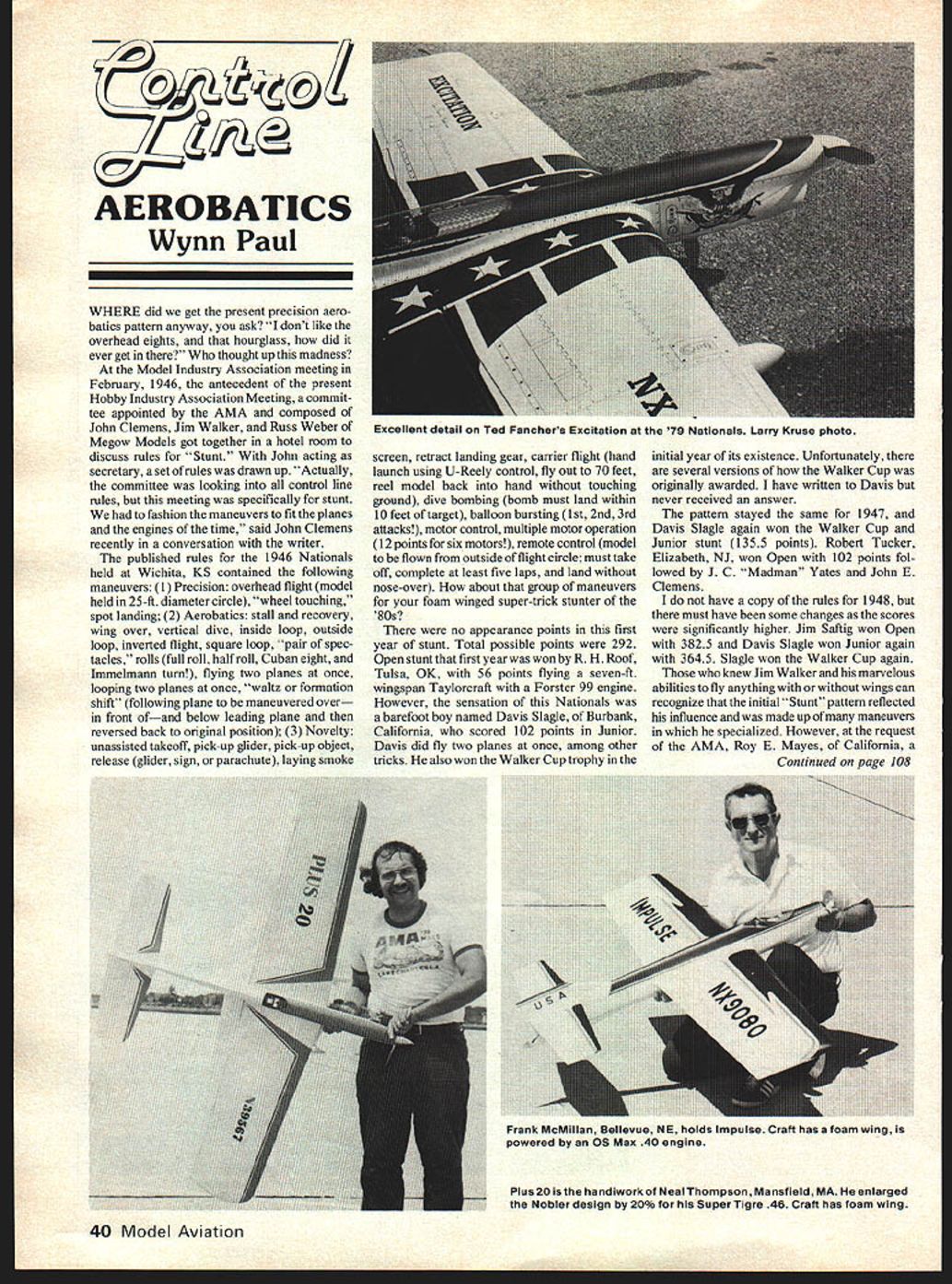
How about that group of maneuvers for your foam-winged super-trick stunter of the '80s?
There were no appearance points in this first year of Stunt. Total possible points were 292. Open Stunt that first year was won by R. H. Roof, Tulsa, OK, with 56 points flying a seven-ft. wingspan Taylorcraft with a Forster .99 engine. However, the sensation of the Nationals was a barefoot boy named Davis Slagle, of Burbank, California, who scored 102 points in Junior. Davis did fly two planes at once, among other tricks. He also won the Walker Cup trophy in the initial year of its existence. Unfortunately, there are several versions of how the Walker Cup was originally awarded. I have written to Davis but never received an answer.
The pattern stayed the same for 1947, and Davis Slagle again won the Walker Cup and Junior Stunt (135.5 points). Robert Tucker, Elizabeth, N.J., won Open with 102 points, followed by J. C. "Madman" Yates and John E. Clemens. I do not have a copy of the rules for 1948, but there must have been some changes as the scores were significantly higher. Jim Saftig won Open with 382.5 and Davis Slagle won Junior again with 364.5. Slagle won the Walker Cup again.
Those who knew Jim Walker and his marvelous abilities to fly anything with or without wings can recognize that the initial "Stunt" pattern reflected his influence and was made up of many maneuvers in which he specialized. However, at the request of the AMA, Roy E. Mayes of California, a founding father of the Aero Modelers Association of Northern California (which later became WAM — Western Associated Modelers), wrote up a new set of rules for Stunt which were basically the same rules then being used in Northern California. This occurred in the fall of 1948 or early 1949. According to correspondence with Roy Mayes, he is a little foggy on dates and much of his correspondence and records from the '40s was destroyed in a fire.
Regardless of whether the new pattern was first used in 1948 or '49, Roy introduced some new ideas:
- The eight-minute time limit.
- Three attempts to make two official flights.
- Appearance points (the old controversial item).
- Flight pattern points.
WAM appearance points were at that time only 25% of the total score. Roy explained appearance points in one of his letters: "After seeing how the old time free flight gas models changed from semi-realistic models into 'thingies' and the same thing happening to Round-the-Pole race cars, I was determined to keep the same thing from happening to control line stunt."
The 1949 rules included the following sequence:
- Starting and takeoff
- Level flight
- Climb
- Dive
- Wingover
- Five consecutive inside loops
- Five consecutive outside loops
- Inverted eight
- Three successive outside eights
- Outside loop
- Square loop
- Special maneuver (must be described in detail to judges prior to flight)
- Landing
Appearance points were 8 to 80.
In 1951, the special maneuver was dropped from the pattern. Otherwise, the pattern was the same for 1951 and 1952. The 1951–52 pattern is the one used most of the time for "old time" stunt.
According to the rule book, the 1953 pattern changed the appearance points to a range of 21 to 77. The reverse wingover maneuver was added (this was in addition to the wingover). Inside loops were cut to three and inverted flight was repositioned just after the inside loops as we know the procedure today. Outside round loops were then started from inverted flight and only three were done. The square loop maneuver was moved to follow the outside round loops; it was followed by horizontal eights, vertical eights, overhead eights, and then a new maneuver, destined to be the nemesis of many: the square eight. The rules cycle kept the pattern the same for 1954.
The rules cycle for 1955–56, according to a copy of the rule book sent to me by Bill Netzeband, changed the appearance points to a range of 3 to 24. The triangle figure was added at this time.
In the spring of 1957, George Aldrich was asked by Carl Wheeler of the AMA to work over the stunt rules. According to a recent conversation with George (and, remember, this is from memories of 23 years ago), he made all the scores range from 0 to 40; however, through a printing or editing error, the scores came out in the rule book as 10–40 for all maneuvers except landing! George said that he tried for a couple of years to get the 10–40 changed back to his original 0–40 but couldn't get the rules altered. We also know that the 1957 pattern added the hourglass figure and the four-leaf clover. George said he got the idea for the four-leaf clover from the pattern used at the old New York Mirror Meet. The hourglass was George's idea of a "triangular vertical eight." He doesn't remember who named the figure hourglass, but he does remember that Bill Netzeband wrote him showing that the maneuver couldn't be done as it was written and described in the rule book. Someone from Europe finally wrote a description of the hourglass that could actually be performed. George also changed the appearance points to a maximum of 40.
The "Aldrich pattern" stayed in effect until appearance points were changed for the 1974–75 rules cycle. Also, the 1976–77 rules cycle allowed contestants to use a backup model in case of a crash or equipment failure.
Because of space, etc., I have left out some of the sublime points, such as pull testing, description of the maneuvers (45 or 60 degrees, for instance), and some other information, but the idea was to present the development of the pattern from the first Nationals.
For information on stunt or PAMPA contact Wynn Paul, 1640 Maywick Dr., Lexington, KY 40504.
Transcribed from original scans by AI. Minor OCR errors may remain.

