
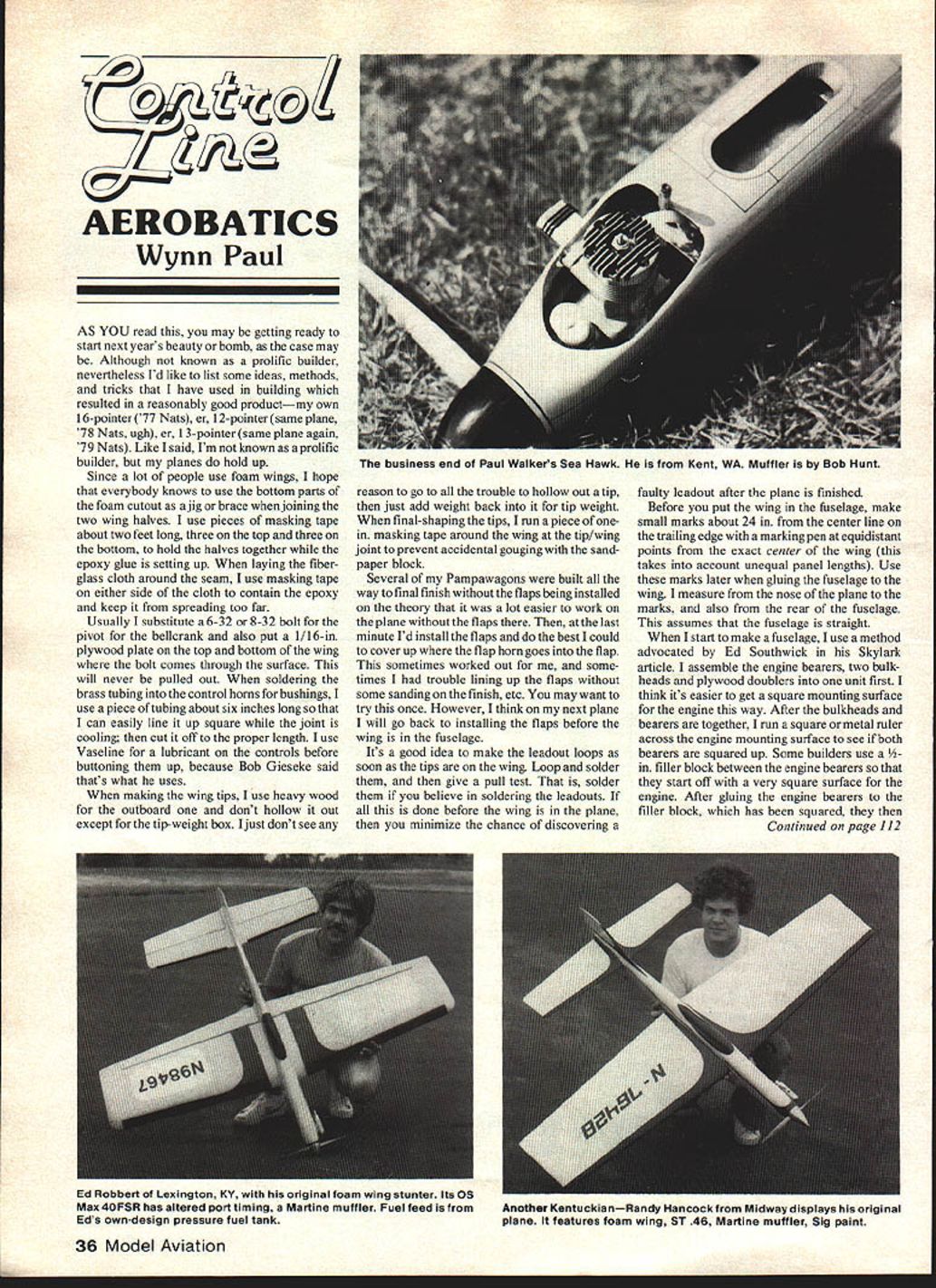
AEROBATICS
By Wynn Paul
As you read this, you may be getting ready to start next year's beauty or bomb, as the case may be. Although I'm not known as a prolific builder, I'd like to list some ideas, methods, and tricks I have used in building that resulted in a reasonably good product—my own 16-pointer ('77 Nats), er, 12-pointer (same plane, '78 Nats, ugh), er, 13-pointer (same plane again, '79 Nats). Like I said, I'm not a prolific builder, but my planes do hold up.
Wing construction and joining
- If you use foam wings, use the bottom parts of the foam cutout as a jig or brace when joining the two wing halves. I use pieces of masking tape about two feet long—three on the top and three on the bottom—to hold the halves together while the epoxy sets.
- When laying fiberglass cloth around the seam, put masking tape on either side of the cloth to contain the epoxy and keep it from spreading too far.
- For the bellcrank pivot I usually substitute a 6-32 or 8-32 bolt, and I put a 1/16-in. plywood plate on the top and bottom of the wing where the bolt comes through. This will never be pulled out.
- When soldering brass tubing into the control horns for bushings, use a piece of tubing about six inches long so you can easily line it up square while the joint cools; then cut it off to the proper length.
- I use Vaseline as a lubricant on the controls before final assembly because Bob Gieseke said that's what he uses.
Wing tips and flap installation
- For wing tips, I use heavy wood for the outboard tip and don't hollow it out except for the tip-weight box. I don't see any reason to hollow the tip—just add weight back in the tip-weight box.
- When final-shaping the tips, run a piece of 1-in. masking tape around the wing at the tip/wing joint to prevent accidental gouging with the sandpaper block.
- Several of my Pampawagons were finished without the flaps installed on the theory that it was easier to work on the plane. Then, at the last minute, I'd install the flaps and try to cover up where the flap horn enters the flap. Sometimes this worked; sometimes I had trouble lining up the flaps without sanding the finish. You may want to try this once, but I think I'll go back to installing the flaps before the wing is in the fuselage on my next plane.
Leadouts and alignment
- Make the leadout loops as soon as the tips are on the wing. Loop and solder them, and give them a pull test—solder them if you believe in soldering the leadouts. Doing this before the wing is in the plane minimizes discovering a faulty leadout after the plane is finished.
- Before you put the wing in the fuselage, make small marks about 24 in. from the center line on the trailing edge at equidistant points from the exact center of the wing (this takes into account unequal panel lengths). Use these marks later when gluing the fuselage to the wing. I measure from the nose of the plane to the marks and also from the rear of the fuselage. This assumes the fuselage is straight.
Fuselage and engine-bearer assembly
I use a method advocated by Ed Southwick in his Skylark article: assemble the engine bearers, two bulkheads, and plywood doublers into one unit first. I find it's easier to get a square mounting surface for the engine this way.
Steps I follow:
- Square and, if desired, attach a 1/2-in. filler block between the engine bearers so they start off with a very square surface.
- Glue the engine bearers to the filler block (which has been squared).
- Add the bulkheads and then the plywood doublers.
- After assembly, run a square or metal ruler across the engine-mounting surface to ensure both bearers are squared up.
This method helps ensure the engine mounting surface is flat and won't put stress on one bearer (and cause annoying cracks later when your finish dries). It also enables a good tank fit without wrestling the fuselage sides. Before gluing on the plywood doublers, I pencil several lengthwise lines on both sides of each doubler to help line up the fuselage sides and the wing later.
Gluing the fuselage to the wing
- I find it much better to make the cutouts for the wing on the bottom side of the fuselage. It's easier to lay the fuselage down over the wing than to block up the fuselage from the bottom.
- When I first put the fuselage on the wing, I tack-glue the top block onto the fuselage so the fuselage is unbowed. This prevents big gaps later when you try to put the blocks back on top and bottom.
Hollowing blocks
I can't offer any "star tricks"—on my last plane I went through the block and the wing tip in about five places. I've tried electric lights, flashlights, pins, fluorescent lights, mine detectors, stethoscopes, etc., and I still go through the wood. The best advice is to go slowly and carefully.
Canopy and ventilation tip
- Tape a piece of sandpaper onto the top of the fuselage and run the canopy over it to trim to final shape before inserting into the wood—it works.
- Someone long ago (maybe Jim Silhavy or Bob Lampione) told me to make one small pinhole at the very rear of the canopy to allow the canopy to "breathe." This reduces condensation when it's hot outside. I have done this on my planes, and most of the time it works.
Engine compartment protection
I think it's a good idea to lay a coat of epoxy or fiberglass cloth on the engine bearers and down under the engine compartment to help eliminate fuel soaking and to help keep the front end together with the high-zippity-zip engines we all have now.
Cowling and fuel line safety
- When building cowlings, try to construct them so the side of the cowling is close enough to the engine that it helps keep the fuel tubing and filter from moving and possibly coming loose in flight. My cowling side just touches the fuel filter so it is very difficult for the fuel line to slide off the spray bar. This is a safety measure you can incorporate into some cowling designs.
- My latest airplane has a full plywood ring at the nose so the cowling slips in behind the ring. This is the first time I've used a full plywood ring, and I like it a lot—it's nice looking, should keep the front end held together, and the cowling fits well.
Contact
For information on stunt or PAMPA, write: Wynn Paul 1640 Maywick Dr. Lexington, KY 40504
Transcribed from original scans by AI. Minor OCR errors may remain.

