
AEROBATICS
Wynn Paul
CONTINUING the engine craze of the last two or three years, the latest news is that the Enya .49 can be used successfully for Stunt. This engine (about 12 oz.) has more power than the OS Max .45, according to Bill Simons, who switched to it after his eighth-place finish in the 1980 Nats. Bill Werwage is also experimenting with the Enya.
Simons reported that he did not alter the engine except to disassemble it to clean and check the ring gap — it was about .005–.006, a little loose but workable. He installed a .280 venturi and an ST.60 needle valve assembly. After breaking the engine in with about a gallon of fuel, he flew with a 13-3/4 x 6 prop. Using a uniflow tank with pressure and a Bobby Hunt–type muffler, the engine burned about 7 to 7-1/2 oz. of fuel to get through the pattern. He was using 12% nitro in a plane that weighed about 56 oz. and had 720 sq. in. of wing.
Line length and performance
Simons has gone to very long lines with this engine: 68 feet from handle to center of airplane. With this length of .018-in. lines he is getting 6.1-second laps, which is a welcome change after the 5.0-second laps sometimes seen with the Tigres. Simons is planning his new 1981 plane around the Enya .49, but cautions about a few items:
- Remember, it is about 12 oz.
- It is a big engine and you will need plenty of room in the engine compartment.
- It is almost impossible to rout out an ST.46 mounting for this engine, although you may be able to do it with a mount set up for a Max .45.
- Parts are hard to get, so you may have to buy a second engine to find a liner–ring–piston combination.
Bill also reports that some in the Jersey crowd are experimenting with the Enya .40 (with Dykes ring) and the Enya .45 (no ring, but aluminum liner). If you wish to get into a bigger engine, this might be the ticket — if you can stand the fuel bill.
Fuel tanks — sources and systems
More mail arrives requesting information about fuel tanks than probably any other subject, so here is a review of sources and systems.
Duke Fox appears to be getting out of the tank business and has offered his tank dies for sale. The original Veco-type tank will likely fade away. Two Stunt people now offer custom-built tanks:
- Mike Mustain
214 Gilbert Street, Kenton, OH 43326 Phone: 419-675-2578 Has been building tanks for a couple of years and has worked out the bugs. He can build conventional suction or uniflow-type (venting) tanks, sized to the engine. Cost now around $20 per tank. Mike has very good delivery time.
- Ed Robbert
1616 Meadowthorpe Ave., Lexington, KY 40505 Phone: 606-253-1769 An articulate craftsman offering tanks in several forms. Completed tanks cost about $15 (suction) and $18 (uniflow), plus $2 for cases and postage. A semi-kit with body soldered and ends and tubing is $10; a kit with sheet metal cut out is $5. Ed makes tanks with a slight out-taper front to back (looking from the top) to help force the fuel pickup tube. He will deliver the item ordered; call or write with specific needs.
References and reprints:
- Dave Rees, "Custom Control-line Stunt Fuel Tanks," Flying Models, January 1977, p. 42.
- Bob Barron, "Outwitting Murphy's Law — Make Fuel Tank Work," American Aircraft Modeler, November 1974, p. 88.
- Harry Higley, "Making Metal Fuel Tank," Model Airplane News, July 1975, p. 83.
- Wynn Paul, Model Aviation columns on tanks: January 1976, p. 32 and August 1977, p. 37.
The author has reprints of columns and articles for $1.00 including postage and may be able to purchase back issues of magazines.
Mustain's tapered tank idea
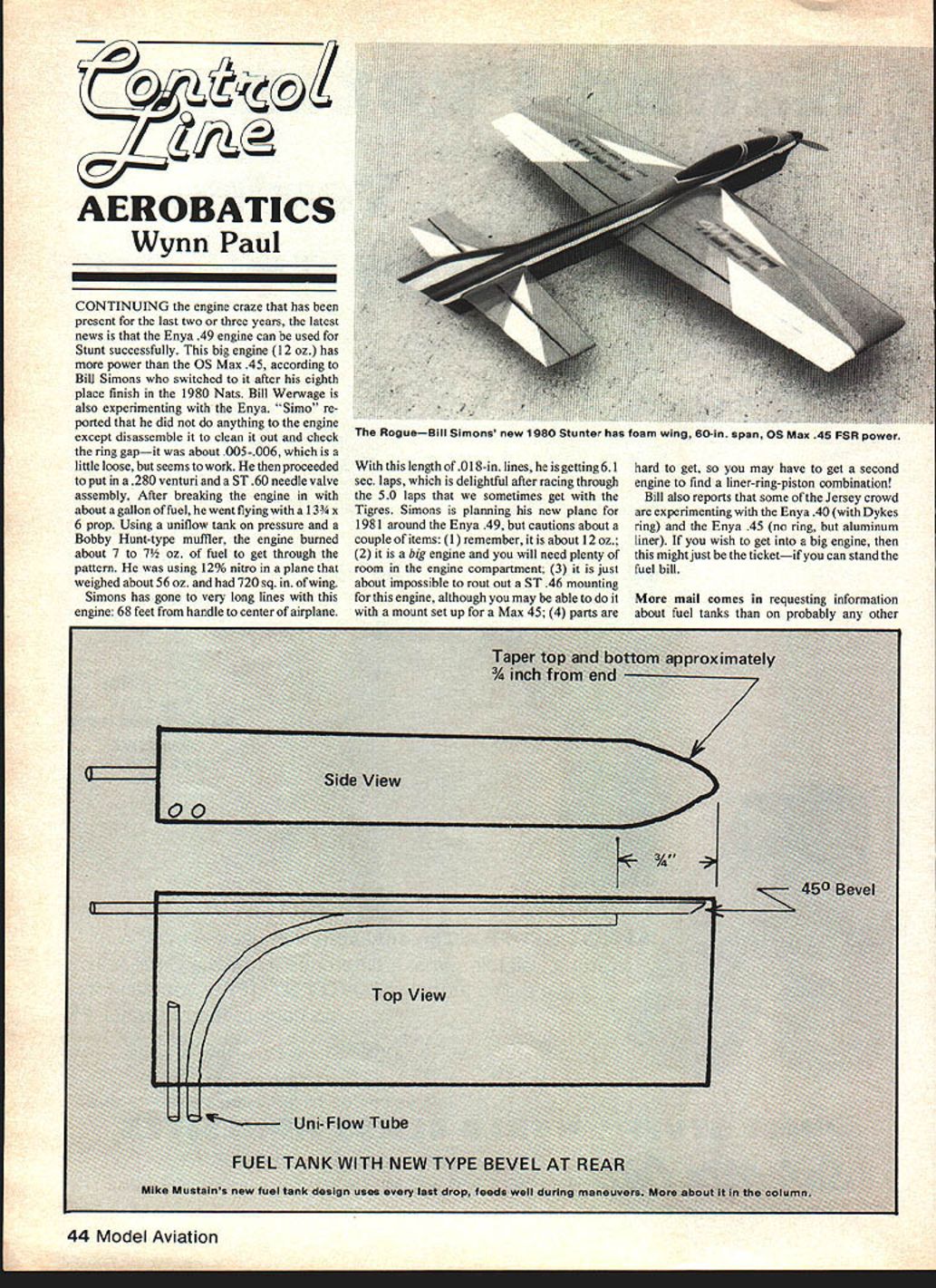
Mike Mustain has developed a tank shape that seems to steady the run and prevent speed-up during maneuvers, especially on the OS Max .40 and .45. The tank has both top and bottom surfaces tapering back beginning at a point about 3/4 in. rear of the tank. The uniflow tube is soldered alongside the pickup tube just before the end, about 3/4 in. from the rear of the tank. This top-and-bottom taper appears to improve running consistency and also allows the tank to use the last drop of fuel, eliminating leftover fuel as dead weight — useful for larger engines where unused fuel is undesirable.
Plastic clunk tanks
Don't overlook plastic clunk tanks. Successful Stunters including Bob Barron and Norm Whittle have used clunk tanks for years and endorse them. Several RC plastic tanks can be adapted for Stunt depending on engine size. They are extremely capable of handling the rigors of stunt use. Be careful not to crack the rubber seal at the tank mouth: push the tubing straight through and do not drill out holes to make passage easier. Plastic tanks are removable, which helps for troubleshooting. You can set them up for straight suction, muffler pressure, or uniflow — with or without pressure.
Tank cleaning tip
Some tank troubles can be solved without removing a built-in tank. One suggested procedure (used successfully by Nick Gant on his Gieseke Nobler) is:
- Force an industrial-strength carburetor cleaner through the tank to remove manufacturing debris.
- Rinse with water to remove the water-soluble cleaner.
- Use isopropyl alcohol to remove remaining water.
This procedure can save removing a built-in tank if the engine leans out as soon as it gets in the air.
For information on PAMPA or Stunt, write: Wynn Paul 1640 Maywick Dr. Lexington, KY 40504
Transcribed from original scans by AI. Minor OCR errors may remain.

