
Aerobatics
Wynn Paul
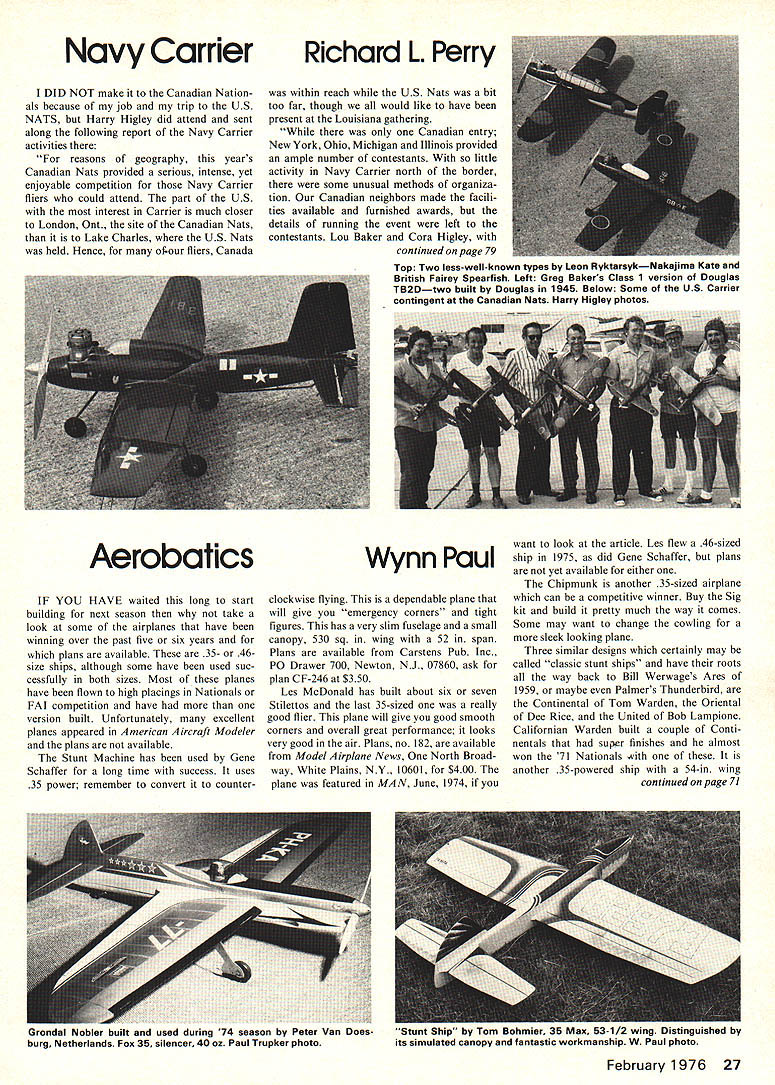
IF YOU HAVE waited this long to start building for next season then why not take a look at some of the airplanes that have been winning over the past five or six years and for which plans are available. These are .35- or .46-size ships, although some have been used successfully in both sizes. Most of these planes have been flown to high placings in Nationals or FAI competition and have had more than one version built. Unfortunately, many excellent planes appeared in American Aircraft Modeler and the plans are not available.
The Stunt Machine has been used by Gene Schaffer for a long time with success. It uses .35 power; remember to convert it to counterclockwise flying. This is a dependable plane that will give you "emergency corners" and tight figures. This has a very slim fuselage and a small canopy, 530 sq. in. wing with a 52 in. span. Plans are available from Carstens Pub. Inc., P.O. Drawer 700, Newton, N.J., 07860, ask for plan CF-246 at $3.50.
Les McDonald has built about six or seven Stilettos; the last .35-sized ship was a really good flier. This plane will give you good smooth corners and overall great performance; it looks very good in the air. Plans no. 182 are available from Model Airplane News, One North Broadway, White Plains, N.Y., 10601, for $4.00. The plane was featured in MAN, June, 1974, if you want to look at the article. Les flew a .46-sized ship in 1975, as did Gene Schaffer, but plans are not yet available for either one.
The Chipmunk is another .35-sized airplane which can be a competitive winner. Buy the Sig kit and build pretty much the way it comes. Some may want to change the cowling to a more sleek-looking plane.
Three similar designs which certainly may be called "classic stunt ships" and have their roots all the way back to Bill Werwage's Ares of 1959, or maybe even Palmer's Thunderbird, are the Continental of Tom Warden, the Oriental of Dee Rice, and the United of Bob Lampione. Warden built a couple of Continentals that had super finishes and he almost won the '71 Nationals with one of these. It is another .35-powered ship with a 54-in. wing
CL Navy Carrier / Perry
An able assist from the Windsor Model Airplane Club provided the judging expertise. The Detroit Carrier Team brought the deck labor needed to set up and pack things away and to help the contestants.
"The winners, mostly the Detroit Carrier Team, received beautiful walnut trophies that were worthy of their best efforts. A nice gesture of our Canadian hosts was a special trophy for the best non-winning score posted by a junior. All age groups were combined so the younger flyers appreciated this.
"Next year the Canadian Nats move way out west and will be too distant for most of us. When it returns to the London area, I am sure our hosts can again be assured a strong Carrier entry.
"Flying conditions were good though the heat and humidity were a bit on the high side. As might be expected with the humidity, the trash barrel was the recipient of a couple hundred cooked glow plugs. The wind was ever present but steady and not too strong; no one crashed as a result of it. Our host was spared the worst share of problems and it is nice when the weather makes its contribution to our affairs.
"There are several measures for the success of a contest, and by any measure the trip was worth the effort. One method of evaluating is to count the number of entries. Since the check was every minute it is safe to say there were enough. Another standard is to compare the winners' scores with those of other contests or to compare them against national records. The readers may make their own comparisons. The scores were 569 in Class I, 588 in Class II and 383 in Profile. None of these flights was an easy winner because the second and third place flights were only a few points off the pace. Another measure of success is the attitude of the contestants, which was commendable! Nearly everyone commented on the relaxed atmosphere. (It was too hot to get excited.)
Have you ever seen a new Carrier record printed in Competition Newsletter and wondered who set it and what equipment was used? I am going to try to keep you all posted on what is being used to set the records. We broke both Class I and II Open records in Dayton, Ohio, last September. Dave Wallick set the Class II record at 642.43, and I moved the Class I record up to 625.14.
Dave used a 33‑in. span Guardian, which is small by normal Class II standards at about 165 sq. in. wing area. Dave's engine was a Rossi 60 swinging a Rev‑Up 10‑8W Super M prop and burning a mixture of 70% nitromethane, 10% propylene oxide, and 20% oil. Speed control was by means of a fuel‑metering and exhaust slide using crankcase pressure and a Fox idle‑bar glow plug.
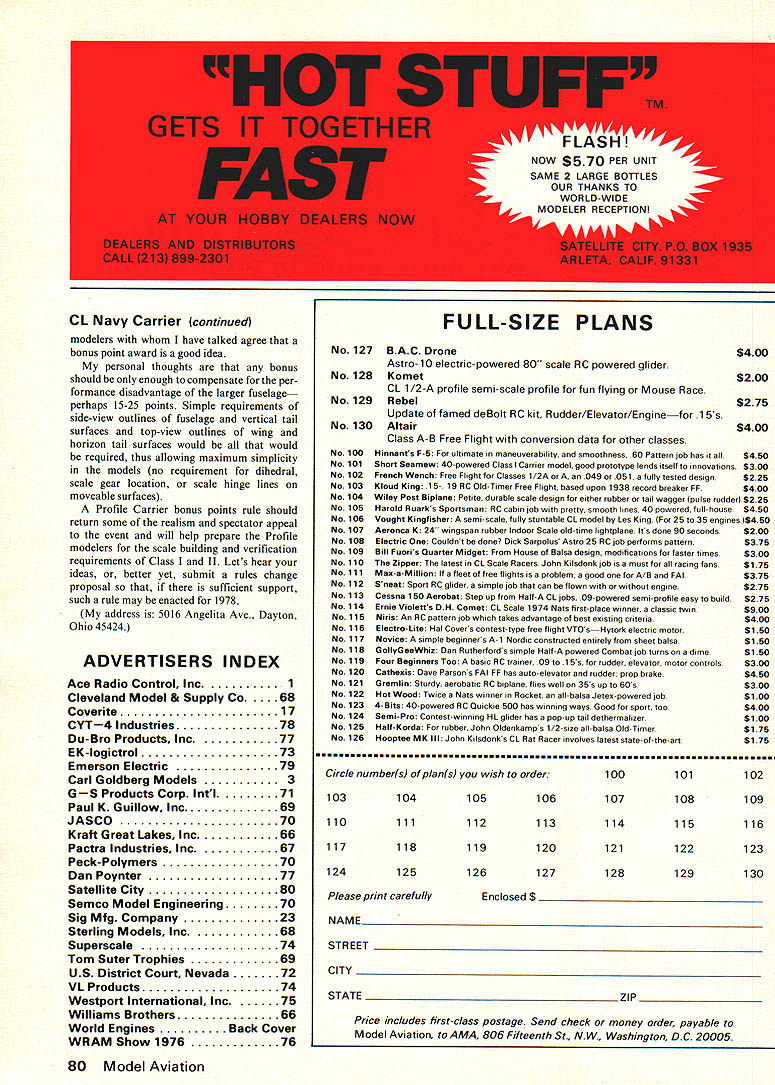
The 33‑in. Guardian is available as Model Airplane News plan #173.
I used my Short Seamew whose 140 sq. in. wing area is larger than most. The engine was a SuperTiger G40 ABC with a ST Mag throttle and a pressure fuel tank. Fuel and plug were the same as Dave used. I have been having good luck with Top Flite props lately, using an 8‑3/8 x 6 made from a 10‑3/8 speed prop. I will discuss the fuel system and throttle used in the next column. The Seamew plans are available as Model Aviation plan #101.
What are your opinions on whether or not Profile Carrier models should look like real airplanes? Joe Koch of Levittown, Penn., wrote that the ones that don't look like the real things or paint schemes are necessary. Other Carrier modelers, myself included, would like to see some realism return to the Profile event. Many modelers with whom I have talked agree that a bonus point award is a good idea.
My personal thoughts are that any bonus should be used only as an attempt to compensate for the performance disadvantage of the larger fuselage—perhaps 15-25 points. Simple requirements of side-view outlines of fuselage and vertical tail surfaces and top-view outlines of wing and horizontal tail surfaces would be all that would be required, thus allowing maximum simplicity in the models (no requirement for dihedral, scale gear location, or scale hinge lines on moveable surfaces).
A Profile Carrier bonus points rule should return some of the realism and spectator appeal to the event and will help prepare the Profile modelers for the scale building and verification requirements of Class I and II. Let's hear your ideas or, better yet, submit a rules change proposal so that, if there is sufficient support, such a rule may be enacted for 1978.
(My address is: 5016 Angelita Ave., Dayton, Ohio 45424.)
Transcribed from original scans by AI. Minor OCR errors may remain.

