
Control Line: Aerobatics
Wynn Paul
Finishing Stunt Planes
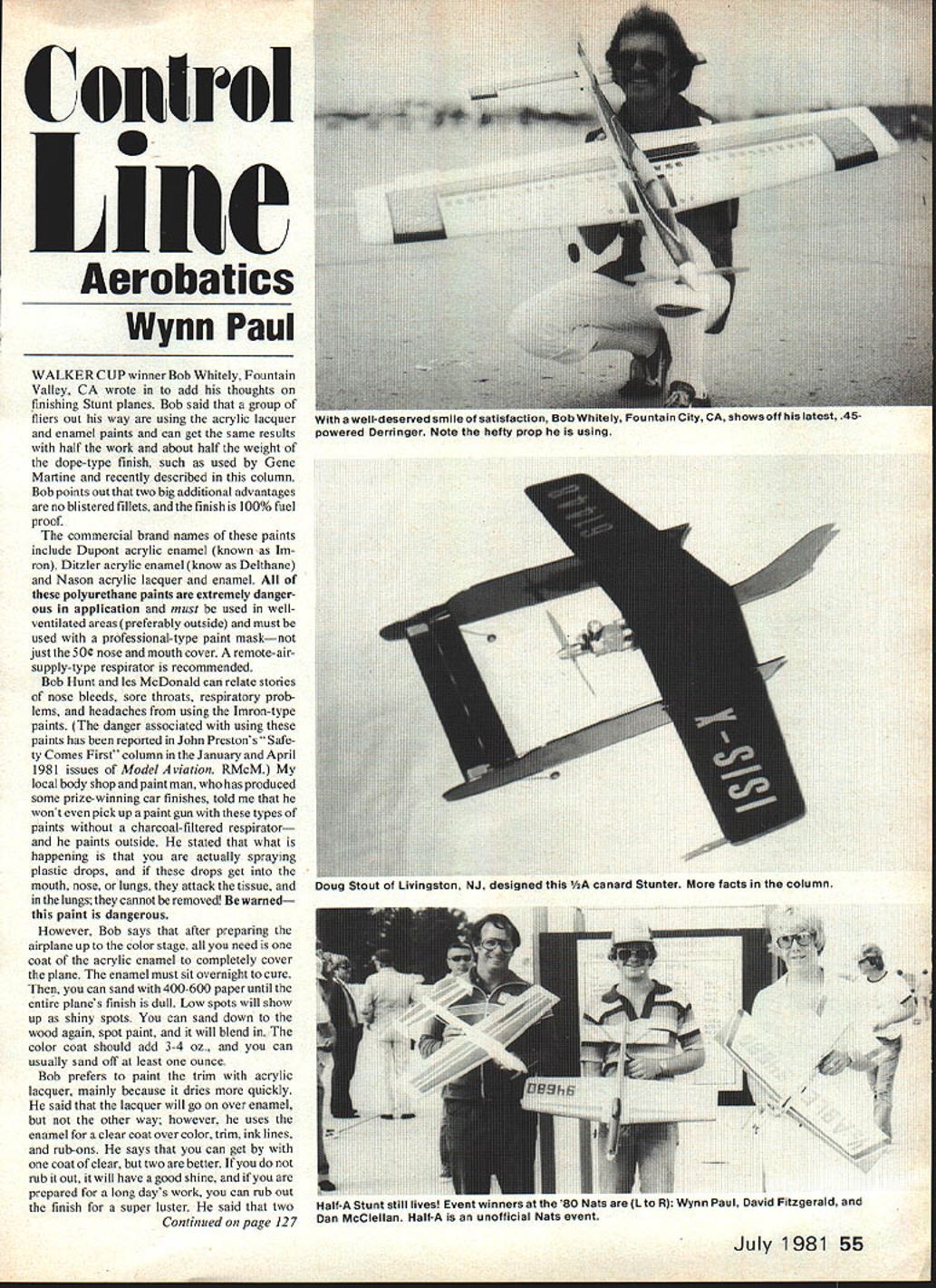
WALKER CUP winner Bob Whitely, Fountain Valley, CA, wrote to add his thoughts on finishing Stunt planes. Bob says a group of fliers in his area are using acrylic lacquer and enamel paints and can get the same results with about half the work and about half the weight of a dope-type finish (such as recently described in this column). He points out two big advantages: no blistered fillets and a finish that is 100% fuel proof.
Commercial brand names include:
- DuPont acrylic enamel (Imron)
- Ditzler acrylic enamel (Delthane)
- Nason acrylic lacquer and enamel
These are polyurethane paints.
Safety with polyurethane paints
Polyurethane paints are extremely dangerous to apply and must be used in well-ventilated areas (preferably outside). Use a professional-type paint mask — not a cheap nose-and-mouth cover. A remote-air-supply respirator or a charcoal-filtered respirator is strongly recommended.
Experienced users report nosebleeds, sore throats, respiratory problems, and headaches from Imron-type paints. A professional body-shop painter who has produced prize-winning finishes warns that sprayed plastic droplets can be inhaled and attack lung tissue; once in the lungs they cannot be removed. Be warned — this paint is dangerous. Use these paints only if you have professional equipment and adequate ventilation. Mask costs are likely in the several-hundred to low-thousand-dollar range; in some cases people have died from effects of inadequate protection.
Finishing technique and weights
Bob’s recommended procedure:
- Prepare the airplane up to the color stage.
- Apply one coat of acrylic enamel to completely cover the plane; let it sit overnight to cure.
- Sand with 400–600 grit paper until the finish is uniformly dull. Low spots will show as shiny spots.
- Sand down to bare wood where necessary, spot-paint, and the color coat will blend.
Typical weight changes:
- Color coat adds about 3–4 oz.; you can usually sand off at least 1 oz.
- Two coats of clear weigh about 1.5 oz.
Bob prefers to paint trim with acrylic lacquer because it dries quicker. Lacquer will go over enamel; enamel is used as a clear coat over color, trim, ink lines, and rub-ons. One coat of clear will give a good shine; two coats are better. If you have time to rub the finish out, you can achieve a super luster.
Several top fliers use these finishes (Jim Armour, John Poynter). Jim applied acrylic clear over a regular dope finish and achieved a very shiny, bright result. Again: use these paints only with professional spray equipment, a very well-ventilated spray area, and a professional respirator.
Beware: Canard Stunter
Doug Stout, Livingston, NJ, a former National Champion, reports experiments with a canard Stunter. He describes a half-A canard prototype (Isis‑X) and plans for a full-size canard Stunt plane next year.
Isis‑X specifications:
- Wing span: 25 in.
- Leading edge: 1° forward sweep
- Wing incidence: 5° anhedral (negative dihedral)
- Aspect ratio: 5:1
- Wing area: 125 sq. in.
- Canard span: 10 in.
- Canard area: 25 sq. in.
- Canard aspect ratio: 4:1
- Leadouts: just behind the center of gravity (CG is on the center of the prop)
Flight characteristics: the plane does not yaw or roll and is very stable, yet responsive in pitch.
The profile half-A version weighs about 10 oz., plus roughly 2 oz. for nose weight. Doug says the Isis‑X is the control-line version of the original Black Widow. He had help from Mark Sullivan and Mike Giordano.
Design/trimming advice (from Doug): understand the effects of static and dynamic stability and analyze them separately. Compared to a standard Stunter, total elevator travel from neutral should be no more than about 10°, with a static margin of 10–15%. Doug believes an aerobatic canard can be built to compete with current Stunter designs.
Flying Lines (newsletter)
Flying Lines is a newsletter published by model enthusiasts in the Northwest U.S. It is not directly associated with any club. Editor: John Thompson. The Aerobatics column is written by Rich Schaper and Paul Walker.
Subscription rates:
- $4.50 for six issues (domestic)
- $8.00 for twelve issues (domestic)
- Overseas: $10.00 for six, $18.00 for twelve
The January 1981 issue contained 15 pages, all Control Line, and had several good items. Contact: John Thompson, 1411 Bryant Avenue, Cottage Grove, OR 97424.
Fuel tanks and model fuels
Douglas Taffinder reports he is back in business with fuel tanks for control-line airplanes. He took over for Randy’s Model Aeronautics, which had previously taken over from the well-known "Don’s Tanks." The tanks are high quality and reasonably priced.
Available tank types and sizes:
- Narrow Stunt: 3, 3.5, 4 oz.
- Narrow uniflow: 3, 3.5, 4 oz.
- Profile: 3, 3.5, 4 oz.
- Wide uniflow: 4, 5, 6 oz.
- Wide Stunt: 3, 4, 5 oz.
- Wide uniflow profile: 2.5, 3, 3.5, 4 oz.
- Mini‑Stunt: 1.5, 2, 2.5 oz.
- Tanks also available for Combat, Rat Race, and Goodyear
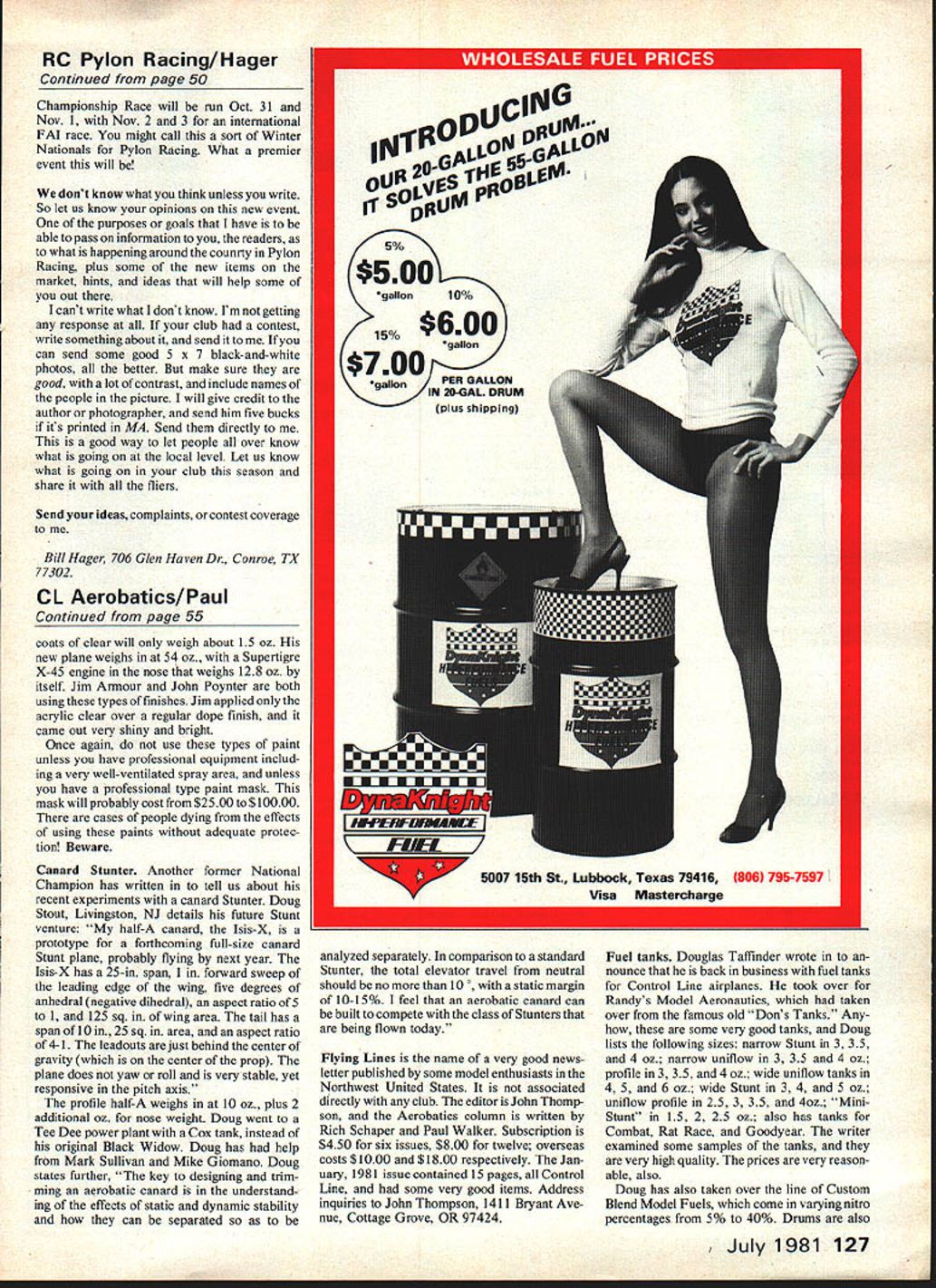
Doug also carries Custom Blend Model Fuels with nitro percentages from 5% to 40%. Drums are available.
Transcribed from original scans by AI. Minor OCR errors may remain.

