
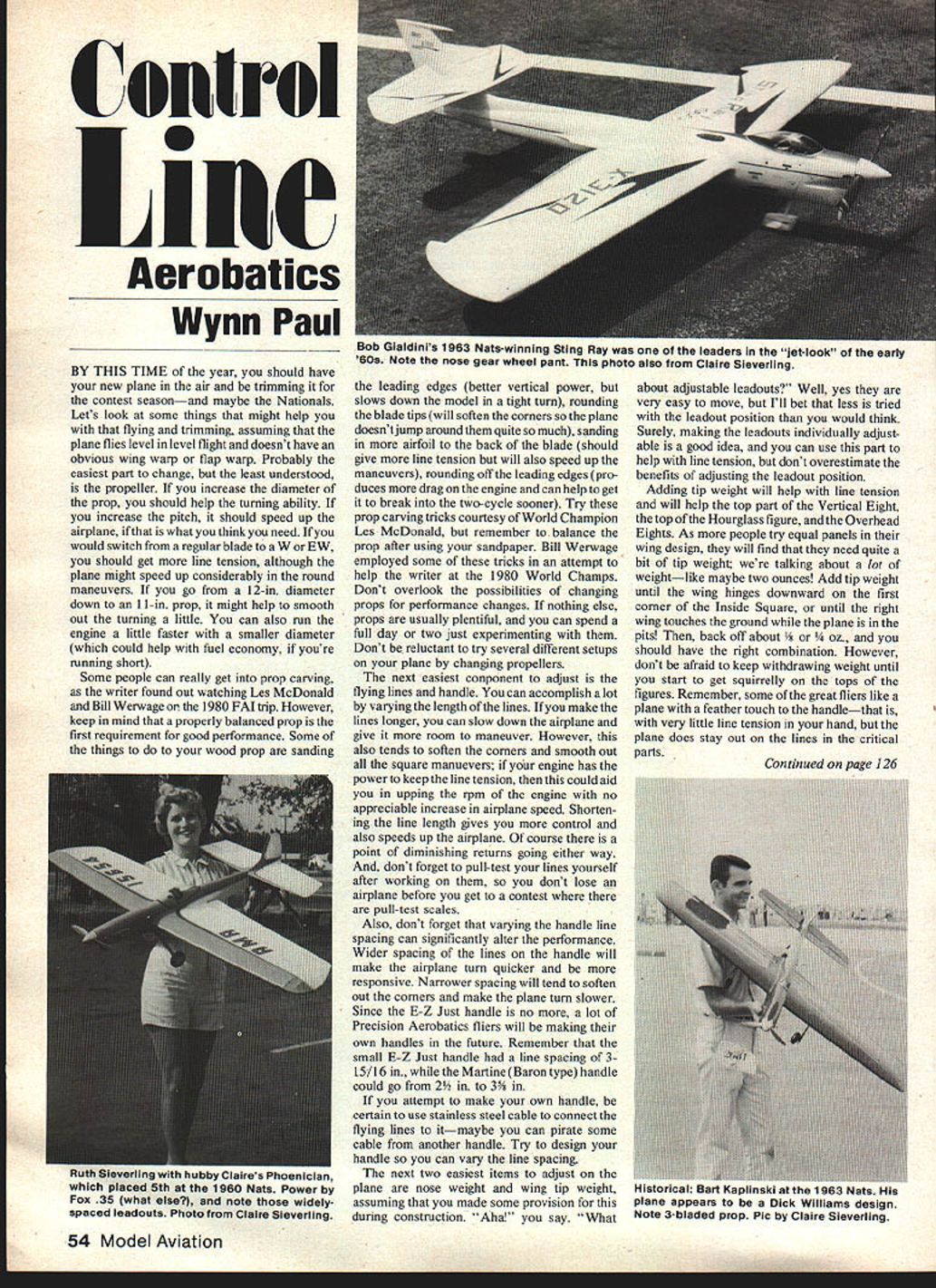
Control Line: Aerobatics
Wynn Paul
Introduction
By this time of the year you should have your new plane in the air and be trimming it for the contest season—and maybe the Nationals. The following suggestions assume the plane flies level in flight and does not have an obvious wing warp or flap warp. The easiest parts to change are described below, starting with the propeller.
Propeller
- Increasing propeller diameter generally improves turning ability.
- Increasing pitch tends to speed up the airplane.
- Switching from a regular blade to a W or EW blade will usually increase line tension, though the plane may speed up considerably in the round maneuvers.
- Going from a 12‑inch diameter prop down to an 11‑inch prop can smooth out the turning somewhat and allow the engine to run a little faster (which can help fuel economy).
Don't overlook changing props for performance changes—props are usually plentiful, and you can spend a day or two experimenting with different setups.
Prop carving and balancing
Some people get deeply into prop carving (the author observed Les McDonald and Bill Werwage doing this at the 1980 FAI trip). Important points:
- A properly balanced prop is the first requirement for good performance.
- Possible carving changes and effects:
- Sanding the leading edges: better vertical power but slows the model in a tight turn.
- Rounding the blade tips: softens corners so the plane doesn't jump around them as much.
- Sanding more airfoil into the back of the blade: increases line tension but can speed up maneuvers.
- Rounding off the leading edges: produces more drag on the engine and can help it break into the two‑cycle sooner.
Try these tricks (courtesy of World Champion Les McDonald), but always re‑balance the prop after sanding. Bill Werwage used some of these techniques to help the author at the 1980 World Championships.
Flying lines and handle
- Varying flying line length has a large effect:
- Longer lines slow the airplane and give it more room to maneuver; they soften corners and smooth square maneuvers. If the engine has enough power to maintain line tension, longer lines can allow higher rpm without much speed increase.
- Shorter lines give more control and speed up the airplane.
- There is a point of diminishing returns in either direction.
- Always pull-test your lines after working on them (to avoid losing an airplane at a contest).
Varying the handle line spacing also affects performance:
- Wider spacing makes the airplane turn quicker and be more responsive.
- Narrower spacing softens corners and slows turning.
- The small E‑Z Just handle had a line spacing of 3‑15/16 in.; the Martine (Baron type) handle could go from 2‑1/2 in. to 3‑5/8 in.
Handle construction
If you make your own handle:
- Use stainless steel cable to connect the flying lines to the handle—consider salvaging cable from another handle.
- Design the handle so you can vary the line spacing.
Leadouts, tip weight, and adjustable leadouts
- Adjustable leadouts are easy to move and making leadouts individually adjustable is a good idea; they can help with line tension but do not expect miracles from leadout position changes.
- Adding tip weight helps line tension and benefits the top part of the Vertical Eight, the top of the Hourglass figure, and Overhead Eights.
- As more fliers use equal panels in wing design, they often need significant tip weight—possibly around two ounces.
- Guideline for adding tip weight:
- Add tip weight until the wing hinges downward on the first corner of the Inside Square, or until the right wing touches the ground while the plane is in the pits.
- Then back off about 1/2 oz. to 3/4 oz. That usually yields the right combination.
- If the tops of the figures become squirrely, remove weight until you regain stability.
- Some great fliers prefer a "feather touch" to the handle—very little line tension in the hand while the plane stays out on the lines in critical parts.
Nose weight
- Increasing nose weight is a useful general remedy:
- It can desensitize a tail‑heavy plane.
- It can help the plane "groove" (settle into smooth, predictable flight).
- It can make round figures appear smoother rather than jerky.
Further adjustments not yet covered
There are additional adjustments you can make inside the plane or to the engine that were not detailed here, including:
- Adjusting flap horns or flaps.
- Changing the tank position.
- Shimming the engine forward or backward to influence turning.
- Changing engine offset if line tension problems persist.
Practice and experimentation
With the variables described, you have enough adjustments to give you at least 50 flights. Those flights will teach you a lot about the airplane and its characteristics. Fifty practice flights is a solid number and is likely more than half the competitors at the Nationals have in the month before the meet.
Flying buddy
Having a flying buddy is very helpful when experimenting with trimming:
- A buddy can observe the airplane from the judges' position or from underneath the maneuvers and provide useful feedback.
- Letting someone else fly your plane can show you how it feels to another pilot and how it looks from a different perspective. This can help determine whether difficulties are due to the plane or the pilot.
Contact
For information on Stunt or PAMPA, contact: Wynn Paul 1640 Maywick Dr. Lexington, KY 40504.
Transcribed from original scans by AI. Minor OCR errors may remain.

