
Control Line: Aerobatics
Wynn Paul
Stunt offshoots
Keep in mind that Stunt now has three offshoots from the traditional "Big Stunt" event:
- Profile Stunt
- Half-A Stunt
- Old Time Stunt
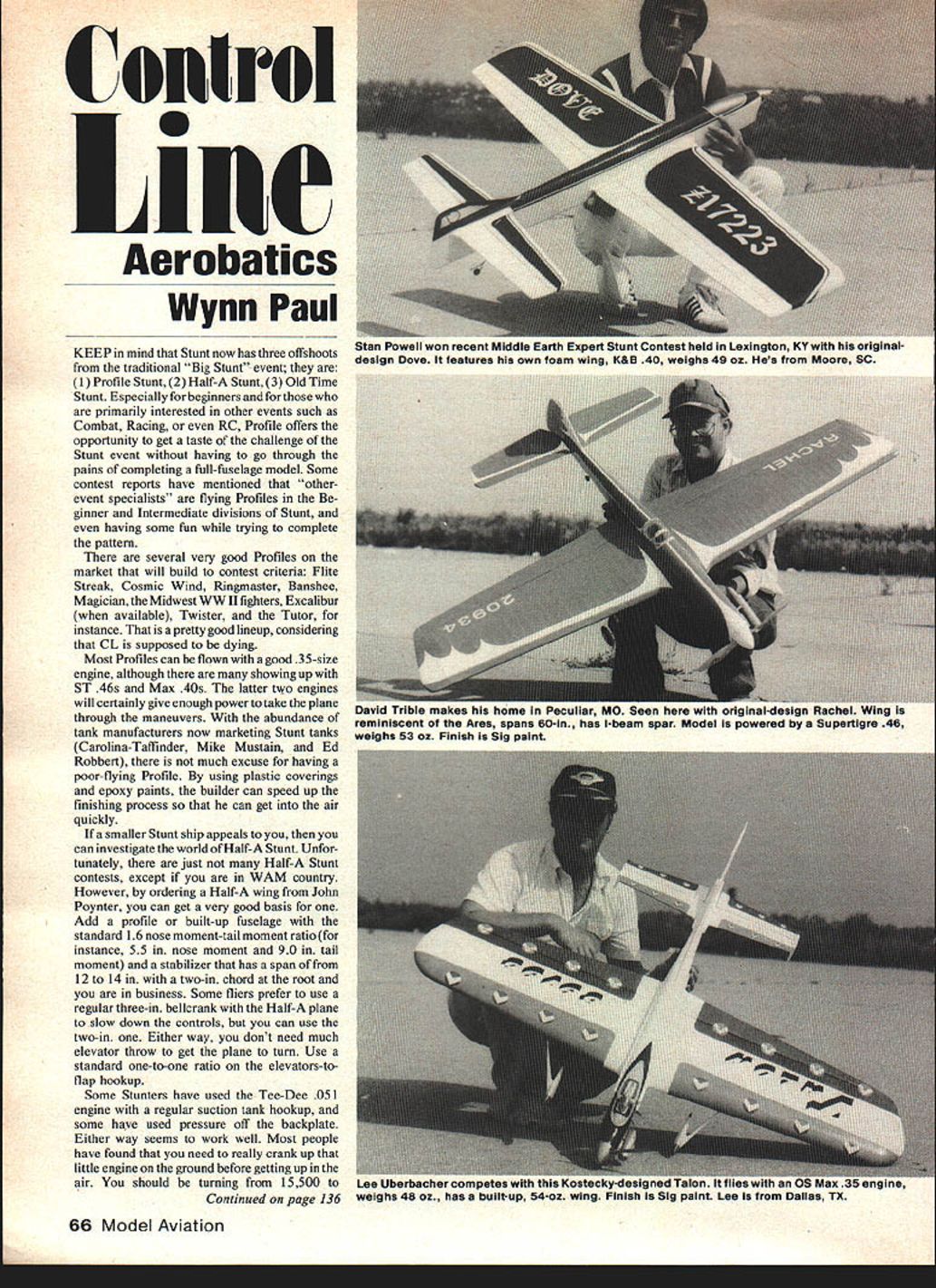
Especially for beginners and for those primarily interested in other events such as Combat, Racing, or even RC, Profile offers the opportunity to get a taste of the challenge of the Stunt event without having to go through the pains of completing a full-fuselage model. Some contest reports have mentioned that "other-event specialists" are flying Profiles in the Beginner and Intermediate divisions of Stunt, and even having some fun while trying to complete the pattern.
Profile Stunt
Several very good Profiles on the market will build to contest criteria, for example:
- Flite Streak
- Cosmic Wind
- Ringmaster
- Banshee
- Magician
- Midwest WWII fighters
- Excalibur (when available)
- Twister
- Tutor
Most Profiles can be flown with a good .35-size engine, although many show up with ST .46s and Max .40s. The latter two engines will certainly give enough power to take the plane through the maneuvers. With the abundance of tank manufacturers now marketing Stunt tanks (Carolina-Taffinder, Mike Mustain, and Ed Robbert), there is not much excuse for having a poor-flying Profile. By using plastic coverings and epoxy paints, the builder can speed up the finishing process and get into the air quickly.
Half-A Stunt
If a smaller Stunt ship appeals to you, investigate the world of Half-A Stunt. Unfortunately, there are not many Half-A Stunt contests, except in WAM country. However, by ordering a Half-A wing from John Poynter, you can get a very good basis for one.
Recommended design and setup:
- Nose moment–tail moment ratio: 1.6 (for instance, 5.5 in. nose moment and 9.0 in. tail moment)
- Stabilizer span: 12–14 in., with a 2 in. chord at the root
- Bellcrank: Some fliers prefer a regular 3-in. bellcrank to slow down the controls; a 2-in. one is acceptable
- Elevator throw: You don't need much to get the plane to turn
- Elevator-to-flap hookup: Standard 1:1 ratio
Engines and fuel:
- Some use the Tee-Dee .051 with a regular suction tank hookup; others use pressure off the backplate
- Warm the engine on the ground until it's turning 15,500–18,000 rpm before launching
- Try 25–30% nitro fuel and a Cox 6-3 prop
- Fly on .008 lines that are 38–45 ft. long
- Tank capacity for a five-minute flight: about 4–6 oz.
- If tank pickup is too deep, try a pickup with about 1.5 in. spacing
- You can order a custom fuel tank (1.25–1.75 oz.) from one of the suppliers mentioned; actual size depends on engine, prop, fuel, and line length
- Expected finished weight: approximately 10–18 oz.
Design inspiration — Half-A articles to obtain:
- Freedom Fighter, Richard Byron, Flying Models, April 1981
- Half-A Mirage, Lou Wolgast, Flying Models, August 1980
- Foxy Lady (pylon racer prototype), Don Winfree, Flying Models, December 1979
- Sunspot, Chris Leis, Model Airplane News, October 1977
- Tercel, Keith Trostle, Model Aviation, September 1976
- Gremlin, Tom Dixon, Model Builder, May 1975
- Pinto, Dick Mathis, Flying Models, December 1972
Also check the column devoted to building a Half-A Stunter in Model Aviation, March 1978.
Old Time Stunt (OTS)
Old Time Stunt is probably the most fun of these three offshoots and is catching on, particularly in the East (thanks to John Miske and the Garden State Circle Burners) and the far West (thanks to WAM). Doug Dahlke (Oshkosh, WI) is the primary mover in the Midwest for OTS.
Rules and pattern:
- Old Time Stunt is flown using the Stunt pattern of the 1951–52 AMA rules, omitting the appearance points.
- A bonus of 20 points is awarded for the use of an operating spark ignition system.
- The 1951–52 Stunt pattern includes:
- Starting
- Takeoff
- Level flight
- Climb
- Dive
- Upright wingover
- Inside round loops (five)
- Outside round loops (five)
- Inverted flight
- Horizontal, vertical, and overhead eights
- One inside square loop
- Landing
Aircraft eligibility and modifications:
- Aircraft selection for OTS is limited to those available in kit or plan form prior to December 31, 1952.
- No modifications are permitted other than structural changes to strengthen the model.
- Any modifications that, in the opinion of the judges, significantly change the appearance and/or performance of the aircraft as originally designed are not allowed.
For the latest list of qualifying kits and plans, and for many of the over 130 eligible designs, contact:
- John Miske
- 415 Clifton Blvd., Clifton, NJ 07013
- Telephone: (201) 472-2752
Most OTS devotees use a modern engine for reliability, but occasionally an old faithful shows up. After some effort getting it started, the owner usually has a good time flying that old pattern.
Nationals — PAMPA category discussion
There has been much discussion at contests about incorporating the PAMPA category system of flying classes into the Nationals. This would require a rules change and significant record keeping. The present honor system (picking a class by your scoring average) generally works on the local level, but at the Nationals there could be entrants who are over- or under-classed for the class they choose. If scoring averages are not used to determine categories, using placings at local contests would necessitate a large amount of paperwork to keep records.
Suggested three-category system for the Nationals:
- Expert — open to anyone
- Advanced — limited to those who have not qualified at the Nationals within the last 10 years
- Sportsman — limited to profile airplanes and/or fliers who have never been to the Nationals before
No matter which direction is taken, someone will need to undertake the record keeping and paperwork. Ideas on this proposition are welcome.
For information on Stunt or PAMPA, contact: Wynn Paul 1640 Maywick Dr. Lexington, KY 40504
Transcribed from original scans by AI. Minor OCR errors may remain.

