
Control Line: Aerobatics
Wynn Paul
LOOK FOR a noticeable growth in Half-A stunt competition in the near future. W.A.M. has had Half-A stunt since 1953 in their contests and periodically there have been some Half-A contests at the local level, but the interest generated by the L.M. Cox Co. sponsored Half-A championships at the last two Nationals will produce a bonafide, though unofficial, Half-A precision aerobatics event at the 1976 Nationals.
PAMPA president Keith Trostle has appointed a committee consisting of Arlie Preszler, Tom Dixon, and Bill Fitzgerald to draw up guidelines for the event. The previous two events at Lake Charles were quite informal and had very little organization. Hey! Maybe this would be the best way to keep it! Anyhow, here are the guidelines approved by the committee:
- Any airplane design; no builder-of-the-model rule (to allow the Cox planes), powered by an engine or engines having a total displacement no greater than 0.051 cu. in.
- Flight pattern to be the same as AMA aerobatics with the same scoring except omitting appearance points. Contestants will fly two patterns, with the best score used for placing.
- Line sizes must be a minimum of .008 stranded or cable. Pull-test as per AMA rule book.
- One airplane per pilot allowed with back-up airplane as per the new AMA rule. Same airplane may not be used by more than one pilot. AMA numbers of the pilot must be on the plane, but the size may be 1/2 in.
At the time of this writing it is planned to run the Half-A event in regular AMA classes (Junior, Senior and Open) on Wednesday and Thursday of Nationals week, immediately after Junior and Senior stunt is completed each day. Judges and other officials will come from PAMPA volunteers. Awards will be given. It is the hope of PAMPA members that the Cox company will again sponsor the event.
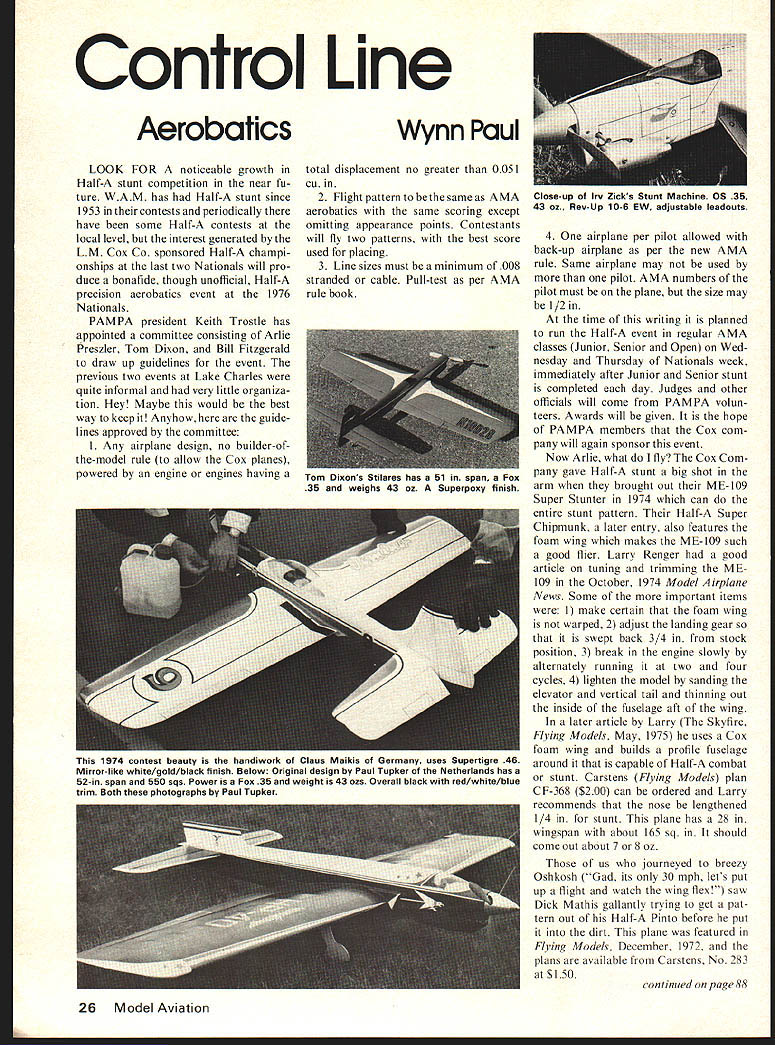
Now Arlie, what do I fly? The Cox Company gave Half-A stunt a big shot in the arm when they brought out their ME-109 Super Stunter in 1974 which can do the entire stunt pattern. Their Half-A Super Chipmunk, a later entry, also features the foam wing which makes the ME-109 such a good flier. Larry Renger had a good article on tuning and trimming the ME-109 in the October, 1974 Model Airplane News. Some of the more important items were: 1) make certain that the foam wing is not warped, 2) adjust the landing gear so that it is swept back 3/4 in. from stock position, 3) break in the engine slowly by alternately running it at two and four cycles, 4) lighten the model by sanding the elevator and vertical tail and thinning out the inside of the fuselage aft of the wing.
In a later article by Larry (The Skyfire, Flying Models, May, 1975) he uses a Cox foam wing and builds a profile fuselage around it that is capable of Half-A combat or stunt. Carstens (Flying Models) plan CF-368 ($2.00) can be ordered and Larry recommends that the nose be lengthened 1/4 in. for stunt. This plane has a 28-in. wingspan with about 165 sq. in. It should come out about 7 or 8 oz.
Those of us who journeyed to breezy Oshkosh ("Gad, it's only 30 mph, let's put up a flight and watch the wing flex!") saw Dick Mathis gallantly trying to get a pattern out of his Half-A Pinto before he put it into the dirt. This plane was featured in Flying Models, December, 1972, and the plans are available from Carstens, No. 283 at $1.50.
CL Aerobatics/Paul
In his words, it is a "scaled down Dee Rice 'Oriental' with a straight 34-in. built-up wing." The plane has a built-up fuselage, full flaps and conventional stunt plane construction. Dick advocates 30-degree flap and elevator movement for control. The model came out weighing about 12 ounces. Tom Dixon, Atlanta, suggests that the nose of the Pinto be lengthened 3/4 in. to make the plane fly more groovy.
Fuel tank size for a Half-A stunter should be 1.25 to 1.5 ounces. The Clary (Veco) 6811 or 6817 should work and give enough fuel for the entire pattern. The vent and pick-up tubes should be replaced with 3/32 in. O.D. tubing for Half-A flying. The tank shown in the Pinto plans is actually too big, so substitute the Clary.
Dick stresses the use of .008 in. braided steel lines 45-52 ft. long. He feels that these offer little resistance, yet give positive control feel that fabric lines do not.
Tom Dixon built a Half-A "Gremlin," published in the May, 1975 Model Builder, plans available no. 5753 at $2.75. This sharp little flier was built after Tom tried the Pinto and decided to use a thick, tapered wing, longer moments, and a Cox stunt special engine. The wing span is 33½ in. with 217 sq. in. The front moment is 5¾ in., rear moment is 8¾ in., and stabilizer span is 13 in. According to Tom, this plane will fly a very competitive pattern. He advises adjustable tip weight and leadouts. He also advises that the controls be set up "slower" than a big stunter, with more handle movement required as Half-A models are much more sensitive than the larger stunt ships. Tom found that 42-ft .008 lines worked best for him. He uses a Cox 6-4 prop and Sig 5% stunt fuel.
Soon to be published is another Dixon delight, the Stilarus, which combines the better features of the Stiletto and the Ares. Look for it soon. Both Arnold Stott (Foam Flite Co.) and Bob Hunt (Control Specialties Co.) should have foam Half-A stunt wings available. Bob says that he has a complete Half-A wing with tips, controls, flaps, and landing gear that comes in at two ounces! Bob has two wings available, one a 24% airfoil and the other a 21%.
So much for specifications, start building now and get ready for the Nationals.
Incidentally, PAMPA is considering changing stunt finals in open category to the best two patterns out of three over a two day span. It is felt that the Open stunt champion should be selected by more than just one pattern. Send in comments to Wynn Paul, 1640 Maywick Dr., Lexington, Ky., 40504.
Transcribed from original scans by AI. Minor OCR errors may remain.

