
Control Line: Aerobatics
Wynn Paul
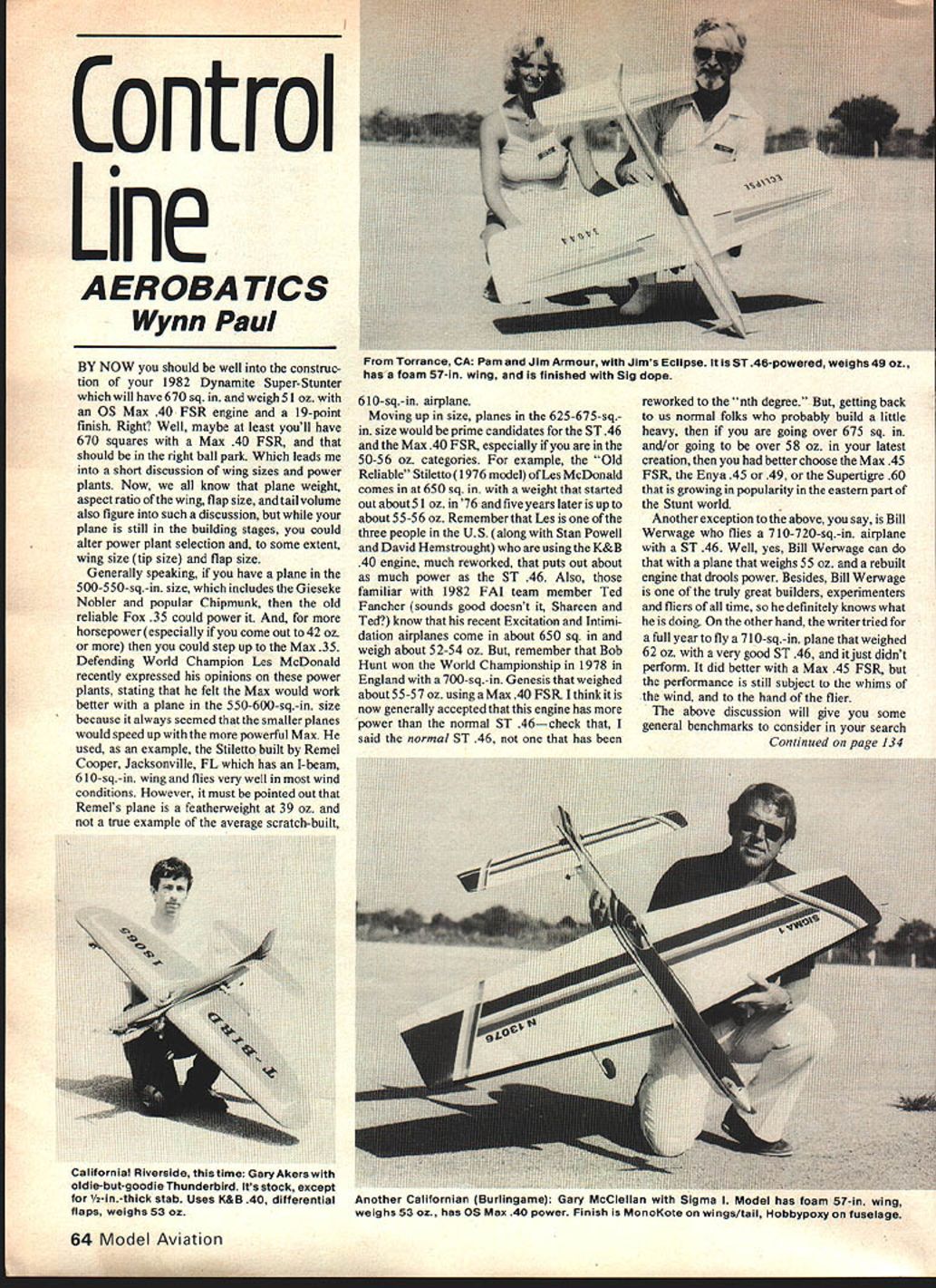
By now you should be well into the construction of your 1982 Dynamite Super-Stunter, which will have 670 sq. in. and weigh 51 oz. with an OS Max .40 FSR engine and a 19-point finish. Right? Well, maybe at least you'll have 670 sq. in. with a Max .40 FSR, and that should be in the right ballpark. Which leads me into a short discussion of wing sizes and power plants. Now, we all know that plane weight, aspect ratio of the wing, flap size, and tail volume also figure into such a discussion, but while your plane is still in the building stages, you could alter power plant selection and, to some extent, wing tip size and flap size.
Powerplant and wing-size guidelines
Generally speaking, if you have a plane in the 500–550 sq. in. size (which includes the Gieseke Nobler and the popular Chipmunk), then the old reliable Fox .35 could power it. For more horsepower (especially if you come out to 42 oz. or more) you could step up to the Max .35. Defending World Champion Les McDonald recently expressed his opinion on these power plants, stating that he felt the Max would work better with a plane in the 550–600 sq. in. size because it always seemed that the smaller planes would speed up with the more powerful Max. He used, as an example, the Stiletto built by Remel Cooper, Jacksonville, FL, which has an I-beam, 610-sq.-in. wing and flies very well in most wind conditions. However, it must be pointed out that Remel's plane is a featherweight at 39 oz., and not a true example of the average scratch-built 610-sq.-in. airplane.
Moving up in size, planes in the 625–675 sq. in. range would be prime candidates for the ST .46 and the Max .40 FSR, especially if you are in the 50–56 oz. categories. For example, the "Old Reliable" Stiletto (1976 model) of Les McDonald comes in at 650 sq. in. with a weight that started out about 51 oz. in '76 and five years later is up to about 55–56 oz. Remember that Les is one of the three people in the U.S. (along with Stan Powell and David Hemstrought) who are using the K&B .40 engine, much reworked, that puts out about as much power as the ST .46. Also, those familiar with 1982 FAI team member Ted Fancher know that his recent Excitation and Intimidation airplanes come in at about 650 sq. in. and weigh about 52–54 oz. But remember that Bob Hunt won the World Championship in 1978 in England with a 700-sq.-in. Genesis that weighed about 55–57 oz. using a Max .40 FSR. It is now generally accepted that this engine has more power than the normal ST .46 — not one that has been reworked to the "nth degree."
For the rest of us who probably build a little heavy: if you are going over 675 sq. in. and/or will be over 58 oz. in your latest creation, then you should choose the Max .45 FSR, the Enya .45 or .49, or the Supertigre .60, which is growing in popularity in the eastern part of the Stunt world.
Another exception to the above is Bill Werwage, who flies a 710–720-sq.-in. airplane with an ST .46. Yes, Bill Werwage can do that with a plane that weighs 55 oz. and a rebuilt engine that absolutely pours out power. Besides, Bill Werwage is one of the truly great builders, experimenters, and fliers of all time, so he definitely knows what he is doing. On the other hand, the writer tried for a full year to fly a 710-sq.-in. plane that weighed 62 oz. with a very good ST .46, and it just didn't perform. It did better with a Max .45 FSR, but the performance is still subject to the whims of the wind and to the hand of the flier.
The above discussion should give you some general benchmarks to consider in your search for a flyable plane with what you have to work with in terms of wing and power plant.
Miscellaneous information
- Bob Hunt recently called to report that his father's Genesis muffler production is still going strong and that all mufflers are now sand-blasted for a very pleasing finish. Those mufflers are available from Jim Hunt at J.H. Design and Sales Co., P.O. Box 599, Saddle Brook, NJ 07662-0599 for the cost of $15.00 plus $2.00 postage and packing.
- Bob also noted that another engine might be very suitable for Stunt: the Enya .40X, side-exhaust, Schnuerle-ported with a flat ring. Some of the N.J.–N.Y. Stunt clan are going to try this out, and more information should be available after the snow season is over.
- Bob has been experimenting with some carbon fiber tape from Dave Brown products. Possible uses are in the construction of I-beam spars or in the front end of a Stunter in place of the 1/16-in. plywood doublers. This tape is 1 in. wide by .003 in. thick and comes in 4-yd. lengths. Bob says the tape is strong enough to lift a Volkswagen (at least that's what the literature says). He cautions that you cannot actually glue this tape, but rather must surround it with balsa and overlap an epoxy dam to hold the tape securely. Bob is going to use this tape in a current Stunt plane, so more information should be forthcoming.
Assembly and trimming tips (from Ted Fancher)
Two excellent ideas from Ted Fancher that may have escaped your reading in his Excitation article in Model Aviation (December 1981):
- Stabilizer installation: When you are about to install the stabilizer-elevator assembly in your new plane, wait before gluing the stab in place until you have the top and bottom blocks fully installed and glued down. Allow for some forward-rearward play in the stab, and be certain that the controls are completely finished and free. If you glue the blocks in place first, then the fuselage will be rigid and will not twist or warp after the stab is solidly installed.
- Trimming technique: Rather than add nose weight for a too-sensitive plane, decrease the line spacing on the handle. This, of course, requires a Bob Baron/Gene Martinet-style adjustable handle. Ted reasons that adding nose weight "results in an airplane trimmed to less than its full aerobatic potential." In plain terms, why add more weight to a plane when you can accomplish the same thing by changing the line spacing? Think it over, and when the snows melt (or the rains stop if you live in California), try this method to help in trimming your new airplane.
For information on Stunt or PAMPA, contact Wynn Paul, 1640 Maywick Dr., Lexington, KY 40504.
Transcribed from original scans by AI. Minor OCR errors may remain.

