
Control Line: Aerobatics
Wynn Paul
Biplane / Triplane Stunt
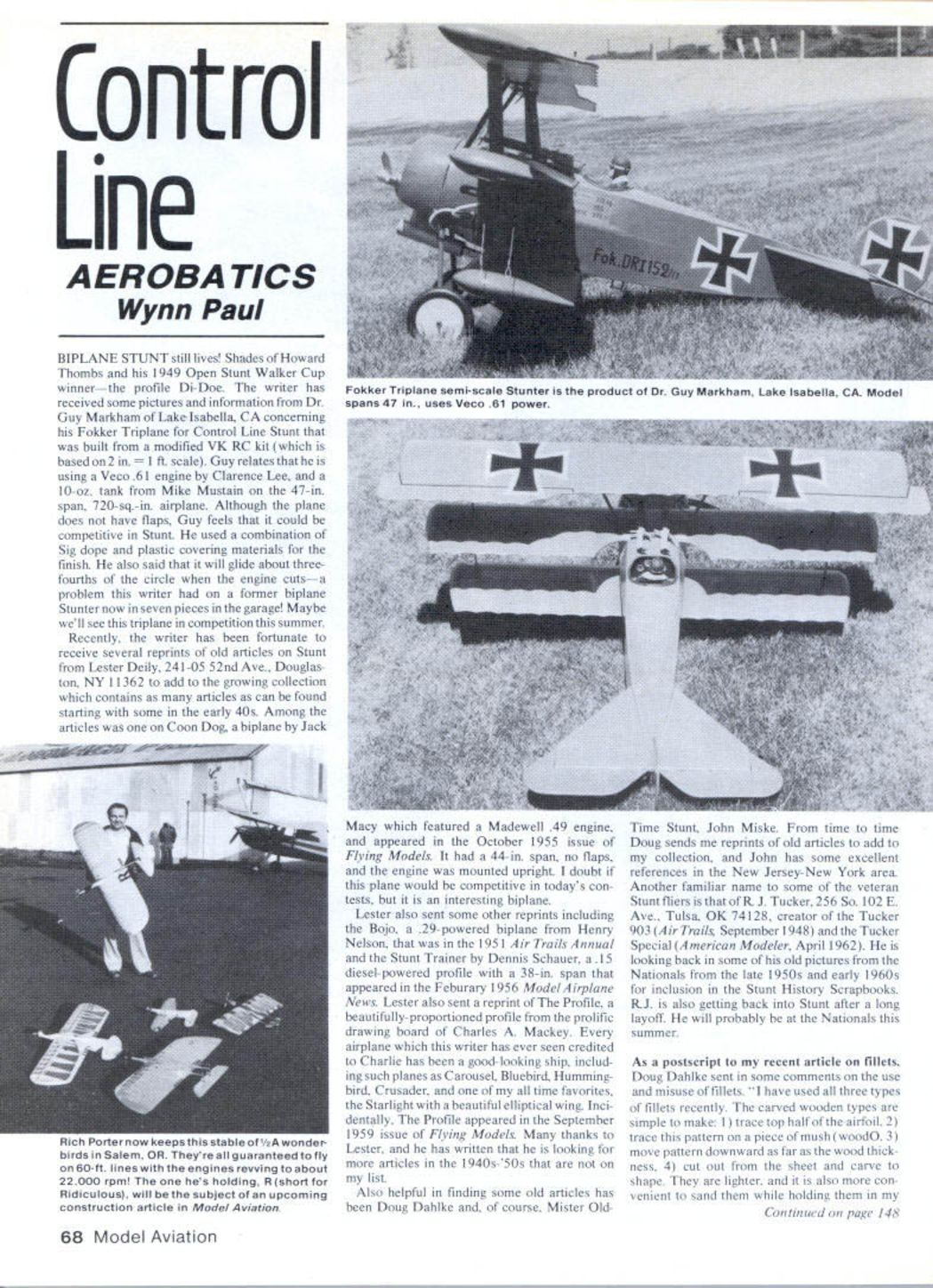
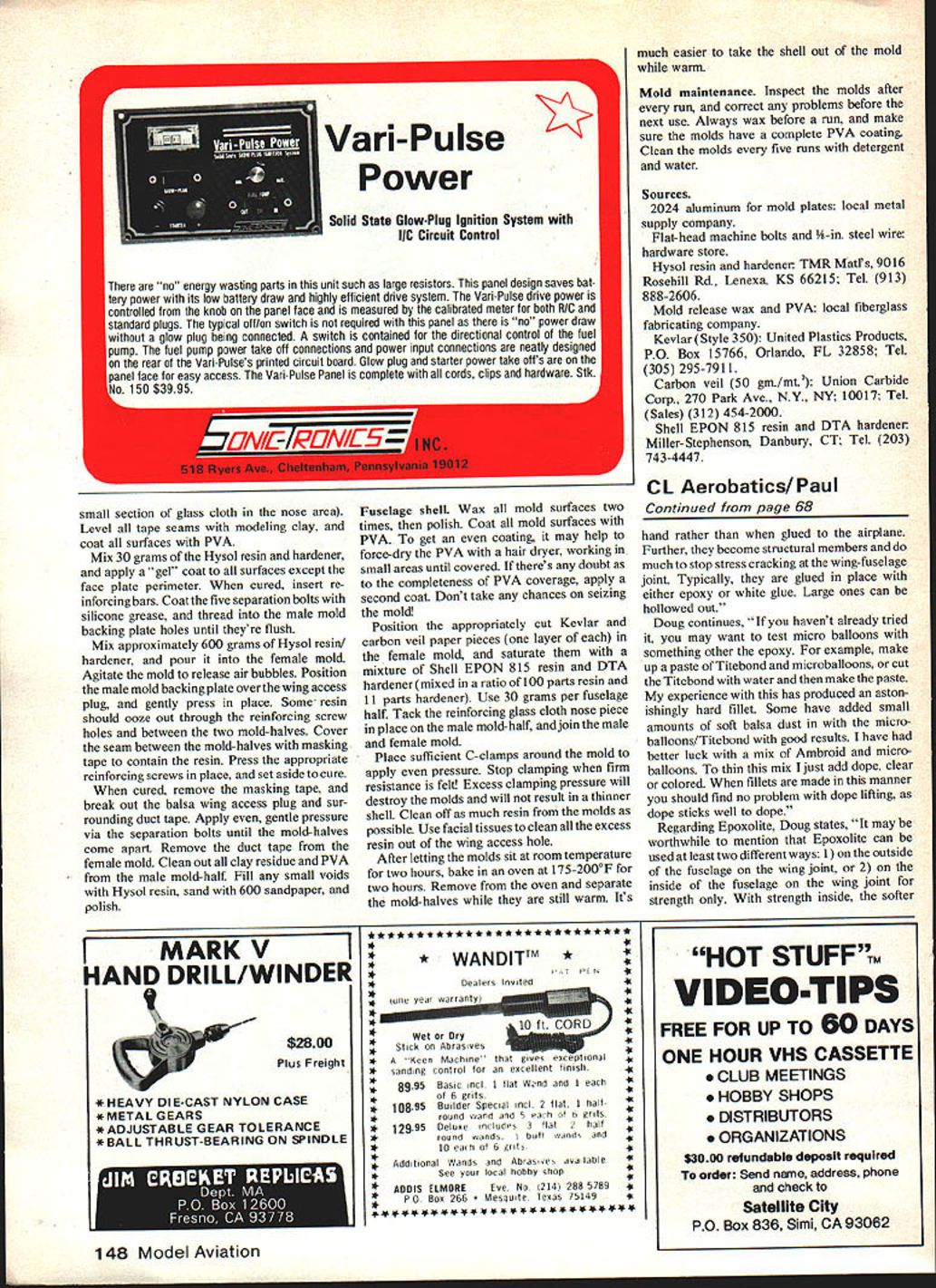
Biplane stunt still lives. Dr. Guy Markham of Lake Isabella, CA sent pictures and information about his Fokker Triplane built from a modified VK RC kit (based on 2 in. = 1 ft. scale). He is using a Veco .61 engine by Clarence Lee and a 10-oz. tank from Mike Mustain on the 47-in. span, 720-sq.-in. airplane. Although the plane does not have flaps, Guy feels it could be competitive in Stunt. He used a combination of Sig dope and plastic covering materials for the finish. He also said it will glide about three-fourths of the way around the circle when the engine cuts—a problem the writer experienced on a former biplane stunter now in seven pieces in the garage. Maybe we'll see this triplane in competition this summer.
Reprints and Historical Planes
The writer recently received several reprints of old Stunt articles from Lester Deily, 241-05 52nd Ave., Douglaston, NY 11362, to add to a growing collection of articles dating back to the early 1940s. Notable reprints include:
- Coon Dog — a biplane by Jack Macy (Madewell .49 engine). Appeared in Flying Models, October 1955. 44-in. span, no flaps, engine mounted upright.
- Bojo — a .29-powered biplane from Henry Nelson (Air Trails Annual, 1951).
- Stunt Trainer — a .15 diesel-powered profile by Dennis Schauer, 38-in. span (Model Airplane News, February 1956).
- The Profile — a well-proportioned profile from Charles A. Mackey (Flying Models, September 1959). The writer notes Mackey's consistently attractive designs, including Carousel, Bluebird, Hummingbird, Crusader, and Starlight (elliptical wing).
Lester is looking for more articles from the 1940s–'50s that are not yet on the list.
Contributors and Historical Notes
- Doug Dahlke has been helpful in finding old articles and occasionally sends reprints for the collection.
- John Miske (Mister Old-Time Stunt) has excellent references in the New Jersey–New York area.
- R. J. Tucker, 256 So. 102 E. Ave., Tulsa, OK 74128, creator of the Tucker 903 (Air Trails, September 1948) and the Tucker Special (American Modeler, April 1962), is looking through old Nationals pictures from the late 1950s and early 1960s for inclusion in the Stunt History Scrapbooks. R.J. is getting back into Stunt after a long layoff and will probably be at the Nationals this summer.
Fillets — Comments from Doug Dahlke
Doug sent comments on the use and misuse of fillets and described several methods he has used recently.
Carved wooden fillets:
- Trace the top half of the airfoil.
- Trace this pattern on a piece of wood.
- Move the pattern downward as far as the wood thickness allows.
- Cut out from the sheet and carve to shape.
- Carved wooden fillets are lighter and easier to sand when held in the hand before gluing. They become structural members that help stop stress cracking at the wing-fuselage joint.
- Typically glued in place with either epoxy or white glue. Large ones can be hollowed out for weight savings.
Microballoons with adhesives:
- Try mixing microballoons with adhesives other than epoxy, for example:
- Make a paste of Titebond and microballoons.
- Thin the Titebond with water and then mix in microballoons.
- Doug reports this produces an astonishingly hard fillet. Some add small amounts of soft balsa dust to the microballoons/Titebond mix with good results.
- He has also had good results with a mix of Ambroid and microballoons. To thin this mix he adds red dye (clear or colored can also work). Fillets made this way adhere well to dope, avoiding dope lifting.
Epoxolite usage:
- On the outside of the fuselage at the wing joint — sands well and leaves a hard shell that should be primed with epoxy primer before painting.
- On the inside of the fuselage at the wing joint — used for strength only; the softer outside fillet will compress while the outer skin takes the finish and the dope.
- Dope/microballoons can be used on the outside for easier sanding and finishing.
- Maximum strength comes from using Epoxolite both inside and outside, but that also yields maximum weight.
- A practical Epoxolite shaping tool is a small light bulb (flashlight bulb up to larger sizes). Advantages: easy to clean, replaceable, uniform. For larger fillets use a larger bulb. For a handle, glue the screw-end into a scrap balsa stick.
Handle-Making Requests
Several readers requested information on making a control-line handle, especially one similar to the Bob Baron–Gene Martine fully-adjustable type. With the E-Z Just handle now off the market, stunt fliers are looking for a handle that has the same "feel" but is more adjustable. The writer requests comments or success stories from those who have built their own handles and plans to run a column on handle-making in the near future.
Contact
For further information on Precision Aerobatics or PAMPA, contact: Wynn Paul 1640 Maywick Dr. Lexington, KY 40504
Transcribed from original scans by AI. Minor OCR errors may remain.

