
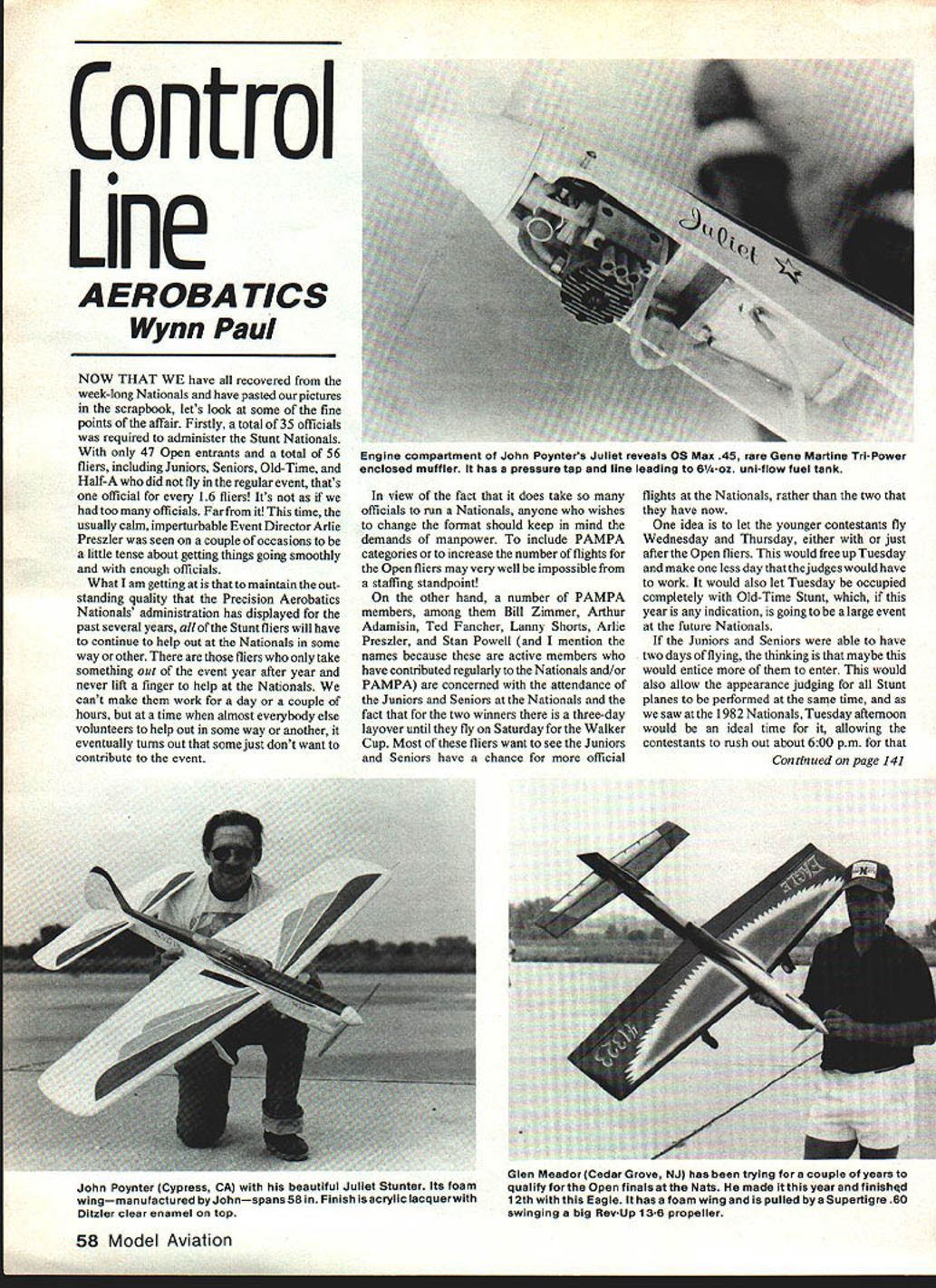
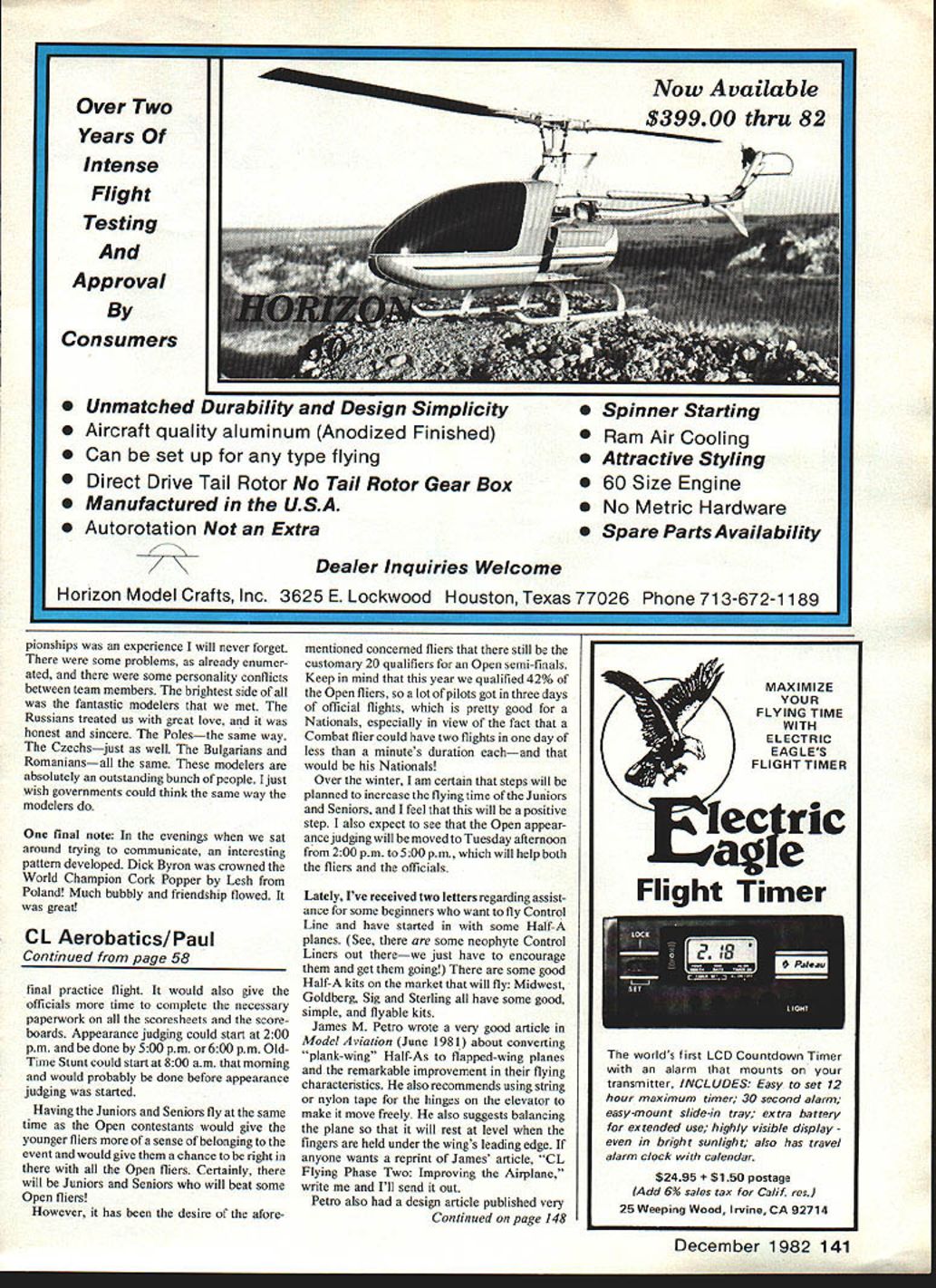
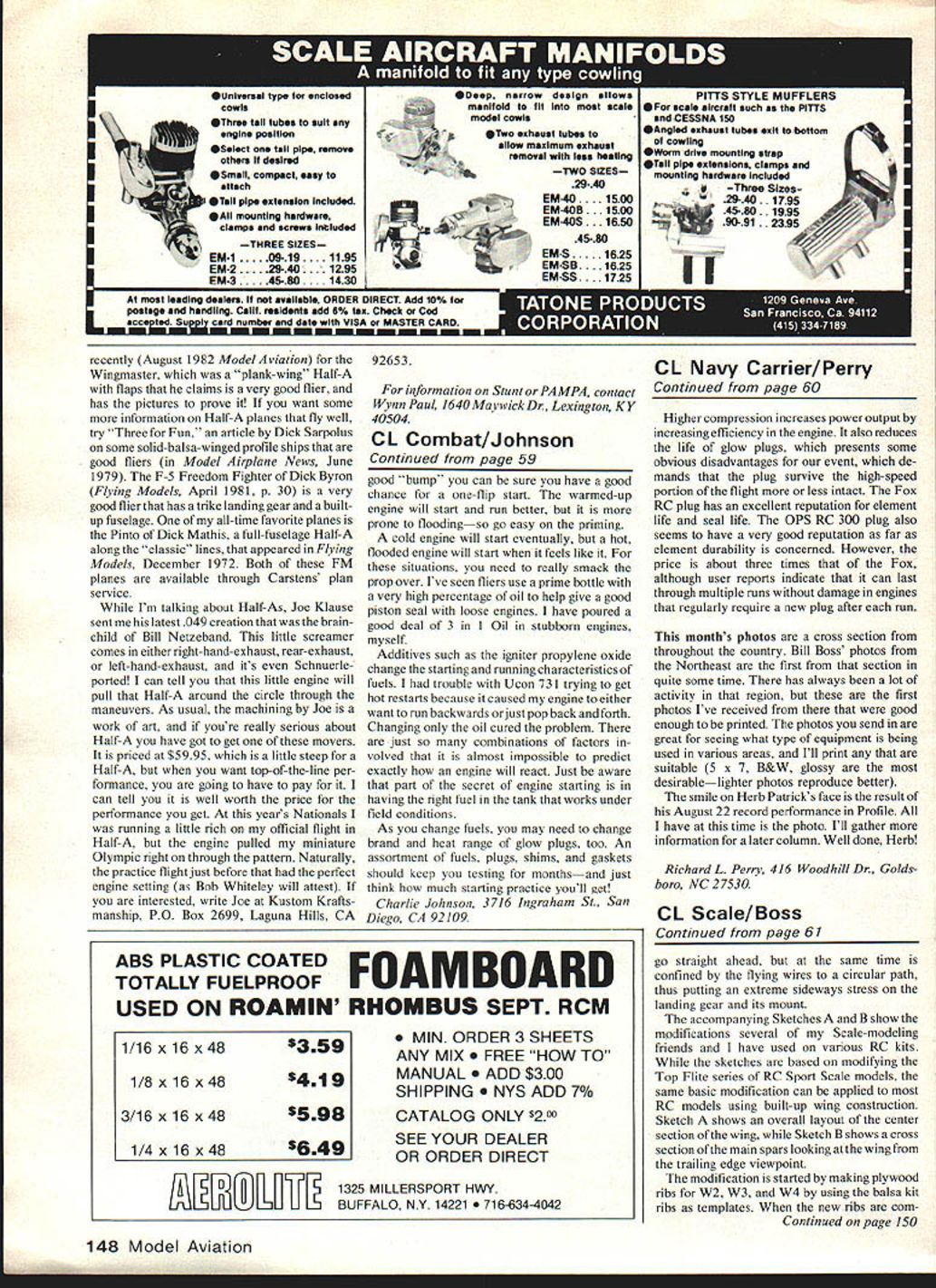
Control Line: AEROBATICS
Wynn Paul
NOW THAT we have all recovered from the week-long Nationals and have pasted our pictures in the scrapbook, let's look at some of the fine points of the affair. Firstly, a total of 35 officials was required to administer the Stunt Nationals. With only 47 Open entrants and a total of 56 fliers, including Juniors, Seniors, Old-Time, and Half-A who did not fly in the regular event, that's one official for every 1.6 fliers! It's not as if we had too many officials. Far from it! This time, the usually calm, imperturbable Event Director Arlie Preszler was seen on a couple of occasions to be a little tense about getting things going smoothly and with enough officials.
What I am getting at is that to maintain the outstanding quality that the Precision Aerobatics Nationals' administration has displayed for the past several years, all of the Stunt fliers will have to continue to help out at the Nationals in some way or other. There are those fliers who only take something out of the event year after year and never lift a finger to help at the Nationals. We can't make them work for a day or a couple of hours, but at a time when almost everybody else volunteers to help out in some way or another, it eventually turns out that some just don't want to contribute to the event.
In view of the fact that it does take so many officials to run a Nationals, anyone who wishes to change the format should keep in mind the demands of manpower. To include PAMPA categories or to increase the number of flights for the Open fliers may very well be impossible from a staffing standpoint!
Attendance of Juniors and Seniors
A number of PAMPA members—among them Bill Zimmer, Arthur Adamisin, Ted Fancher, Lanny Shorts, Arlie Preszler, and Stan Powell (I mention the names because these are active members who have contributed regularly to the Nationals and/or PAMPA)—are concerned with the attendance of the Juniors and Seniors at the Nationals and the fact that for the two winners there is a three-day layover until they fly on Saturday for the Walker Cup. Most of these fliers want to see the Juniors and Seniors have a chance for more official flights at the Nationals, rather than the two that they have now.
One idea is to let the younger contestants fly Wednesday and Thursday, either with or just after the Open fliers. This would free up Tuesday and make one less day that the judges would have to work. It would also let Tuesday be occupied completely with Old-Time Stunt, which, if this year is any indication, is likely to be a large event at future Nationals.
If the Juniors and Seniors were able to have two days of flying, the thinking is that maybe this would entice more of them to enter. This would also allow the appearance judging for all Stunt planes to be performed at the same time. As we saw at the 1982 Nationals, Tuesday afternoon would be an ideal time for appearance judging—starting about 2:00 p.m. and finishing by 5:00 p.m.—allowing the contestants a final practice flight around 6:00 p.m. It would also give officials time to complete the necessary paperwork, scoresheets, and scoreboards. Old-Time Stunt could start at 8:00 a.m. that morning and would probably be done before appearance judging started.
Having the Juniors and Seniors fly at the same time as the Open contestants would give the younger fliers more of a sense of belonging to the event and would give them a chance to be right in there with all the Open fliers. Certainly, there will be Juniors and Seniors who will beat some Open fliers!
However, the concerned fliers still want to keep the customary 20 qualifiers for an Open semi-finals. Keep in mind that this year we qualified 42% of the Open fliers, so a lot of pilots got in three days of official flights, which is pretty good for a Nationals—especially in view of the fact that a Combat flier could have two flights in one day of less than a minute's duration each, and that would be his Nationals!
Over the winter, I am certain that steps will be planned to increase the flying time of the Juniors and Seniors, and I feel that this will be a positive step. I also expect to see the Open appearance judging moved to Tuesday afternoon from 2:00 p.m. to 5:00 p.m., which will help both the fliers and the officials.
Half-A and Beginners
Lately I've received two letters regarding assistance for some beginners who want to fly Control Line and have started in with some Half-A planes. (See — there are some neophyte Control Liners out there—we just have to encourage them and get them going!) There are some good Half-A kits on the market that will fly:
- Midwest
- Goldberg
- Sig
- Sterling
James M. Petro wrote a very good article in Model Aviation (June 1981) about converting "plank-wing" Halfs to flapped-wing planes and the remarkable improvement in their flying characteristics. He also recommends using nylon tape for the hinges on the elevator to make it move freely. He suggests balancing the plane so that it will rest level when the fingers are held under the wing's leading edge. I wrote about some of James' article, "CL Flying Phase Two: Improving the Airplane," and I'll send it out.
Petro also had a design article published very recently (August 1982 Model Aviation) for the Wingmaster, which was a "plank-wing" Half-A with flaps that he claims is a very good flier, and has the pictures to prove it!
If you want more information on Half-A planes that fly well, try:
- "Three for Fun," an article by Dick Scarpole on some solid-balsa-winged profile ships that are good fliers (Model Airplane News, June 1979).
- The F-5 Freedom Fighter by Dick Byron (Flying Models, April 1981, p. 30) — a very good flier with trike landing gear and a built-up fuselage.
- The Pinto by Dick Mathis, a full-fuselage Half-A along the "classic" lines (Flying Models, December 1972).
Both of the Flying Models planes above are available through Carstens' plan service.
Engines and Hardware
While I'm talking about Half-As, Joe Kausse sent me his latest .049 creation that was the brainchild of Bill Nerzenbach. This little screamer comes in either right-hand-exhaust, rear-exhaust, or left-hand-exhaust, and it's even Schnuerle-ported! I can tell you that this little engine will pull that Half-A around the circle through the maneuvers. As usual, the machining by Joe is a work of art, and if you're really serious about Half-A you have got to get one of these movers.
It is priced at $59.95, which is a little steep for a Half-A, but when you want top-of-the-line performance, you are going to have to pay for it. I can tell you it is well worth the price for the performance you get. At this year's Nationals I was running a little rich on my official flight in Half-A, but the engine pulled my miniature Olympic right on through the pattern. Naturally, the practice flight just before that had the perfect engine setting (as Bob Whiteley will attest). If you are interested, write Joe at:
Kustom Kraftsmanship P.O. Box 2699 Laguna Hills, CA 92653
For information on Stunt or PAMPA, contact:
Wynn Paul 1640 Maywick Dr. Lexington, KY 40504
Transcribed from original scans by AI. Minor OCR errors may remain.

