
Control Line: Aerobatics
Wynn Paul
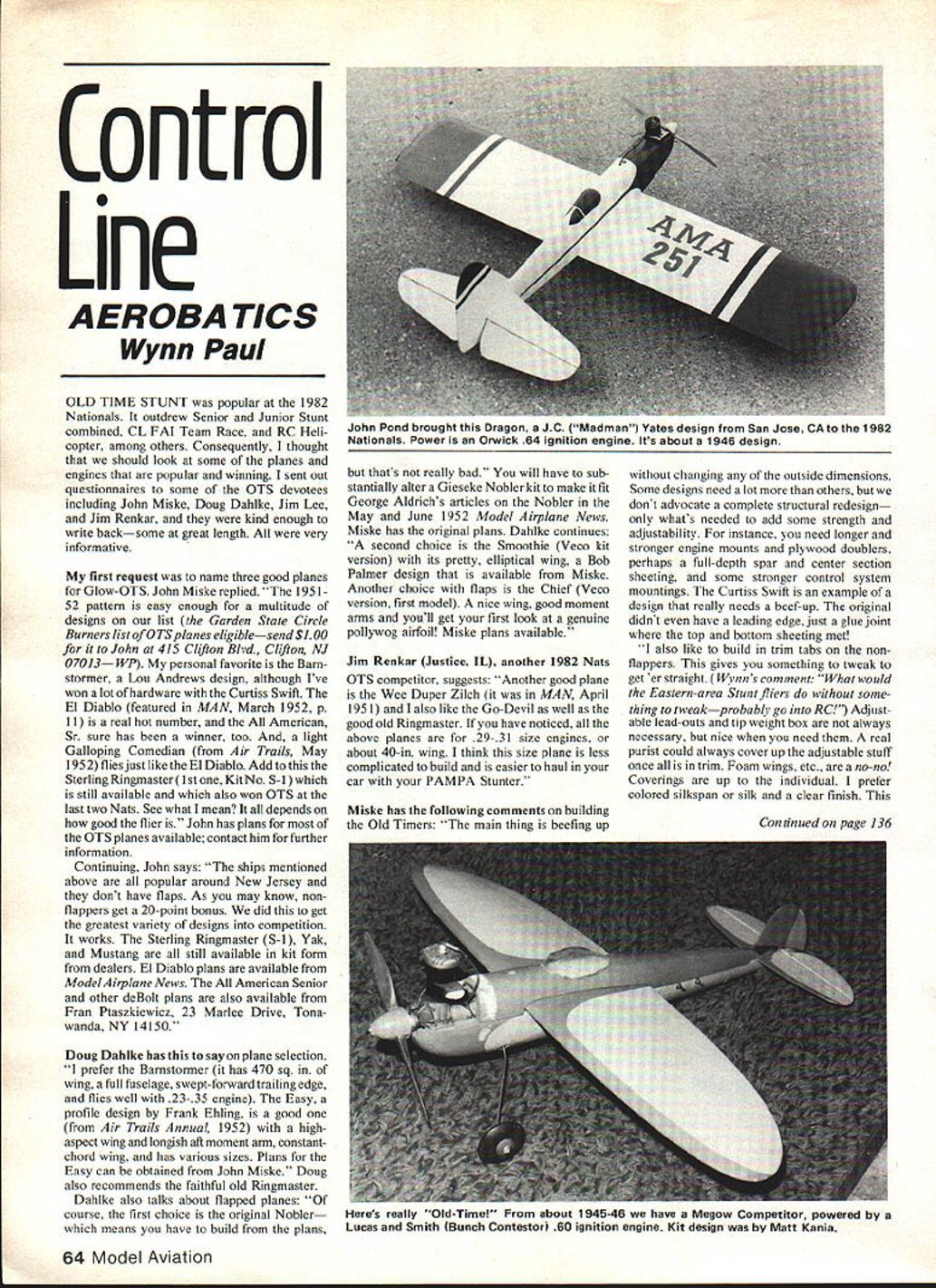
Old Time Stunt was popular at the 1982 Nationals. It outdrew Senior and Junior Stunt combined, CL FAI Team Race, and RC Helicopter, among others. Consequently, I thought that we should look at some of the planes and engines that are popular and winning. I sent out questionnaires to some of the OTS devotees including John Miske, Doug Dahlke, Jim Lee, and Jim Renkar, and they were kind enough to write back—some at great length. All were very informative.
Plane recommendations
John Miske (comments and planes available)
- "The 1951-52 pattern is easy enough for a multitude of designs on our list (the Garden State Circle Burners list of OTS planes eligible—send $1.00 for it to John at 415 Clifton Blvd., Clifton, NJ 07013)."
- Personal favorites: the Barnstormer (a Lou Andrews design) and the Curtiss Swift.
- Other good designs: El Diablo (Model Airplane News, March 1952), All American, Sr., a light Galloping Comedian (Air Trails, May 1952), and the Sterling Ringmaster (Kit No. S-1) which won OTS at the last two Nats.
- Notes: Many of the popular ships around New Jersey don't have flaps. Non-flappers get a 20-point bonus to encourage variety. The Sterling Ringmaster (S-1), Yak, and Mustang are still available in kit form; El Diablo plans from Model Airplane News; All American Senior and other deBolt plans from Fran Ptaszkiewicz, 23 Marlee Drive, Tonawanda, NY 14150. John has plans for most OTS planes available—contact him for further information.
Doug Dahlke
- Prefers the Barnstormer (470 sq. in. wing, full fuselage, swept-forward trailing edge, flies well with .23-.35 engine).
- Recommends the Easy (profile design by Frank Ehling, Air Trails Annual 1952) — high-aspect wing, longish moment arm, constant-chord wing, various sizes. Plans obtainable from John Miske.
- Also recommends the Ringmaster.
Flapped planes (Dahlke)
- First choice: the original Nobler (build from plans; Gieseke Nobler kits require substantial alteration to fit George Aldrich's articles in Model Airplane News, May and June 1952). Miske has the original plans.
- Second choice: the Smoothie (Veco kit version), elliptical wing by Bob Palmer; available from Miske.
- Another flapped choice: the Chief (Veco version, first model) — nice wing, good moment arms; Miske plans available.
Jim Renkar (Justice, IL)
- Suggestions: Wee Duper Zilch (Model Airplane News, April 1951), Go-Devil, and the Ringmaster.
- Notes: Most of these planes are for .29-.31 size engines, or about 40-in. wing. He finds this size less complicated to build and easier to haul with a PAMPA Stunter.
Building and strengthening Old Timers
John Miske on building Old Timers
- Main goal: beef up Old Timers without changing outside dimensions.
- Recommendations: longer and stronger engine mounts with plywood doublers, perhaps a full-depth spar and center-section sheeting, and stronger control system mountings. The Curtiss Swift is cited as needing significant beef-up—the original lacked a proper leading edge.
- Add trim tabs on non-flappers to permit fine adjustments. Adjustable lead-outs and tip-weight boxes are useful but not always necessary; a purist could cover adjustable hardware once trimmed. Foam wings are not acceptable. Preferred coverings: colored silkspan or silk with a clear finish.
Coverings
- The coverings look more like the original. A few have used iron-ons, but most leave that to the RC O-T.
Other vintage models
- Many older designs fly great but haven't been built for OTS events: profile Trixters, Hotter 'n' That (Model Airplane News, April 1952), the 1950 Internats winner (Air Trails, January 1951), and others. Built right and flown well, they perform comparably.
Doug Dahlke — special building hints
- Since adding wood is legal to beef up the model, do things that prevent warps and promote solid engine mounting. Always use cap-sparring—don't build a PAMPA Stunter without it; do the same for any OT Stunter.
- Older wing designs often used solid leading and trailing edges that tend to warp. With cyanoacrylate-type glues this is less of a problem. A simple trick: ZAP a 1/16-in. square strip on each side of the 1/16-in. rib, both top and bottom, giving a 3/16-in. wide cap spar on the rib. Butt strips snugly against the leading and trailing edges.
- When building the Ringmaster, remove the toy-like engine mounts, install new ones that extend over the leading edge of the wing, and avoid the lightweight originals.
- Another wing beef-up: convert to a four-spar setup. At roughly the 30% and 60% chord lines (both top and bottom) notch the top of each rib just enough to insert 1/8-in. square spars—small weight penalty, much greater wing resistance.
- Build a very light tail. Old Timers often have short moment arms; tail-heavy models perform poorly. A very light inboard wing helps; Dahlke's Barnstormer flies with only three grams of tip weight.
Jim Lee (1982 Nats OTS ignition winner)
- Pay special attention to the stabilizer to ensure adequate thickness, strength, and rigidity without changing flight characteristics. Many Old-Timers used 1/8-in. stock for stabilizer/elevator; Lee used 3/16-in. on his El Diablo per John Miske's suggestion, and added stiffeners in the large wingtips. He soaked parts of the tips and elevator with Jet to add rigidity.
Jim Renkar on building
- Extend the short engine mounts back to the wing and add plywood doublers.
- Add plywood doublers to the butt joints of the spar, leading, and trailing edges for strength.
- Note: event organizers don't want to chase people away, so sometimes illegal plan changes are tolerated—moving the leadout location is a common infraction and definitely alters the airplane's handling. Some fliers have adjustable lead-outs.
Next month we'll take up engines and ignition planes for the Old Time event.
For information on PAMPA or Stunt, contact Wynn Paul, 1640 Maywick Dr., Lexington, KY 40504.
Transcribed from original scans by AI. Minor OCR errors may remain.

