
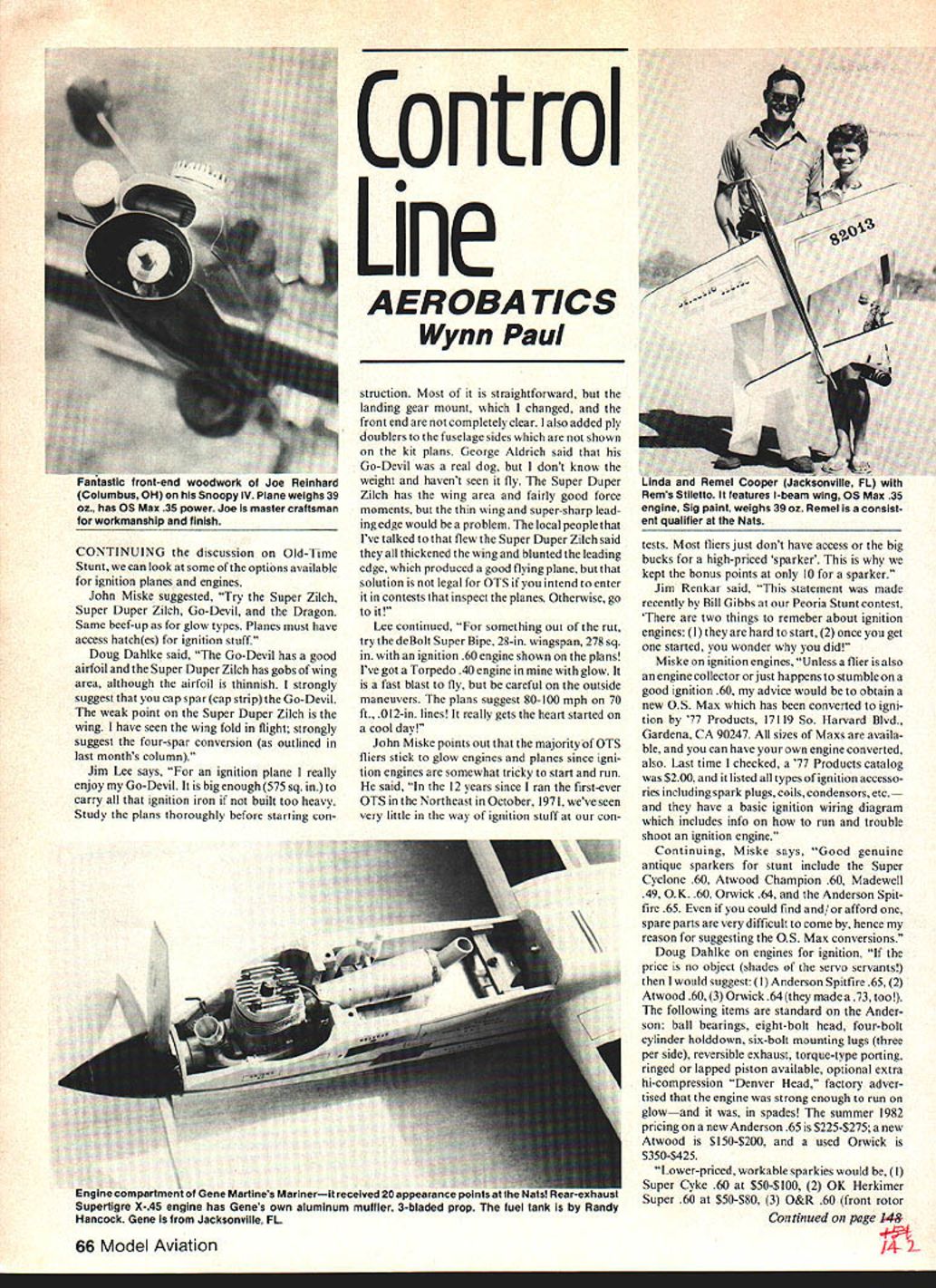
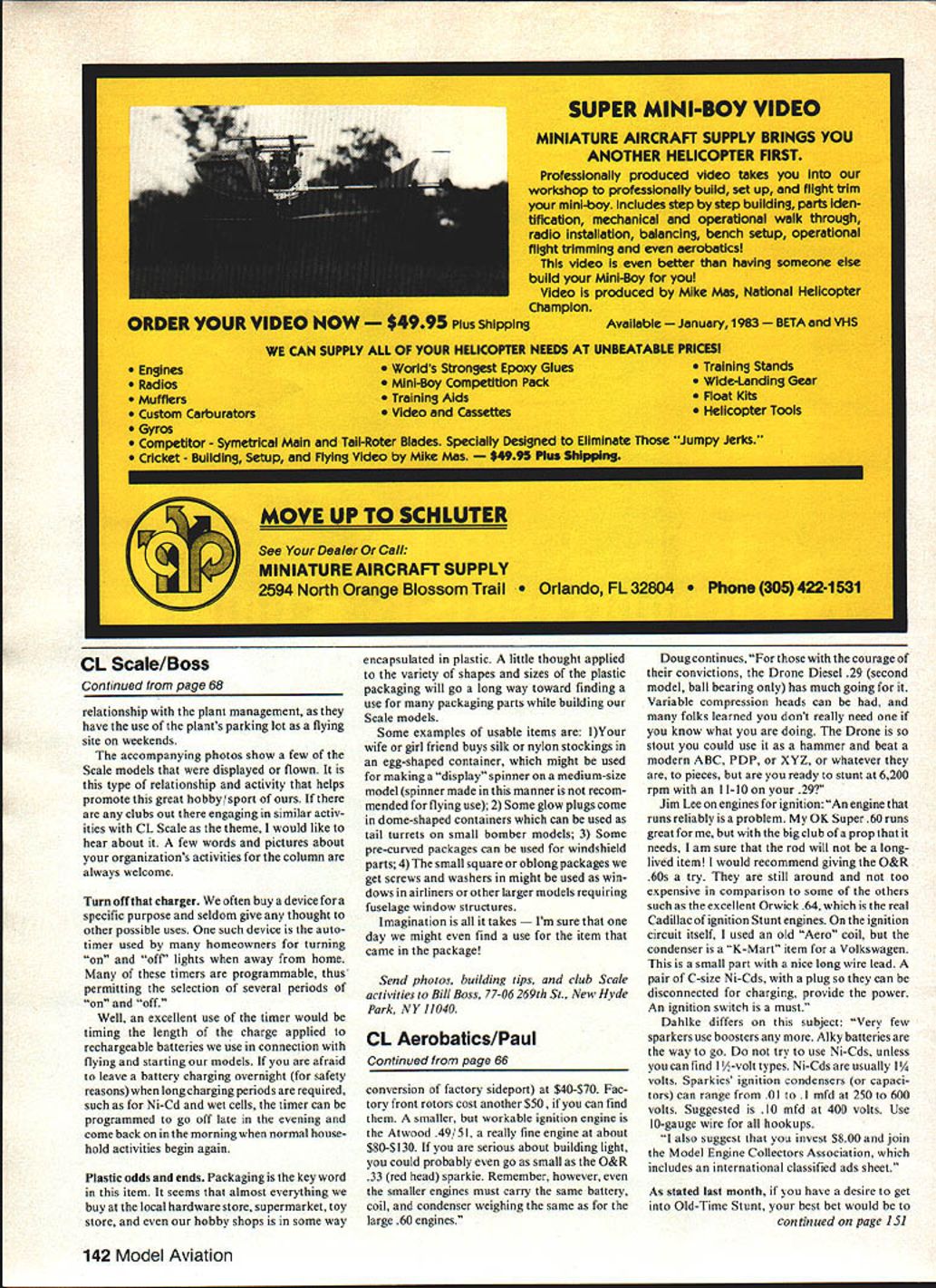
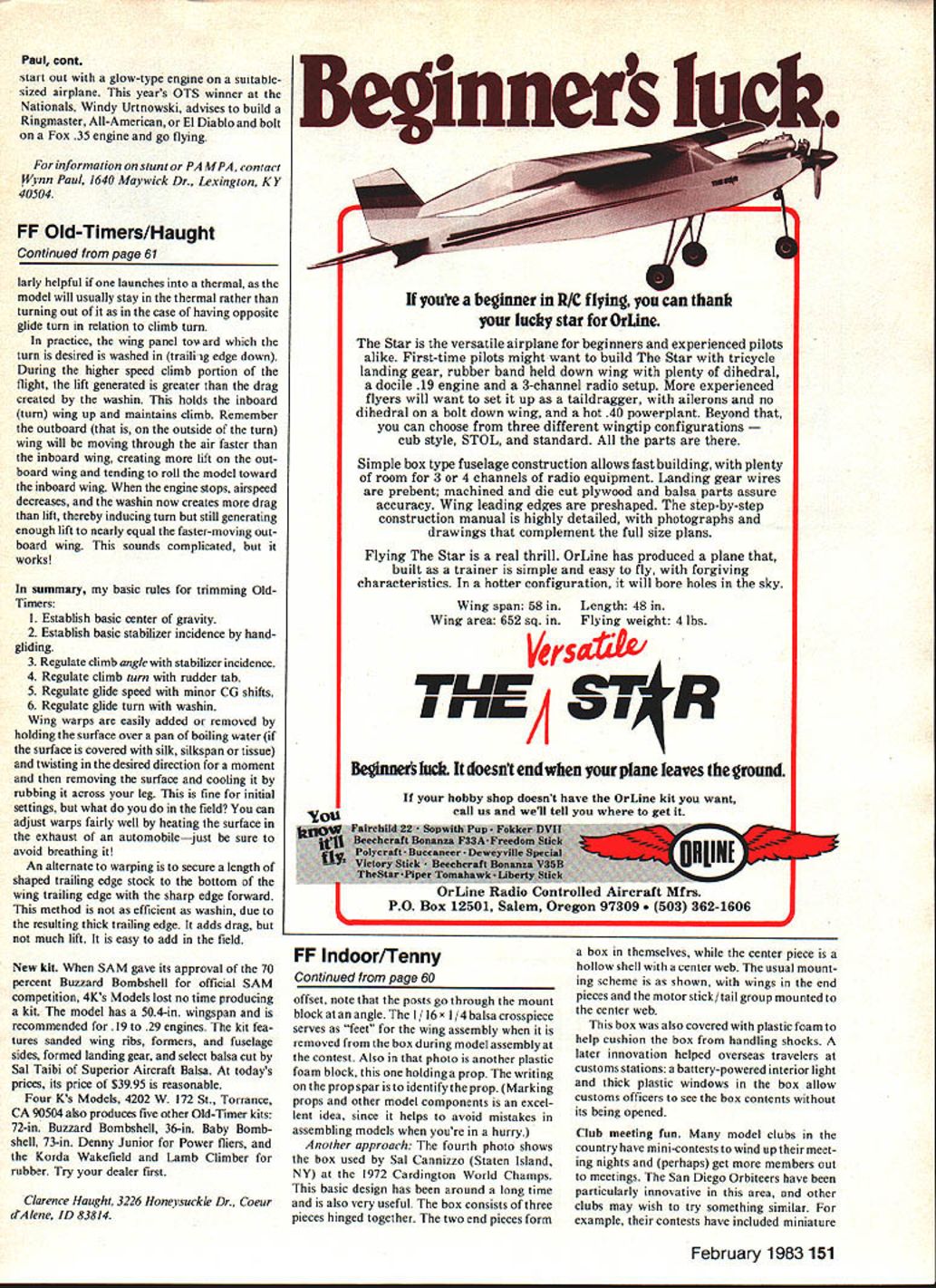
Control Line: Aerobatics
Wynn Paul
Planes and airframes
John Miske suggested trying the Super Zilch, Super Duper Zilch, Go-Devil, and the Dragon for ignition-equipped stunt planes. He emphasized the need for planes to have access hatch(es) for ignition components.
Doug Dahlke commented:
- The Go-Devil has a good airfoil; the Super Duper Zilch has lots of wing area but a thin airfoil.
- Cap-spar (cap strip) the Go-Devil to strengthen it.
- The weak point on the Super Duper Zilch is the wing; he strongly suggests the four-spar conversion (as outlined in last month’s column) because he has seen the wing fold in flight.
Jim Lee:
- Enjoys his Go-Devil for ignition use. At 575 sq. in. it can carry ignition gear if not built too heavy.
- Advises studying the plans thoroughly; landing gear mount and front end are not completely clear on the plans.
- Added plywood doublers to the fuselage sides (not shown on kit plans).
- Reports that the Super Duper Zilch’s thin wing and sharp leading edge are problematic; some local fliers thickened the wing and blunted the leading edge to improve flight, but that modification may be illegal for Old-Time Stunt (OTS) contest inspection.
- Recommends, for something different, the deBolt Super Bipe (28 in. wingspan, 278 sq. in.) which on the plans shows an ignition .60. He has one with a Torpedo .40 glow and says it’s fast and exciting — be careful on outside maneuvers. The plans suggest 80–100 mph on 70 ft., .012-in. lines.
Ignition vs. glow — general observations
John Miske notes that most OTS fliers stick to glow engines and planes since ignition engines are tricky to start and run. In the 12 years since he ran the first-ever OTS in the Northeast (October 1971), he’s seen very little ignition equipment at contests. Many fliers lack access to, or the funds for, high-priced ignition engines—hence the OTS bonus for a “sparker” was kept at only 10 points.
Jim Renkar relays Bill Gibbs’ remark at the Peoria Stunt contest: “There are two things to remember about ignition engines: (1) they are hard to start, (2) once you get one started, you wonder why you did!”
Engine recommendations — ignition
John Miske recommends converting O.S. Max engines to ignition (via ’77 Products) as a practical alternative to hunting rare antiques. He also lists good genuine antique sparkers for stunt (though spare parts are hard to find):
- Super Cyclone .60
- Atwood Champion .60
- Madewell .49
- O.K. .60
- Orwick .64
- Anderson Spitfire .65
’77 Products (for O.S. Max conversions and ignition accessories): 17119 So. Harvard Blvd., Gardena, CA 90247. Their catalog (last checked) was $2.00 and includes spark plugs, coils, condensers, wiring diagrams, and troubleshooting tips.
Doug Dahlke — high-priced recommends:
- Anderson Spitfire .65
- Atwood .60
- Orwick .64 (they made a .73, too)
Notes on the Anderson:
- Ball bearings, eight-bolt head, four-bolt cylinder holddown.
- Six-bolt mounting lugs (three per side), reversible exhaust, torque-type porting.
- Ringed and lapped piston available; optional high-compression “Denver Head.”
- Factory claimed it could run on glow.
Typical summer 1982 pricing (for reference):
- Anderson .65: $225–$275
- New Atwood: $150–$200
- Used Orwick: $350–$425
Doug’s lower-priced workable sparkies:
- Super Cyclone .60: $50–$100
- OK Herkimer Super .60: $50–$80
- O&R .60 (front-rotor conversion of factory sideport): $40–$70
Other notes:
- A smaller workable ignition engine: Atwood .49/.51 at about $80–$130.
- If building very light, you might consider the O&R .33 (red head) sparkie — remember the battery, coil, and condenser weigh the same regardless of engine size.
- Drone Diesel .29 (second model, ball-bearing only) is stout; variable-compression heads available. It’s very durable but consider whether you’re ready for the stresses it can produce.
Jim Lee’s engine notes:
- Reliability is the key problem. His OK Super .60 runs great but requires a large prop, which may stress the rod.
- Recommends trying O&R .60s — still available and reasonably priced compared to Orwick .64 (the “Cadillac” of ignition stunt engines).
- On the ignition circuit he used an old “Aero” coil and a small condenser (he used a Volkswagen part from K-Mart) with a long lead wire.
- Power: a pair of C-size Ni-Cd batteries with a plug for charging; an ignition switch is a must.
Ignition components and wiring
Doug Dahlke’s advice:
- Very few sparkers use boosters now. Use alkaline batteries rather than Ni-Cd unless you can find 1-1/2 volt Ni-Cd types (Ni-Cds are often about 1-1/4 volts).
- Sparker ignition condensers (capacitors) can range from 0.01 to 0.1 µF at 250 to 600 volts. He suggests 0.10 µF at 400 volts.
- Use 18-gauge wire for all hookups.
- Invest about $8.00 to join the Model Engine Collectors Association for international classified ads and resources.
Tips for beginners
- If starting out, use a glow-type engine on a suitably sized airplane.
- This year’s OTS winner at the Nationals, Windy Urtnowski, advises building a Ringmaster, All-American, or El Diablo and bolting on a Fox .35 engine to get flying.
Contact
For information on stunt or PAMPA, contact: Wynn Paul 1640 Maywick Dr. Lexington, KY 40504
Transcribed from original scans by AI. Minor OCR errors may remain.

