
Control Line AEROBATICS
Wynn Paul
HOW LIGHT is light? How good is light? All Stunt freaks talk about building that "all-time light plane that will win the Nationals," but what happens when you finally get that "super-light airplane?" This month we look at the plane that belongs to Larry Robertson (Louisville, KY). Larry has been flying Stunt since the early Sixties and usually finishes high in the standings on the Midwest contest circuit. He has just missed qualifying a couple of times at the Nationals. He is a good builder, and anyone who knows Larry will attest that he is a serious Stunt flier who knows how to build and fly.
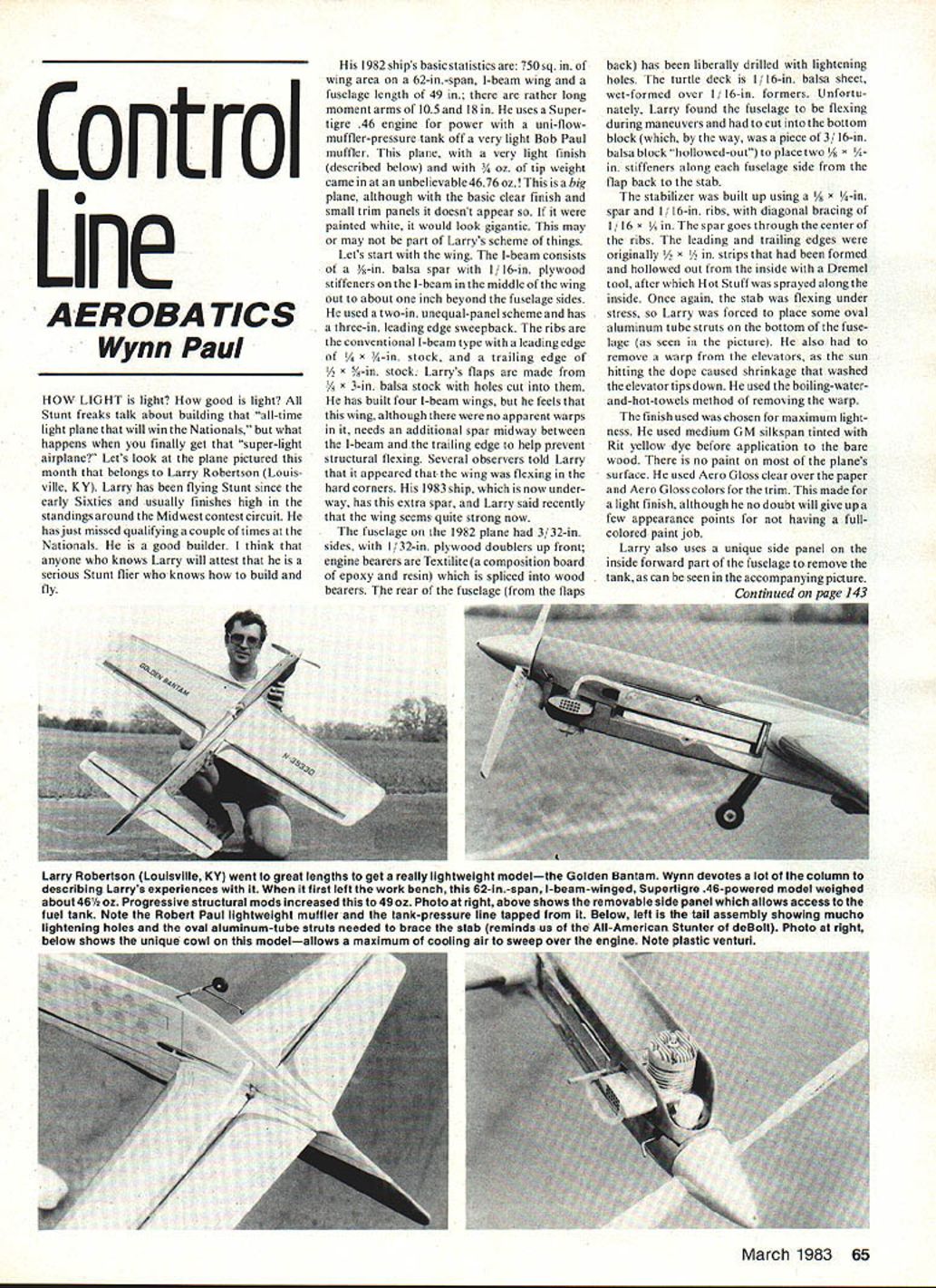
His 1982 ship's basic statistics are: 750 sq. in. of wing area on a 62-in. span, I-beam wing and a fuselage length of 49 in.; moment arms of 10.5 and 18 in. He uses a Supertigre .46 engine with a uni-flow muffler — pressure tank off a very light Bob Paul muffler. This plane, with a very light finish (described below) and with 3/4 oz. of tip weight, came in at an unbelievable 46.76 oz.! This is a big plane, although with the basic clear finish and small trim panels it doesn't appear so. If it were painted white, it would look gigantic. This may or may not be part of Larry's scheme of things.
Wing
The I-beam consists of a 5/8-in. balsa spar with 1/16-in. plywood stiffeners on the I-beam in the middle of the wing out to about one inch beyond the fuselage sides. He used an unequal two-panel scheme and has a three-inch leading-edge sweepback. The ribs are the conventional I-beam type with a leading edge of 1/4 x 1/4-in. stock, and a trailing edge of 1/4 x 3/16-in. stock. Larry's flaps are made from 3/8 x 3-in. balsa stock with holes cut into them.
He has built four I-beam wings, but he feels that this wing, although there were no apparent warps in it, needs an additional spar midway between the I-beam and the trailing edge to help prevent structural flexing. Several observers told Larry that it appeared the wing was flexing in the hard corners. His 1983 ship, now under way, has this extra spar, and Larry said recently that the wing seems quite strong now.
Fuselage
The 1982 fuselage had 3/32-in. sides, with 1/32-in. plywood doublers up front. Engine bearers are Textilite (a composition board of epoxy and resin) which is spliced into wood bearers. The rear of the fuselage (from the flaps back) has been liberally drilled with lightening holes. The turtle deck is 1/16-in. balsa sheet, wet-formed over 1/16-in. formers.
Larry found the fuselage flexed during maneuvers and had to cut into the bottom block (a piece of 3/16-in. balsa block hollowed out) to place two 1/8-in. stiffeners along each fuselage side from the flap back to the stabilizer.
Stabilizer
The stabilizer was built up using a 1/8 x 1/4-in. spar and 1/16-in. ribs, with diagonal bracing of 1/16 x 1/8-in. The spar goes through the center of the ribs. The leading and trailing edges were originally 1/4 x 1/8-in. strips that had been formed and hollowed out from the inside with a Dremel tool, after which Hot Stuff was sprayed along the inside.
The stabilizer was flexing under stress, so Larry placed some oval aluminum tube struts on the bottom of the fuselage. He also had to remove a warp from the elevators after sun and dope shrinkage washed the elevator tips down; he used the boiling-water-and-hot-towels method to remove the warp.
Finish
The finish was chosen for maximum lightness. He used medium GM silkspan tinted with Rit yellow dye before application to the bare wood. There is no paint on most of the plane's surface. He used Aero Gloss clear over the paper and Aero Gloss colors for the trim. This made for a light finish, although he will no doubt give up a few appearance points for not having a full-colored paint job.
Larry also uses a unique side panel on the inside forward part of the fuselage to remove the tank.
Photo credit
CL Aerobatics / Paul
Repairs and performance
He experienced some cracking around the nose, and the fuselage sides started to come loose right at the rear of the engine-mounting holes. Epoxy was used to glue the fuselage sides, doublers, and plywood bulkheads together, but the combination of fuel and vibration is taking its toll.
After some repairs to the outboard wing (which broke in half after some hard landings — the leading and trailing edges were fractured and the whole wing folded) and after stiffening the fuselage, stabilizer, etc., the plane now weighs in at a whopping 49 oz.
As Larry admits, he went all out to get a super-light plane, but there are inherent difficulties when very light construction is attempted. He spent a lot of time in the summer of 1982 repairing his plane when he could have been out practicing the pattern. It was difficult to trim the airplane because of wing flex, stabilizer flex, and fuselage flex.
Wing loading and conclusions
Keep in mind that the wing loading of this airplane is right at 10.85 oz./sq. ft., compared with the "typical" Genesis or Bob Hunt at about 12.35 oz./sq. ft. and the "typical" Geisselche Noble at about 11.20 oz./sq. ft. The Supertigre is able to pull this airplane with relative ease. However, Larry admits that maybe he went too far in striving for the light airplane. The stresses and strains of an airplane performing the Stunt pattern just may be too much for an airplane such as his Golden Bantam.
Larry feels that the new 1983 plane with the added wing spar, 1/8-in. fuselage sides, and stiffer stabilizer construction will not have as many problems. At the time of this writing his 1983 airplane was about 5 oz. heavier than the 1982 plane. He intends to use the same type of finish, so he could come out with a 750-sq.-in. airplane that weighs about 54–55 oz., and this would still be competitive. He also has built in six mounting holes for the engines so that he can interchange the Supertigre with the OS Max .45 and not have an unsightly gap at the nose ring.
We'll see how Larry's new plane works in the summer of 1983.
Contact
For information on Supertigre or PAMPA contact Wynn Paul, 1640 Maywick Dr., Lexington, KY 40504.
Transcribed from original scans by AI. Minor OCR errors may remain.

