
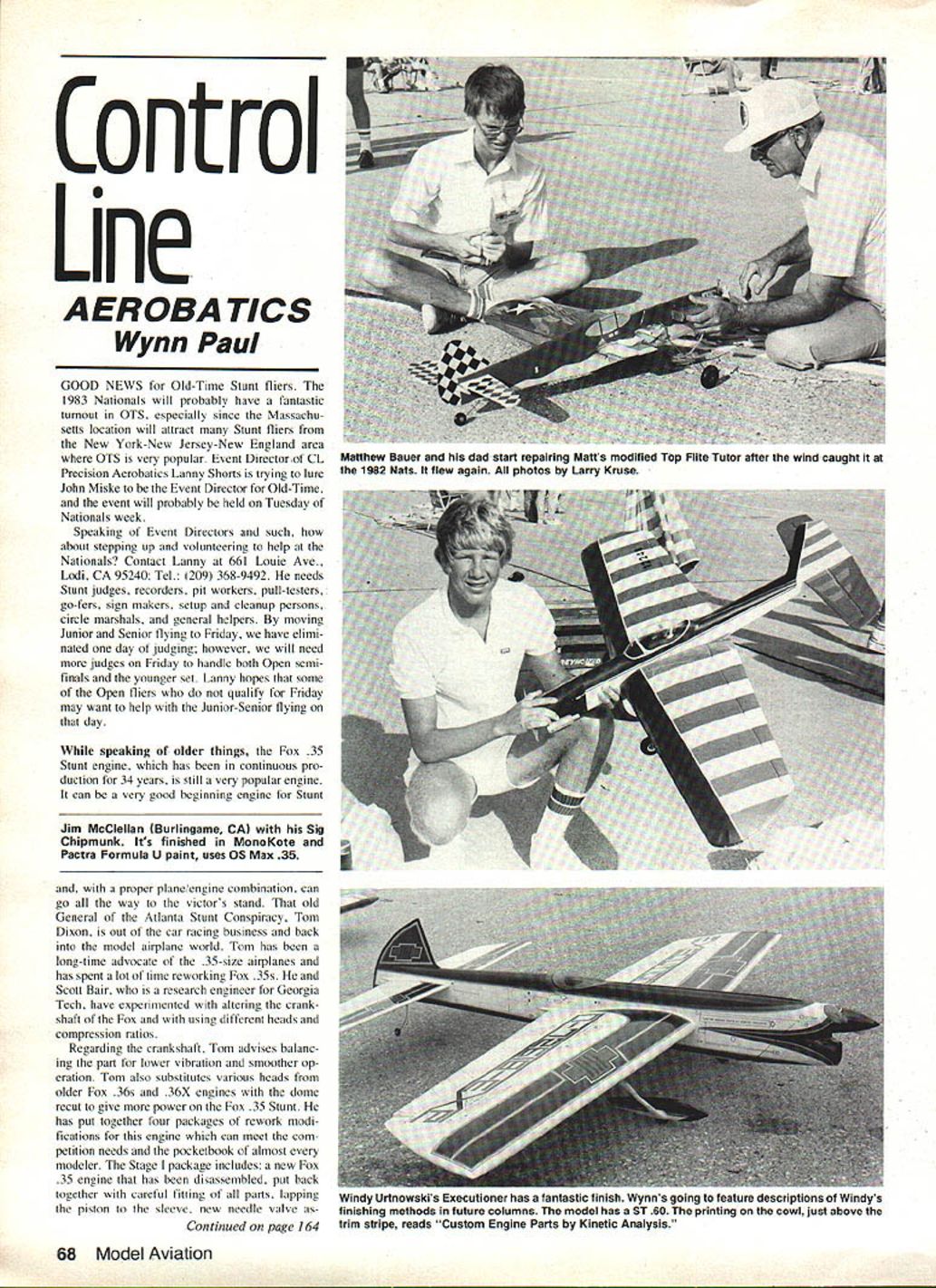
Control Line: Aerobatics
By Wynn Paul
Nationals and Volunteers
Good news for old-time stunt fliers: the 1983 Nationals will probably have a fantastic turnout in OTS, especially since the Massachusetts location will attract many stunt fliers from the New York–New Jersey–New England area where OTS is very popular. Event Director of CL Precision Aerobatics Lanny Shorts is trying to lure John Miske to be the Event Director for Old-Time, and the event will probably be held on Tuesday of Nationals week.
Speaking of event directors and such, please step up and volunteer to help at the Nationals. Contact Lanny at:
- Lanny Shorts, 661 Louie Ave., Lodi, CA 95240
- Tel.: (209) 368-9492
He needs:
- Stunt judges
- Recorders
- Pit workers
- Pull-testers
- Go-fers
- Sign makers
- Setup and cleanup persons
- Circle marshals
- General helpers
By moving Junior and Senior flying to Friday, one day of judging has been eliminated; however, more judges will be needed on Friday to handle both Open semifinals and the younger set. Lanny hopes that some Open fliers who do not qualify for Friday may want to help with the Junior–Senior flying on that day.
Fox .35 Stunt Engine Rework Packages
The Fox .35 stunt engine has been in continuous production for 34 years and remains a popular beginning—and competitive—engine. Tom Dixon (Atlanta Stunt Conspiracy) has spent a lot of time reworking Fox .35s with Scott Bair (research engineer, Georgia Tech), experimenting with crankshaft alterations, different heads, and compression ratios. Tom advises balancing the crankshaft for lower vibration and smoother operation, and he substitutes various heads from older Fox .36 and .36X engines with the dome recut to give more power on the Fox .35 Stunt.
Tom offers four packages of rework modifications:
Stage I
- Includes: a new Fox .35 engine disassembled and reassembled with careful fitting of all parts; lapping the piston to the sleeve; new needle valve assembly; substitution of Allen-head screws for the head and backplate; modification to accept a Fox Stunt Special muffler with a strap connection that will not distort the crankcase.
- Price: $30 plus $2.50 shipping.
Stage II
- Includes everything in Stage I, plus a fully balanced crankshaft for lower vibration and smoother operation.
- Price: $35 plus $2.50 shipping.
Stage III
- Includes everything in Stages I and II, plus a high-compression cylinder head (approximately 9.5:1). May require cowl modifications if the head is enclosed.
- Price: $42 plus $2.50 shipping.
Stage IV
- Full competition package: new Fox .35 engine with all of the above modifications plus a reworked Fox Stunt Special muffler fitted with a special strap that will not distort the crankcase.
- Price: $52 plus $2.50 shipping.
Tom will also prepare a Stunt Special (Fox) muffler with a non-binding strap, a pressure fitting, and a baked-on finish (flat black or white) for $15 plus $2.50 postage.
If you want an engine of your own reworked, contact Tom for special considerations; some parts may need replacement.
Contact:
- Tom Dixon, Controline Sales, P.O. Box 27540, Contract Station #7, Atlanta, GA 30327
Other Engines for Stunt
There are more good engines available for stunt flying now than at many other times. Options include:
- Fox .35 (reliable classic)
- OS Max .35
- .40-size engines: OS Max .40 FSR, HP .40, Coro .40, K&B .40 (for a few)
- Larger favorites: ST .46, Max .45 FSR, growing interest in Super Tigre .60
- Others: Enya .45, Enya .49
- Experimental suggestion: HB .40 PDP (Bob Hunt reports it does not peak out at high rpm like some Max engines and might suit Stunt)
Plans Available from Tom Dixon
Tom Dixon also offers a large number of plans drawn from original plans or kit parts. Examples available include:
OTS:
- Barnstormer Mk I
- Smoothie (Veco kit)
- Mustang (Veco kit)
- Nobler (1952 version from MAN)
- El Diablo (Red Reinhardt)
Nostalgia Stunt (1953–1956):
- Chief (Veco)
- Thunderbird I (Veco)
- Thunderbird II (Veco)
- Nobler (Top Flite)
- Ares and Stuka (Ambroid)
- Cougar (Ken-Rob)
- Warhawk (Berkeley)
- Pow Wow (Palmer)
- Lark (Mackey)
- Jay-Dee Falcon (D'Ottavio)
- Phoenician (Sieverling)
- Fierce Arrow (Netzeband) — $12.00
- Ruffly (Lew McFarland)
- Zilch X (Jim Saftig)
- Oriental (Dee Rice)
- Ballerina (Lickliter)
- Tucker Special (Bob Tucker)
- PT-19 (David Hemstrought)
- Stephens Akro (Dixon)
- 1982 update of the Thunderbird for .35–.40 size engines
All plans are $7 plus $0.70 postage, except the Fierce Arrow ($12). Order from Tom Dixon at the address above. He will be adding plans in the future; contact him if you have a particular plane you'd like.
Foam Wing Shortage
There is currently a foam wing crisis:
- John Poynter has retired from the foam wing business due to health problems.
- Brett Buck (Richmond, KY) has temporarily stopped making wings because he cannot obtain foam.
- Bob Nicks (North Carolina), who specializes in combat wings, is trying to produce a stunt wing; news to follow.
The need for foam wings is great. Foam wings help both beginners and experts eliminate warps in the airfoil—the most common problem with built-up wings. Stunt needs someone who can produce a competitive, unstressed foam wing for about $20–$25.
Building, Finishing, and Flying (Twin Comanche notes)
Forming the windshield:
- Heat the windshield material over an electric stove (with gloved hands) until it becomes pliable enough to jam down over the balsa windshield form to make a good compound curve. It may take several tries to get an acceptable windshield, so be patient.
Finishing and detailing:
- Sand the entire airplane carefully.
- Make fillets with Sig Epoxolite or polyester resin and microballoons.
- Fill pits, dings, dents, and cracks between planking strips with a resin/microballoon mixture or a vinyl spackling compound (e.g., DAP).
- Apply a thin coat of Hobbypoxy Quick Prep Resin and let it cure. Scuff-sand the first coat, then apply a second thin coat.
- While the second coat is still wet, apply a heavy grade of silkspan or silk, pulling out all wrinkles. Cover all surfaces with silk or silkspan—use silk where extra strength is needed and silkspan on large flat surfaces.
- Tack down any edges that come unstuck and let the second coat of resin cure.
- Without sanding, brush on a third coat of resin, attempting to "flow" it smoothly. Wet-sand with 150–200 grit paper if necessary. Add a fourth coat of resin; a glassy sheen should appear.
- Wet-sand the last coat with 320 grit and spray on a light coat of primer.
Color coats:
- Jeff used automotive enamel and automotive primer as the base coat. If you use Hobbypoxy or K&B Super Poxy, use their respective primers for compatibility.
- Wet-sand primer with 400 grit and spray on the white base coat with multiple light applications for a good surface for trim color.
- If you use masking tape for trim lines, remove it carefully—underlying resin can let go of paint if tape is pulled off too hard or sharply.
- Rub out the final finish with a commercial rubbing compound and apply several coats of automotive wax for protection.
- Add windows, windshield, landing gear doors, and other trim bits. To prevent antennas from breaking off, Jeff molded them from silicone rubber and attached them to the fuselage. Side curtains for windows were made from folded paper towels. Logos were hand-painted; press-type letters from an art supply store spelled out "No Step" warnings.
Flying:
- If the plane has been built according to plans and instructions it will be very light and easy to manage in the air. Single-engine performance is marginal at best, so be certain both engines are synchronized as nearly as possible by ear before the first flight.
- Twin-engine airplanes have a crowd-pleasing appeal—the sonic effect of twins singing in unison around the circle is memorable. Good luck with your version of the Twin Comanche.
Reference Sources
- Francis, Devon. Mr. Piper and His Cubs. Iowa State University Press, Ames, IA, 1976, pp. 178, 179, 188, 194, 195, 202.
- Jane's All The World's Aircraft 1972–73. John R. Taylor, ed., McGraw-Hill Book Company, New York, NY, p. 406.
- Jane's All The World's Aircraft 1973–74. John R. Taylor, ed., McGraw-Hill Book Company, New York, NY, pp. 409–410.
- Jane's Encyclopedia of Aviation—Vol. 5. M. H. Taylor, ed., Grolier and Company, Danbury, CT, 1980, pp. 896, 898.
Contact
For information on Stunt or PAMPA:
- Wynn Paul, 1640 Maywick Dr., Lexington, KY 40504.
Transcribed from original scans by AI. Minor OCR errors may remain.

