
Control Line: Aerobatics
Wynn Paul
So, you want to build a stunt plane that has dihedral in the wing? That Spitfire or Bearcat you've always admired is just itching to jump off the drawing board onto your workbench. "But how do I set up the dihedral and the leadouts so that it doesn't fly crooked?" Let's take a look at the subject.
Contributors and building methods
Assisting in this article is Scott Bair of Atlanta, GA, a research engineer who, over the past four years, has built six stunt planes with dihedral in the wing. In addition to the use of dihedral in his planes, Scott uses unique building methods which include a Free Flight–like fuselage structure of longerons and 1/8-in. bulkheads covered with paper, which gives a strong yet featherweight finished result. In the future, we will see some of his masterful building projects that result in 46 oz. airplanes with 670 sq. in. of wing area.
Why use dihedral?
There are some impression points to be gained when your Mustang or P-47 has dihedral in the wing. Scott wrote, "The impression given by a model with dihedral is suggestive of a popular, full-size aircraft, particularly a fighter; in the inverted flight position, the fact that the airplane is upside-down is more pronounced. Secondly, the added propeller-to-ground clearance associated with a low-wing configuration without the need for extended landing gear struts just looks much better with some dihedral in the wing."
Al Rabe added by phone, "I think that dihedral in a 'classic' type of stunt ship, perhaps with more depth in the fuselage than the normal type, would be a very interesting and effective departure that would look very good in the air."
Aerodynamic effects of dihedral on stunt planes
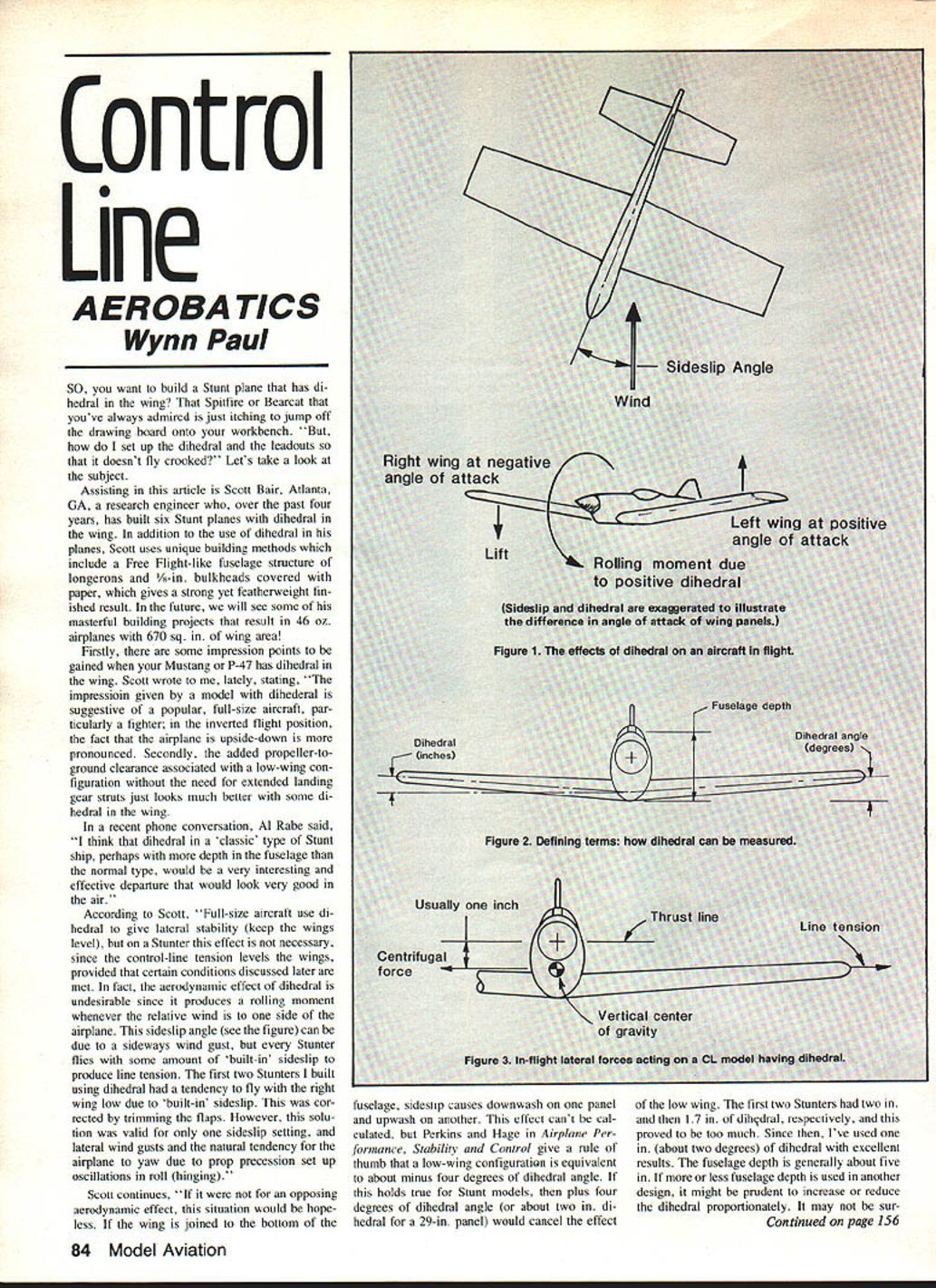
According to Scott, "Full-size aircraft use dihedral to give lateral stability (keep the wings level), but on a stunter this effect is not necessary, since the control-line tension levels the wings, provided that certain conditions discussed later are met. In fact, the aerodynamic effect of dihedral is undesirable since it produces a rolling moment whenever the relative wind is to one side of the airplane. This sideslip angle (see the figure) is due to a sideways wind gust, but every stunter flies with some amount of 'built-in' sideslip to produce line tension.
"The first two stunters I built using dihedral had a tendency to fly with the right wing low due to 'built-in' sideslip. This was corrected by trimming the flaps. However, this solution was valid for only one sideslip setting, and lateral wind gusts and the natural tendency for the airplane to yaw due to prop precession set up oscillations in roll (hunting).
"If it were not for an opposing aerodynamic effect, this situation would be hopeless. If the wing is joined to the bottom of the fuselage, sideslip causes downwash on one panel and upwash on the other panel. This effect can't be calculated, but Perkins and Hage in Airplane Performance, Stability and Control give a rule of thumb that a low-wing configuration is equivalent to about minus four degrees of dihedral angle. If this holds true for stunt models, then plus four degrees of dihedral angle (or about two in. dihedral for a 29-in. panel) would cancel the effect of the low wing.
"The first two stunters had two in. and then 1.7 in. of dihedral, respectively, and this proved to be too much. Since then, I've used one in. (about two degrees) of dihedral with excellent results. The fuselage depth is generally about five in. If more or less fuselage depth is used in another design, it might be prudent to increase or reduce the dihedral proportionately. It may not be surprising that the fuselage–wing interference effect given in the reference was excessive when applied to a stunter, since a stunter has a fuselage much smaller in proportion to the wing than in a full-size, conventional aircraft."
Historical and practical examples
Going back in time, let's look at the dihedral on Al Rabe's Mustang and Bearcat planes. From the June 1969 American Aircraft Modeler, Al wrote that he used approximately 2-1/2 degrees of dihedral, which came out to about 3/8 in. on a 57-5/8 in. span stunt wing. He stated, "By using dihedral to 2-1/2 degrees, and placing the wing on the bottom of the fuselage, we not only have the aerodynamic equivalent of a straight midwing, but we also get the leadout location up around the vertical center of gravity. So, the airplane flies level both upright and inverted."
Later, in Al's Bearcat article (AAM, March 1970) he stated that he used 1/4 in. dihedral per panel. Many knowledgeable fliers regarded Al's Bearcat I (the one with the Hawk on the nose) and Bearcat II (the all-blue one) as the best flying of his several semi-scale planes. He used less dihedral on the Bearcats than on the Mustang. In a recent telephone conversation Al stated that in his last two Mustangs (the blue one and the silver one) he has used as much as 1-1/4 in. dihedral, "... all I could stuff into the wing when using my wing jig." He did not feel that dihedral affected the trim of the airplane in any way.
Frank McMillan, several times a Nationals qualifier, said he uses about 1-1/2 in. dihedral on a 51-in. wing in his Martin-Baker planes. He says he cannot tell any appreciable difference between inside and outside turning, although he has adjusted his handles because of a slightly less ability to turn outside than inside; however, this may not be due to dihedral.
Measuring dihedral
Scott Bair says, "In the design of full-size aircraft, the amount of dihedral is ordinarily given by the angle that the wing makes with the horizontal when the airplane is in level flight and everything is in trim." For a stunter, a more basic and easily performed measurement is the rise of the wing above some datum line.
There is no generally accepted method of measurement for model airplane dihedral, and several ways are used. One popular method is to lay one wing panel on a flat surface and measure from the flat surface to the bottom of the other panel; however, that measurement is influenced by the wing's thickness and taper, which have nothing to do with dihedral. The method used here—and which defines the dihedral discussed earlier—is simply the rise of the wing centerline from the root to the tip when the wing is level to the ground.
Leadouts and center of gravity
An important consideration is the vertical location of the leadouts in relation to the center of gravity. If the leadouts are placed at a higher elevation than the center of gravity, the right wing will be pulled upward as the line tension increases (as shown in the figure). The engine and its associated hardware make up a large portion of the aircraft weight; the vertical center of gravity will usually be found above or below the crankshaft centerline (with an inverted engine).
Therefore, if the wing tip is positioned about one in. below the thrust line, any minor variation in vertical center of gravity can be accommodated by moving the leadouts up or down at the last stages of construction. This should be done whether or not dihedral is used. Hanging the stunter by its leadouts will tell you if the center of gravity and the leadouts are aligned vertically. Sighting straight down the fuselage, the left tip should be directly above the right tip.
Scott adds, "The fact that the leadouts must bend as they move through the guides due to dihedral angle does not seem to be a problem. The vertical location of the bellcrank is not critical. It can be left in its usual position in the wing center section."
To align leadouts and check vertical CG:
- Hang the model by the leadouts to see if the CG and leadouts are vertically aligned.
- Sight down the fuselage; left tip should be directly above the right tip.
- Position wing tips about 1 in. below the thrust line initially, then fine-tune leadout height during final assembly.
Closing
The above should help if you wish to build a World War II fighter for the stunt circles, model one of the Unlimited racers, or— as Al Rabe suggests—build a Stiletto with dihedral. For information on stunt flying or PAMPA, write Wynn Paul, 1640 Maywick Dr., Lexington, KY 40504.
Transcribed from original scans by AI. Minor OCR errors may remain.

