
Control Line Aerobatics
Wynn Paul
Here's more on control-line handles as a follow-up to the column on the building of the "Paul‑Robbert Super Handle" (April 1983 in Model Aviation).
Firstly, Lew McFarland will shortly be marketing the George Aldrich handle through his X-Cell Hobby Shop, Eastland Shopping Center, Lexington, KY 40505. This handle is very lightweight and adjustable for inside/outside turning equivalence.
Windy Urtnowski on handles
I received a very detailed letter from Windy Urtnowski regarding some flying experiments with handles. Excerpts follow. (Keep in mind that Windy flies with many of the New Jersey crowd — Glen Meador, Lou Dudka, Lou Woolgast, Bob Hunt, Doug Stout, Bill Simons — and this group is never at a loss for words: advice, questions, encouragement, experimentation, and lots of good old bench‑flying!)
Windy on handles:
"After reading your excellent article on 'handles,' I thought some of the other fliers might benefit from the experiments I did last season with handles. I felt I could get more from my big- and medium-sized ships by making up a handle custom‑tailored to each one, and tuning all of its variables. The results surprised even me! There's a lot to be gained by fine‑tuning the variables a custom handle offers.
"First, I took a standard E‑Z Just (both sizes) and a 'Hunt' handle and got my impressions with each on a ship that was properly trimmed. Then I had Rich Seifert of Philadelphia build me a handle like the 'Baron‑Martine' handle, but with adjustable line spacing from 3-1/4 in. to 5-1/4 in. and arm‑length (overhang) adjustment from 1 to 4 in.
"Now, starting with 'gut' impressions, I worked my way in 1/2‑in. increments to what I felt was optimum for the ship in question. This process absorbed a full day of flying under varying conditions. With what I felt were the optimum handle settings, I went home and made a handle to these exact dimensions. Why not use the already 'fine‑tuned' handle? Because handles with a lot of adjustable hardware are heavy and create one more thing to go wrong — and possibly cause loss of a ship. The handles I made up all weighed approximately what an E‑Z Just weighs (about 43 g — Wynn). The fully adjustable ones were bricks!
"To clear up my 'gut' impressions, I took a few flights with solder wrapped around the handle, and sure enough, the heavier the handle got, the harder it was to fly consistent maneuvers. It was also far more fatiguing on a long hot day of practice with the heavy handles. So, my impression was as follows: lighter and simpler is better! I also found that 1/32‑in. or less changes in line spacing can significantly change the cornering ability of the airplane.
"I tried other experiments that gave me some insight. Body putty molded to the hand outline was comfortable but heavy. I tried a 'mirror' Imron finish on one handle, but it was too slippery. Now I keep a slightly rough finish on my good handles to improve the grip, especially with an oily hand.
"Handle cables in use varied as much as handles. I like the throttle cables from mopeds or motorcycles best; they are cheap and available. Any cycle dealer will give you a handful of used ones with the end missing very cheaply (or free). They are stainless steel and suit the purpose well. A friend, Doug Stout, made me a handle using bicycle brake cables which was outstanding and is still one of my best handles.
"Maybe E‑Z Just did us a favor by going out of business, as they opened the door to more adjustability and performance using the handle variables. I did a lot of testing several years ago because I was the only one using six‑in. bellcranks and big control horns, but now it seems a lot of fliers, particularly in the eastern part of the States, have gone to heavy‑duty control systems. Many of the East Coast fliers are using larger bellcranks, 7/8‑in.‑diameter steel rod on flap and elevator horns, fiberglass pushrods, custom handles, etc.
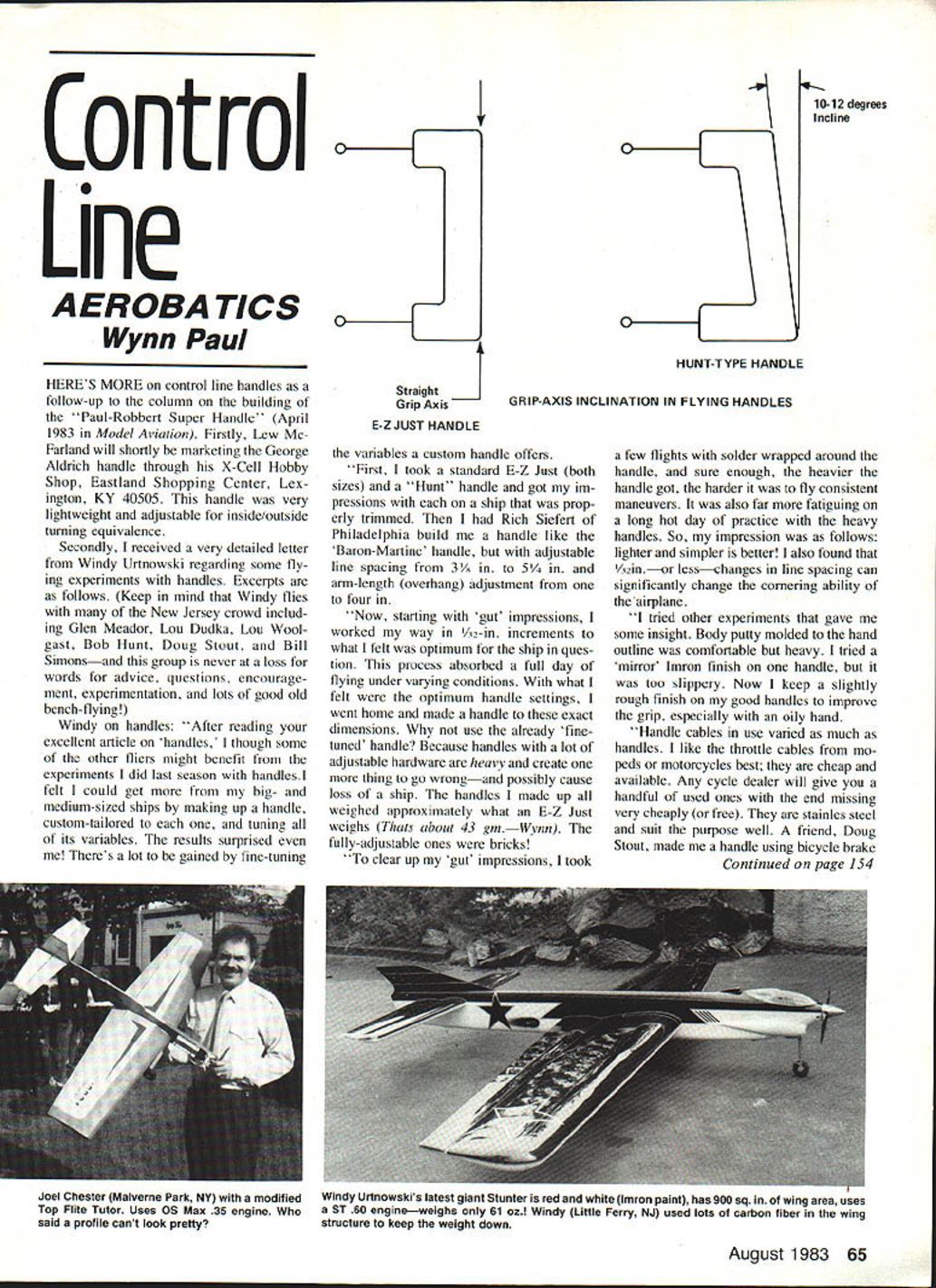
"I have another suggestion when experimenting with handles. The E‑Z Just grip axis was straight up and down, while the Bob Hunt handle was inclined about 10 degrees (see the diagram). I find that the inclined‑grip handle of about 10–12 degrees is much more comfortable and more suited to the natural anatomy of the hand when extended in the flying position.
"If you are comfortable with a Hunt handle (or one designed like it) and you need your plane to corner a little faster, try shortening the arms (the overhang) 3/4 in. at a time, and you will see more sensitivity as the arms get shorter. I'd like to especially thank Doug Stout, Rich Seifert, and Big Jim Greenaway who helped me with the handle ideas, suggestions and technology."
Anyone who wishes to contact Windy can do so at:
- 9 Union Avenue, Little Ferry, NJ 07643
- Tel.: (201) 440‑0905
Many thanks to him for supplying this information about handles. I certainly agree that a light handle flies better, but I also like the idea of having one that is adjustable. I think that if you can keep a handle at 75 g or less, you will have a workable solution (that's about 2-1/2 oz.).
Plans and engine work — Tom Dixon
There was a little confusion on the availability of plans and engine work from Tom Dixon. You can contact him at:
- Control Line Sales, Tom Dixon
- P.O. Box 27540, Contract Station #7, Atlanta, GA 30327
He has added the following plans to his list:
- El Diablo (by Red Reinhardt)
- Baby Barnstormer (Hal A. Guillows kit)
- Tom‑Tom and Warrior (Veco kits)
- Gobleswaltz (Charlie Mackey)
- Argus (Steve Woolley, from his own plans)
- Oriental 40 (similar to the .35 size, but scaled up for .40–.46 engines)
Tom recently said that he has filled several orders for his custom‑stroked Fox .35 stunt engines (see the May 1983 column), so if you want a good .35 for the summer, contact him about the various stages of rework on his veteran engine.
Stunt and PAMPA information
For information on stunt or PAMPA, contact:
- Wynn Paul
- 1640 Maywick Dr., Lexington, KY 40504
Transcribed from original scans by AI. Minor OCR errors may remain.

