
Control Line
AEROBATICS Wynn Paul
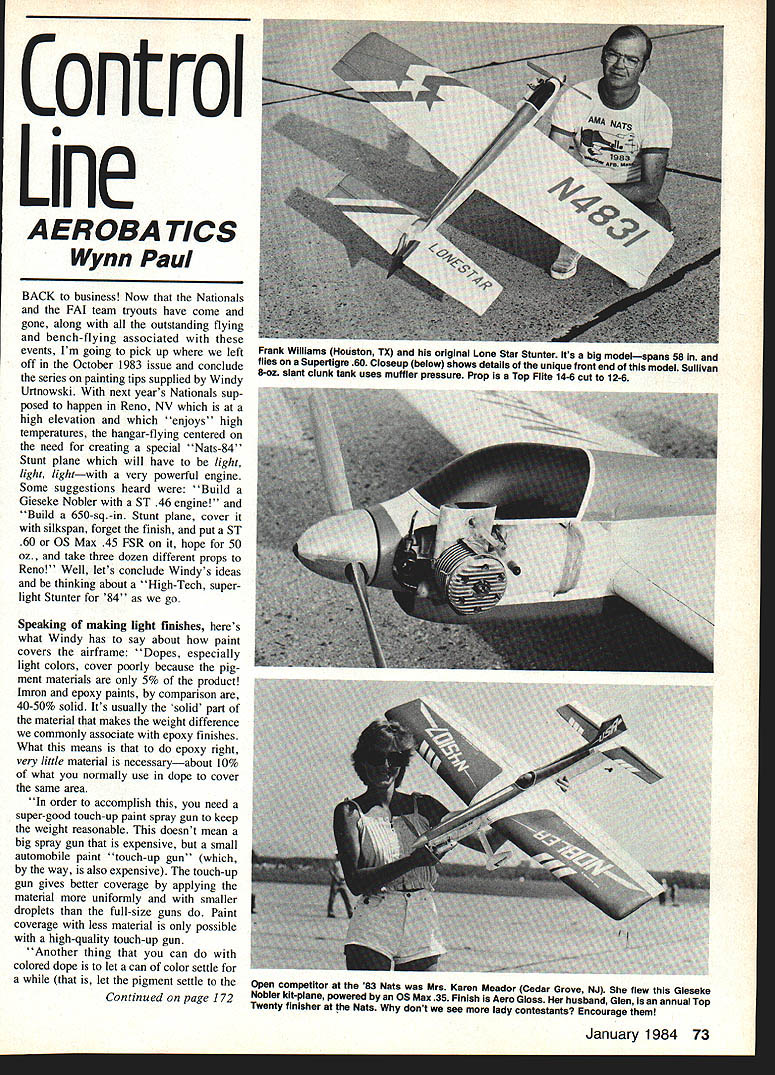
BACK to business! Now that the Nationals and the FAI team tryouts have come and gone, along with all the outstanding flying and bench-flying associated with these events, I'm going to pick up where we left off in the October 1983 issue and conclude the series on painting tips supplied by Windy Urtnowski. With next year's Nationals supposed to happen in Reno, NV — which is at a high elevation and which "enjoys" high temperatures — the hangar-flying centered on the need for creating a special "Nats-84" Stunt plane which will have to be light, light, light — with a very powerful engine. Some suggestions heard were: "Build a Gieseke Nobler with a ST .46 engine!" and "Build a 650-sq.-in. Stunt plane, cover it with silkspan, forget the finish, and put a ST .60 or OS Max .45 FSR on it, hope 50 oz., and take three dozen different props to Reno!" Well, let's conclude Windy's ideas and be thinking about a "High-Tech, super-light Stunter for '84" as we go.
Windy's painting tips
Speaking of making light finishes, here's what Windy has to say about how paint covers the airframe:
"Dopes, especially light colors, cover poorly because the pigment materials are only 5% of the product! Imron and epoxy paints, by comparison, are 40–50% solid. It's usually the 'solid' part of the material that makes the weight difference we commonly associate with epoxy finishes. What this means is that to do epoxy right, very little material is necessary — about 10% of what you normally use in dope to cover the same area."
In order to accomplish this, you need a super-good touch-up paint spray gun to keep the weight reasonable. This doesn't mean a big spray gun that is expensive, but a small automobile paint "touch-up gun" (which, by the way, is also expensive). The touch-up gun gives better coverage by applying the material more uniformly and with smaller droplets than the full-size guns do. Paint coverage with less material is only possible with a high-quality touch-up gun.
"Another thing that you can do with colored dope is to let a can of color settle for a while (that is, let the pigment settle to the bottom), then pour off the top 10% clear. This will make a 10% increase in solid coverage and will improve accordingly. Caution: don't pour off 10% or you will risk improper adhesion to the paint surface."
Windy has this to say about fillets: "I feel Aero Gloss doesn't go well over fillets because the high-shrink product shrinks. Sig and Randolph are both relatively low-shrink dopes. Aero Gloss, a partly nitrate dope, does adhere well, also shrinks a lot. For the best of both worlds use a low-shrink nitrate like Randolph.
"Fillet technique: use tape half a prop, leave fillets relatively rough; do them as the last step after talc-filler sanding, sealing, and a clear coat. Next step would be air-brushing — inch overspray — five coats auto primer, allowing an hour to dry between coats; sand with No. 400 paper after coats have dried overnight. Fine grade 000 steel wool is excellent for sanding in. If you'd like to try something new, use gloves — those splinters are awful."
Miscellaneous comments
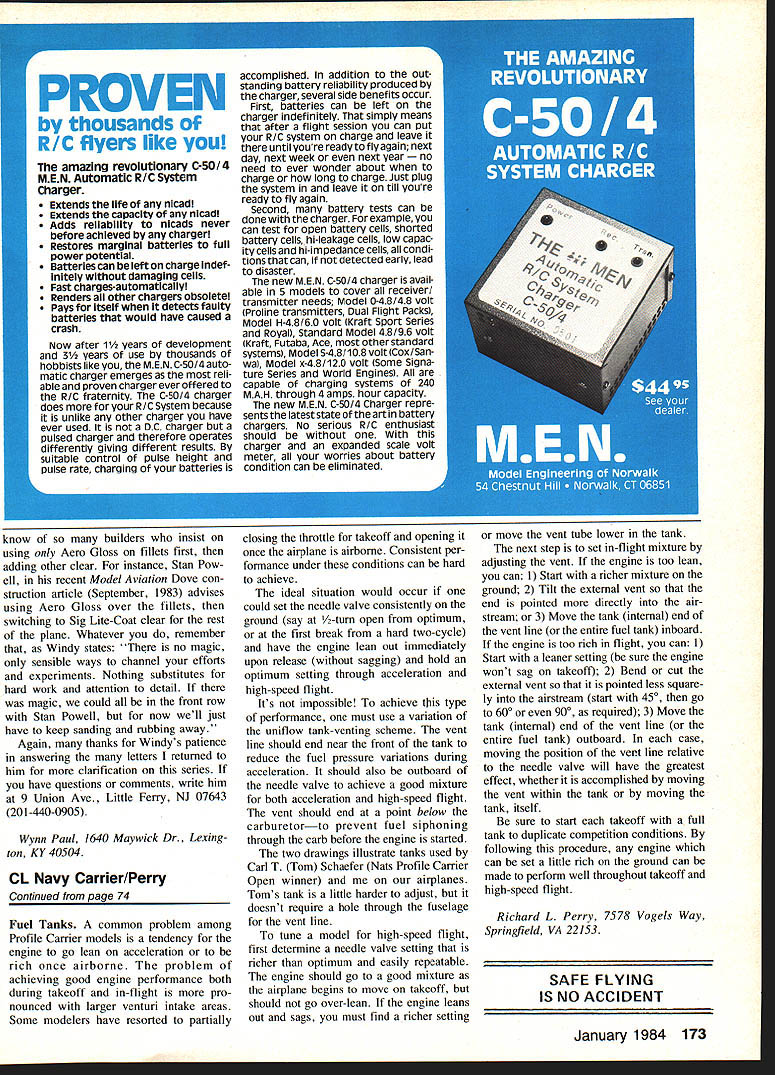
- Low-shrink dopes work well on Noble- or Juno-type airframes which have large areas of silkspan with only ribs underneath.
- Randolph Products publishes good literature regarding combinations of dope products (Randolph Products, P.O. Box 67, Carlstadt, New Jersey 07072). Their dopes also come tinted to help get an even coat over large surfaces; there is a translucent trace-color in their clear nitrate and butyrate dopes. These products are available with or without this tint; without the tint, the clear is crystal-clear.
- "The best spray gun I've found for all my spraying is the DeVilbiss touch-up gun, which is available most places they sell auto body supplies. It will cost about $100. I use a number two tip and about 40 lb. of air pressure to spray Imron and about 50 lb. of pressure to spray dope."
- Thinner comes in all grades. The most expensive is called 'slow', 'rich', or 'penetrating' — it is not recommended except to clean the gun. 'Fast' or 'non-penetrating' thinner is what you want; you will use more thinner in the mix, but it will loosen the paint you are spraying over. DuPont 3608 S is a good 'fast' thinner. Fast thinner is cheaper; it really works the best for airplanes — and it won't melt canopies! I found this out the hard way!
Paint types and basic facts
- Imron
- Goes over anything.
- Use the cheapest lacquer thinner available.
- Spray at 50 lb. of pressure.
- Let cure eight hours to "tack" and a total of 24 hours.
- Sig and Randolph dopes
- Will go over: 1) auto primer; 2) nitrate; 3) Aero Gloss; 4) butyrates; 5) acrylics.
- Use Randolph dope thinner or Sig thinner.
- Spray at 35–45 lb.
- Let dry one to four hours.
- Randolph nitrate dope
- Will go over bare wood or Epoxolite only.
- Use Randolph dope and thinner or Sig thinner.
- Brush on a thinned 50% solution and let it dry one hour.
- Aero Gloss
- Suggested to cover over Aero Gloss only.
- Use Aero Gloss thinner only.
- Spray at 35–45 lb.
- Let dry one to four hours, normally.
- Acrylic lacquers
- Will go over: 1) auto primer; 2) nitro lacquers; 3) Aero Gloss dope; 4) butyrate dopes.
- Use "rich" lacquer thinner on colors; use the lighter thinner on clear.
- Spray at 50 lb.
- Let dry at least one hour.
- Epoxy paints (like Hobbyoxy)
- Generally will go over epoxy only.
- Use only specially thinned Hobbyoxy thinner.
- Spray at 50–60 lb.
- Let dry one hour; allow two coats per full day.
Generally speaking, the only item in Windy's discourse some modelers may take issue with is his dislike for using Aero Gloss clear on fillets or on bare wood. I know of many builders who insist on using only Aero Gloss on fillets first, then adding other clear. For instance, Stan Powell, in his recent Model Aviation Dove construction article (September 1983), advises using Aero Gloss over the fillets, then switching to Sig Lite-Coat clear for the rest of the plane. Whatever you do, remember that, as Windy states: "There is no magic, only sensible ways to channel your efforts and experiments. Nothing substitutes for hard work and attention to detail. If there was magic, we could all be in the front row with Stan Powell, but for now we'll just have to keep sanding and rubbing away."
Again, many thanks for Windy's patience in answering the many letters I returned to him for more clarification on this series. If you have questions or comments, write him at:
Windy Urtnowski 9 Union Ave. Little Ferry, NJ 07643 (201) 440-0905
Wynn Paul 1640 Maywick Dr. Lexington, KY 40504
Transcribed from original scans by AI. Minor OCR errors may remain.

