
Control Line: Aerobatics
Wynn Paul
THE National Precision Aerobatics Championships for 1976, to be held at Dayton, Ohio, will have a very capable crew at the helm. Former National Champion Bart Klapinski will be event director. He will be assisted by Dayton resident Jim Fasimpaur, an experienced contest director. Former National Champion Bob Gialdini will again serve as head judge; it is planned to have at least six stunt judges for Open competition, although an expected avalanche of entrants this Bicentennial year may require as many as eight judges for Open qualifications. PAMPA president Keith Trostle and newsletter editor Wynn Paul will assist Bart in rounding up the many volunteers needed to put on the five-day Stunt championships. Interested parties who wish to help during "Nationals Week," August 2-8, should write Bart at 1507 Mammoth Circle, Placentia, Ca., 92670, giving the days that they will be available to help.
Five of the outstanding contests east of the Mississippi River will utilize the PAMPA classification system in the precision aerobatics events this summer. The Southeastern C.L. Championships, Winston-Salem, N.C., June 19-20; Flying Goombahs Annual Contest, Quincy, ME, May 1-2; Garden State Circle Burners, N.J., June; Region V Stunt Championships, Atlanta, GA, May 29-30; Mid-America Championships, Lexington, KY, July 31-August 1 will use the PAMPA classes. The idea of ability classes is rapidly drawing more fliers. John Miske, G.S.C.B., stated that their contest last year used the PAMPA classes and the response of the Stunt fliers was very enthusiastic.
The four PAMPA classes are based on previous scores of contestants with the following divisions: 300 and under—PAMPA Beginner; 300-399—PAMPA Intermediate; 400-499—PAMPA Advanced; 500 and over—PAMPA Expert.
Scores are based on standard AMA scores. As originally initiated, Richard Byron, Omaha, NE, volunteered in 1974 to compile the averages of scores of stunt fliers over a two-year period which would establish divisions of fliers based upon ability to score in the AMA pattern. Periodically, lists of fliers in categories have appeared since then in Stunt News, the newsletter of PAMPA.
In practice, and in what amounts to a general consensus, a voluntary placement into categories seems to work out better. Several reasons for this: (1) the paperwork to keep up with over 300 stunt fliers is prohibitive, although Rich has kept up with the contest results that have appeared in Stunt News; (2) the obvious difficulty which comparing scores around the country from different sets of judges presents some problems. One classic example of this is the "advanced" rating of Bill Werwage, Nationals winner and two-time World Champion! Bill seldom competes in the local contests and his scores from a few very tightly judged contests places him in the Advanced category. Of course this is a special case, as the entire scheme was to help the beginner, the novice, the newcomer; (3) peer pressure will probably stop someone from sandbagging by staying in a lower category just to pick up a trophy. There are bound to be some who will try this, but no system is perfect; (4) not every contest director keeps up with Stunt News scores, so a voluntary placement should make for a smoother set up of a contest.
What is the purpose of all this? To bring in and keep new fliers in control-line Stunt, that's what. From personal observations the writer started competing in Stunt off and on around 1967. Over the years many new fliers would show up at contests for a year, or maybe two seasons, then they would disappear. Certainly, there are a thousand reasons for someone to quit: expense, family pressure, interest in other hobbies, or job complications. However, it is my opinion that having to compete directly with seasoned veterans right from the start has done more to discourage newcomers than anything else. The novice who comes to a contest with his Sig Akrobat at .54 with a Fox .15 running a 9-6 prop and with flaps and elevators slightly out of line will take one look at Bob Hunt's Genesis, Jerry Pilgrim's Sundance, Bob Gieseke's Sea Nobler, or watch the smooth flying of Bill Werwage, Bill Simons or Bob Whitely, or catch some of Bart Klapinski's corners and will fold up his tent, go home and call his friend about that used transmitter. Let's remember they have adult divisions in tennis, golf, bowling and Radio Control Aerobatics to let the beginners play against their own level.
Ah, but what if this beginner can fly on the same circle with the "stars" but compare his scores with others who have never scored over 300, or those who have signed up in the Intermediate category because it is their second summer of contests and they still haven't perfected the hourglass for 35's. This idea has worked well in the RC pattern categories. RC contests have just as many fellows battling it out in the beginner and novice categories as in the experts and masters.
How can your contest promote this idea? Send in your contest sanction signifying all three AMA classes in stunt, but enclose a note that you will be using the PAMPA classes. Since the trophy allotment would be three sets normally, you only need to come up with one more set. And if you can't come up with the extra trophies, don't worry, most experts would rather just fly for the competition and forget the hardware. Be certain to give the trophies to the Beginner, Intermediate and Advanced classes.
It is not necessary to have separate circles and judges for the different classes, only if the stunt director can come up with enough judges for another circle. The Garden State Circle Burners and the Southeasterns did this last year, but it isn't really necessary. Draw for order the regular way or run the beginners first; it's up to the stunt director. Then compare the fliers in the four classes to determine the winners. And be certain to send in the scores to Stunt News.
It's also a good idea to try to have the AMA Novice Stunt event included in your contest. This will allow the real beginner with the profile to get his first contest experience. Think this is too much stunt? Well, the fellows who will fly in the PAMPA classes would probably volunteer to judge and tabulate, and the AMA medal is a dandy award to give beginners. Cost of the medals is very economical and the unused ones can be used the next time around since they are not dated.
Think we are trying to slight the Juniors and Seniors by doing away with their divisions? Not on your life! How many of us have seen two Juniors show up, see the small man entry for their division and say, "Well, big deal, let's just fly one flight and move on to Slow Combat or Balloon Bust." But, with the four PAMPA classes they will be in a group with some other fliers of their abilities, and they will be communicating with the Open members, maybe picking up some helpful hints, and certainly getting some positive reinforcement from the Open fliers.
Anyone who is going to host a contest this summer and wants to help in setting up PAMPA classes please write either Dick Byron, 2506 So. 1651 Circle, Omaha, NE, 68130, or Wynn Paul, see below.
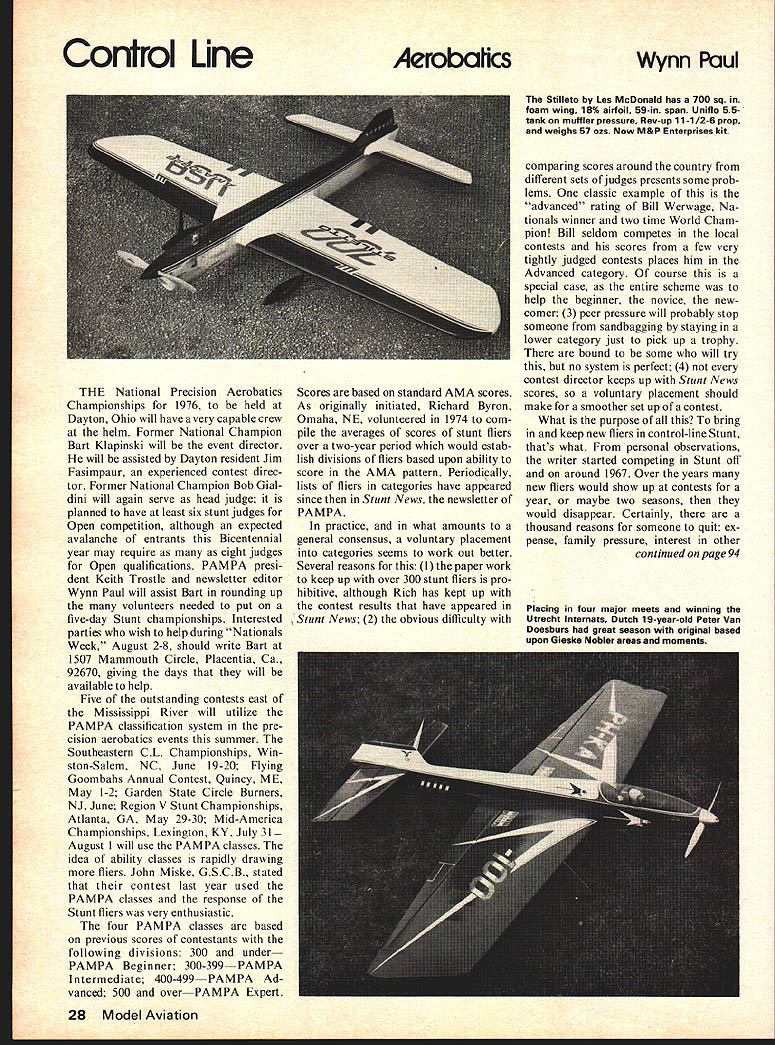
Stiletto of Les McDonald has been kitted by M&P Enterprises, headed up by former stunt flier Dick Mathis. The kit should be available by the time this article is printed. Les has flown the Stiletto to a second, third, fourth, and seventh in Nationals competition, and a fourth in the 1975 FAI tryouts. This is the 35-size Stiletto, with a 56-in. wing span and features extremely simplified construction. The first run of 200 kits is reportedly to be of extremely high quality balsa and should turn out some very competitive airplanes. Cost of the kit will be just under $30.00 and include a lot of hardware.
(My address is Wynn Paul, 1640 Maywick Dr., Lexington, KY, 40504.)
Transcribed from original scans by AI. Minor OCR errors may remain.

