
Control Line: Aerobatics
Ted Fancher
Tribute to Wynn Paul
Contributing Editor Wynn Paul has decided to retire after having written the CL Aerobatics column continuously since the very first issue of Model Aviation: July 1975 (that's very close to nine years!). His efforts in behalf of promoting CL Precision Aerobatics activity — and PAMPA — are greatly appreciated by the Model Aviation editorial staff. We hope that all modelers who get enjoyment from participating in this CL event will also join in giving Wynn a rousing "Well done!" for his efforts.
About the new columnist
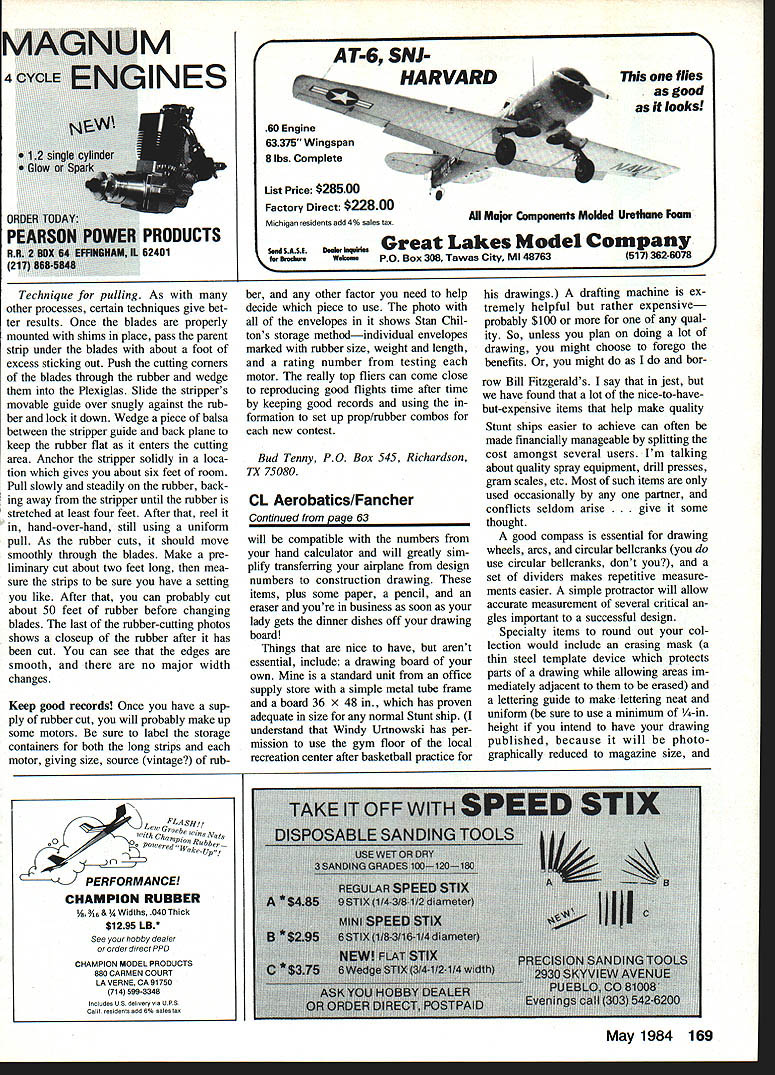
Beginning with this issue, Californian Ted Fancher will take over authorship of this column. Ted has been active in CL Precision Aerobatics for quite a few years; he was also a member of the 1982 U.S. Control Line team at the CL World Championships. This month's column is the first of two parts which address the subject of how to design your own, original Stunt plane. The article will conclude next month.
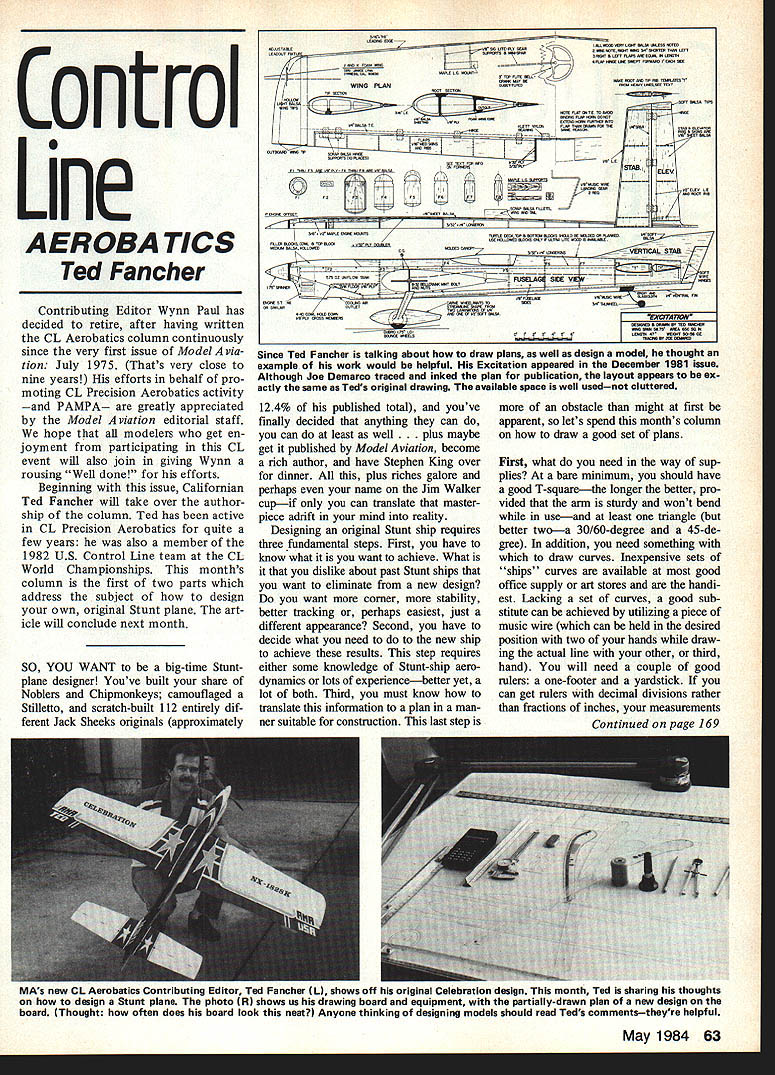
Designing an original Stunt ship
SO, YOU WANT to be a big-time Stunt-plane designer! You've built your share of Noblers and Chipmonkeys; camouflaged a Stiletto, and scratch-built 1/2 a dozen entirely different Jack Sheeks originals (approximately 12.4% of his published total), and you've finally decided that anything they can do, you can do at least as well... plus maybe get it published by Model Aviation, become a rich author, and have Stephen King over for dinner. All this, plus riches galore and perhaps even your name on the Jim Walker cup—if only you can translate that masterpiece adrift in your mind into reality.
Designing an original Stunt ship requires three fundamental steps.
- Know what you want to achieve.
- What is it that you dislike about past Stunt ships that you want to eliminate from a new design?
- Do you want more corner, more stability, better tracking, or, perhaps easiest, just a different appearance?
- Decide what you need to change to achieve these results.
- This step requires either some knowledge of Stunt-ship aerodynamics or lots of experience—better yet, a lot of both.
- Translate this information to a plan suitable for construction.
- This last step is more of an obstacle than might at first be apparent, so this month's column focuses on how to draw a good set of plans.
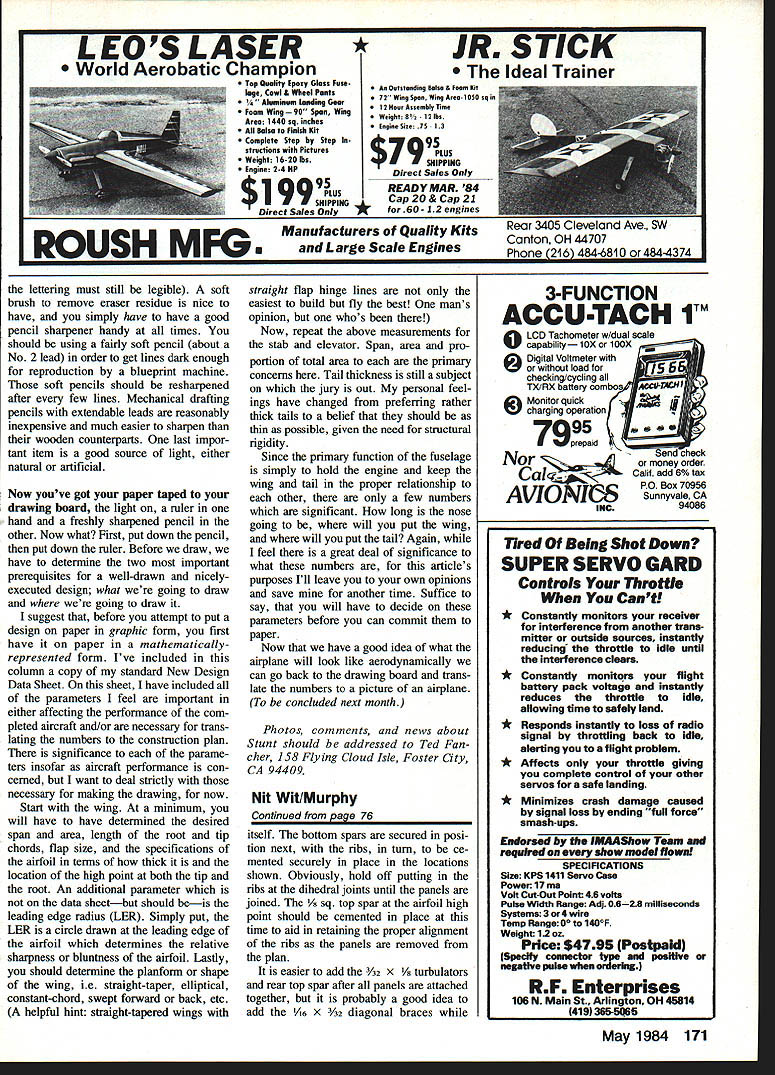
Drawing supplies and tools
Essentials
At a bare minimum, you should have:
- A good T-square — the longer the better, provided the arm is sturdy and won't bend while in use.
- At least one triangle (but three are preferable — two 30/60-degree and one 45-degree).
- Something with which to draw curves. Inexpensive sets of ship's curves are available at most good office supply or art stores and are the handiest. Lacking a set of curves, a good substitute can be achieved by utilizing a piece of music wire (which can be held in the desired position with two of your hands while drawing the actual line with your other hand).
- A couple of good rulers: a one-footer and a yardstick. If you can get rulers with decimal divisions rather than fractions of inches, your measurements will be compatible with the numbers from your hand calculator and will greatly simplify transferring your airplane from design numbers to construction drawings.
- Paper, a pencil, and an eraser.
These items will get you in business as soon as your lady gets the dinner dishes off your drawing board!
Nice to have (but not essential)
- A drawing board of your own. The author uses a standard unit 36 x 48 in., which has proven adequate in size for any normal Stunt ship.
- A drafting machine — extremely helpful but rather expensive (probably $100 or more for one of any quality). If you don't plan on doing a lot of drawing, you might forego it or share the cost with others.
- Shared ownership is a practical approach for expensive, infrequently used equipment (quality spray equipment, drill presses, foam scales, etc.). Splitting the cost among several users can make these items financially manageable.
Additional useful tools
- A good compass for drawing wheels, arcs, and circular bellcranks.
- A set of dividers for repetitive measurements.
- A simple protractor for accurate measurement of several critical angles important to a successful design.
- Specialty items such as an erasing mask (a thin steel template device which protects parts of a drawing while allowing areas immediately adjacent to them to be erased) and a lettering guide to make lettering neat and uniform. Be sure to use a minimum of 1/4-in. height if you intend to have your drawing published, because it will be photographically reduced to magazine size.
Note: Straight flap hinge lines are not only the easiest to build but fly the best—one man's opinion, but one who's been there!
Measurements and proportions
Now, repeat the above measurements for the stab and elevator. Span, area, and proportion of total area to each are the primary concerns here. Tail thickness is still a subject in which the jury is out. My personal feelings have changed from preferring rather thick tails to a belief that they should be as thin as possible, given the need for structural rigidity.
Since the primary function of the fuselage is simply to hold the engine and keep the wing and tail in the proper relationship to each other, there are only a few numbers which are significant. How long is the nose going to be, where will you put the wing, and where will you put the tail? While there is a great deal of significance to what these numbers are, for this article's purposes I'll leave you to your own opinions and save my detailed thoughts for another time. Suffice to say, you will have to decide on these parameters before you can commit them to paper.
Now that we have a good idea of what the airplane will look like aerodynamically, we can go back to the drawing board and translate the numbers to a picture of an airplane. (To be concluded next month.)
Photos, comments, and news about Stunt should be addressed to: Ted Fancher 158 Flying Cloud Isle Foster City, CA 94409
Transcribed from original scans by AI. Minor OCR errors may remain.

