
Control Line Aerobatics
Ted Fancher
StuntFlash
The Precision Aerobatics Model Pilots Association (PAMPA) and its newsletter, Stunt News, are back in business! Fresh and enthusiastic new leadership — long-time stuntman Denny Adamis as president and Mr. "High-Energy" Windy Urtnowski as editor and publisher of Stunt News — has breathed fresh life into the stunt world's national voice. Five excellent newsletters since January are proof positive that your dues dollars will once again bring you all the stunt news that's fit to print. Get with it and send your $7 ($12 outside U.S.) membership fee to PAMPA, 329 Lincoln Place, Brooklyn, NY 11238.
Thank You to Wynn Paul
The first order of business for this, my first regular stunt column for Model Aviation, must be to say a public thank you to the former correspondent, Wynn Paul. For nearly a decade, Wynn has religiously been the voice, ears, and conscience of control line stunt. As secretary/treasurer of PAMPA, and as editor, publisher, printer, stapler, mailer, and general whipping-boy for PAMPA's newsletter Stunt News, it can honestly be said that there is no other individual to whom each of us who eats, lives, and breathes stunt is more beholden.
Wynn, through his efforts, is almost single-handedly responsible for this writer's mid-life return to the stunt circles, and is, therefore, responsible for the third most important part of my adult life. It pleases me greatly to be able to say, through Wynn's own forum, "Thank you, Buddy. My life would have been much less full were it not for you!"
Any of you who feel your hobby — or, if you are a real SSF (Serious Stunt Flier), your avocation — has been similarly enriched by Wynn, a note of appreciation to him at 1640 Maywick Drive, Lexington, KY 40504 would certainly be appropriate.
About the Author
Who am I? My name is Ted Fancher. I live in Foster City, California, and I fly stunt. In fact, I like control line precision aerobatics better than anything except my family and my job.
My family:
- My wife, Shareen, who is famous in stunt circles and allows me to attend the Nats each year to keep her company while she makes sure the event director does the job right. Seriously, she has been the chief tabulator at Nats since 1975 and is truly an irreplaceable constant.
- My daughter, Kim, 17, just about to start college.
- My son, Jeff, 14.
Neither Kim nor Jeff are as intrigued by planes as their father, but both accept their father's idiosyncrasies as long as they don't conflict too much with their own interests — her horses or his computers and track competitions.
I work for United Airlines as a captain on Boeing 727s flying out of San Francisco. The job and the stunt ships share almost equal parts of my heart; however, United pays better.
I learned to fly stunt in the early Fifties, through the thoughtful and much-appreciated tutelage of my good friend Bob Emmett, who is still a pillar of the Northwest stunt community (although a pillar of salt when acting as a judge at many of the very competitive Seattle/Portland-area meets, according to reports from some of his victims). Bob always flew fairly fast, an outgrowth of his own apprenticeship in New England with the likes of Lou Andrews, designer of the Barnstormer. This preference for a faster, flashier pattern has become characteristic of my own style.
I attended the 1959 Navy-sponsored Nats at Los Alamitos as a junior and placed sixth. I was flying a black Ruffy powered by a Fox .35, which blew up the night before junior finals (yes, they had so many junior and senior entries in those days that they had qualifying and finals!). The engine breakdown required that it be rebuilt by none other than Mr. Fox himself — one of the highlights of the Nats.
Another highlight, which has influenced me to this day, was watching a young kid from Ohio blow the socks off my hero, Bob Palmer, in the Walker flyoff. Billy was (and is to this day) a great influence on everything I do in stunt. There are only a handful of fliers in the country who would personally qualify as masters of the sport. Bill is one, and I believe, as more of these columns are written, the others will become obvious.
After a lengthy layoff from competition for college, marriage, and career, I was again attracted by Wynn's regular coverage of stunt in Model Aviation and by meeting a couple of other pilots who had similar desires to rekindle their youthful modeling endeavors: Gary McClellan and Bill Fitzgerald. Together we jumped into the fray with all six feet, and some combination of our families has been in the Walker Cup flyoff every year since 1976.
My personal record:
- Two "Concours d'Elegance" awards (1977, 1981)
- Two fifth places
- One third place
- Two second places
- One National Championship (1982)
I was also on the 1982 U.S. FAI Team at the World Championships, where I finished fourth.
I have published two construction articles in Model Aviation: "The Excitation," a competition stunter, and "The Imitation," an intermediate-type stunter which, although a quasi-profile with an inverted engine, is still a very capable competition ship. It actually placed a hard-fought fifth at the 1980 Nats after a control failure destroyed the Excitation just before the finals.
When Wynn Paul decided he just couldn't continue with the monthly workload, Model Aviation's publisher, Carl Wheeley, called me and asked me to try to fill Wynn's shoes. With your (the readers') help, I'm going to give it a try.
Areas of Strength and Weakness
As many who know me can attest, I can carry on at great length on areas where I have strong opinions. In the stunt arena, those would be airplane design, construction (not necessarily finish — I've got a lot to learn from some real pros, mostly in New York), control systems, and the broad spectrum of stunt philosophy and personalities. I can BS with the best.
Areas where I am frankly weak and would be cautious in making recommendations are engines, fuels, fuel systems, and the powerplant system in general. The most common picture of me at Nats is one which shows me looking quizzically at my motor at the moment, wondering why it is less momentous now than earlier.
Contributions Requested
To get on with this, I'm asking for any and all materials you, the readers, can send me. Pictures are great — preferably black and white 5 x 7s; however, good, uncluttered color shots will reproduce, I'm told. Pictures earn $5 each when published. Fame, and riches to boot!
Technical info is good; however, I must say up front that if I feel strongly the material is not correct or might be misleading, I will either have to edit it or not use it at all. I will do my best to reply to all submissions, especially if one is requested and a SASE is included.
I would particularly appreciate being included on the mailing list of any and all newsletters which might remotely bear on the needs of stunt fliers. Often, techniques and production items intended for one specialty have corollary applications in other areas.
Hint of the Month
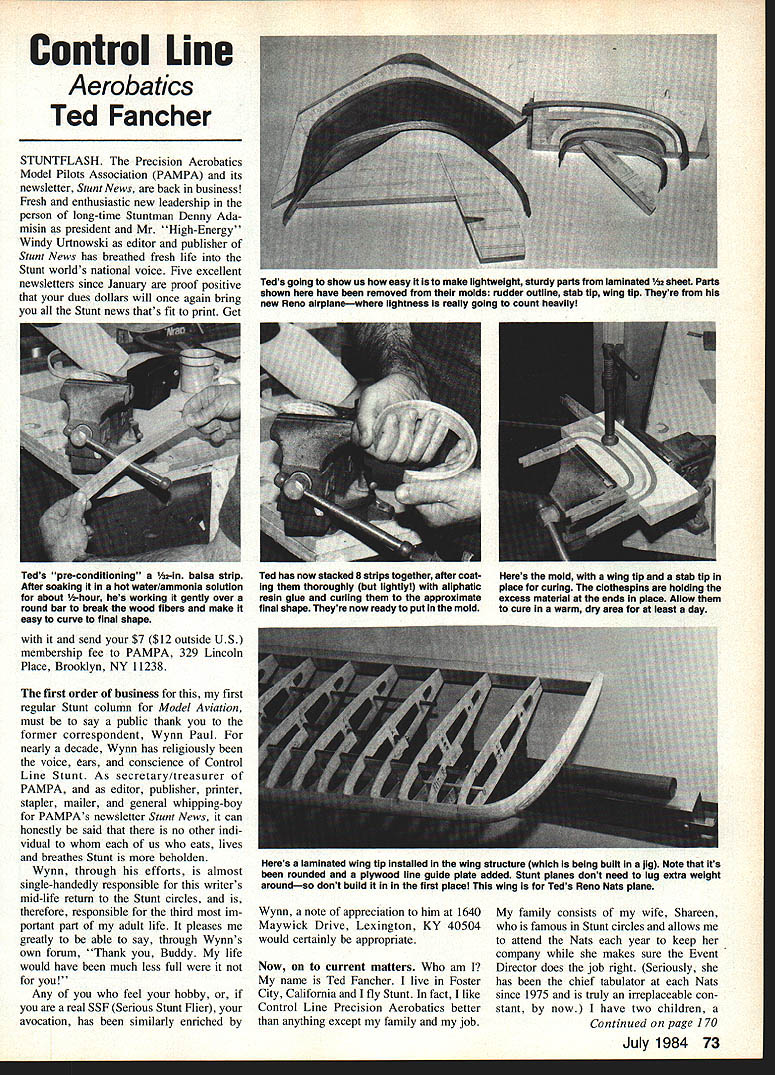
I plan to have a continuing segment in the column known as "Hint of the Month." This month's hint is a quick primer on making small curved outlines — such as rudder shapes, wing and tail tips — from 3/32-in. balsa.
- Make the mold.
- I made mine from 3/4-in. bass on which I rubber-cemented a drawing of the intended part cut out from the plans for my Reno ship.
- Cut out the area you will be laminating, leaving a male and a female segment.
- Glue one segment to a suitable base (I used 1/8-in. ply).
- A nice touch is to line the area that might be touched by glue from the lamination with Monokote to prevent gluing the part to the mold.
- Prepare the strips.
- Cut strips of flexible 1/32-in. sheet balsa to the appropriate width. Remember you'll need eight strips for each 4 in. of part — 1/32-in. is plenty for most stunt applications, as the finished part is quite rigid.
- Soak them in a solution of hot water and ammonia for about a half hour. The ratio of ammonia is not critical; just make it stinky enough that your wife and kids complain and it should be about right.
- Precurve the strips.
- If you have curves tighter than about a two-inch radius, gently stroke each strip around a rounded object until the grain breaks down enough to allow it to curl easily against the mandrel. Experience will quickly show how much is needed.
- Wipe away excess water and apply a good aliphatic resin glue (such as Tite-Bond) lightly but thoroughly to each succeeding piece. Try to avoid using too much, as any excess will seep out and glue your part to the mold.
- Clamp and cure.
- Clamp the laminations to the mold and allow them to cure at least one day in a dry, warm place.
- When the part is fully dried, carefully remove the excess wood protruding from the mold and remove the laminated part. You will be amazed at the strength and lightness — just what the doctor ordered for Reno!
Speaking of Reno, more on the problems there next month.
Contact
Send cards and letters to: Ted Fancher 158 Flying Cloud Isle Foster City, CA 94404
Fly stunt!
Transcribed from original scans by AI. Minor OCR errors may remain.

