

Control Line: Aerobatics
Ted Fancher
RENO — a preview. While it is not my intention to routinely spend time in this column discussing individual Stunt events, the upcoming AMA National Championships, to be held at Reno's Stead Airport, offers such a unique challenge to the Stunt fraternity that I felt it was appropriate to make an exception. The elevation of Stead Field, 5,026 ft. above sea level, coupled with the air‑thinning effects of high seasonal temperatures, will have all competitors concerned, most especially those of us whose airspace is limited by the rules of the event in which we fly (i.e., control liners).
The effects of temperature and altitude, known technically as density altitude, are such that an aircraft must fly faster to achieve the same level of performance as at a lower density altitude. This is not an insignificant problem. For instance, full‑scale aircraft, in order to achieve the same performance at Reno on a 90° day as at sea level on a 60° day, must weigh in the neighborhood of 20% less. In addition, the airspeed at which this equal performance is achieved is approximately 13% higher. (For a more complete discussion of the effects of density altitude on airspeed/lap times, etc., see my article in the July 1982 issue of PAMPA Stunt News.)
A second significant problem will be a substantial loss of engine power. Less air means less fuel in the fuel/air mixture, which means less horsepower.
This combination of factors — having to fly a lighter aircraft faster on less power — led me to prepare this Reno preview for the benefit of those of you who will actually compete in Reno, and for the education of all who wish to expand their fund of Stunt wisdom.
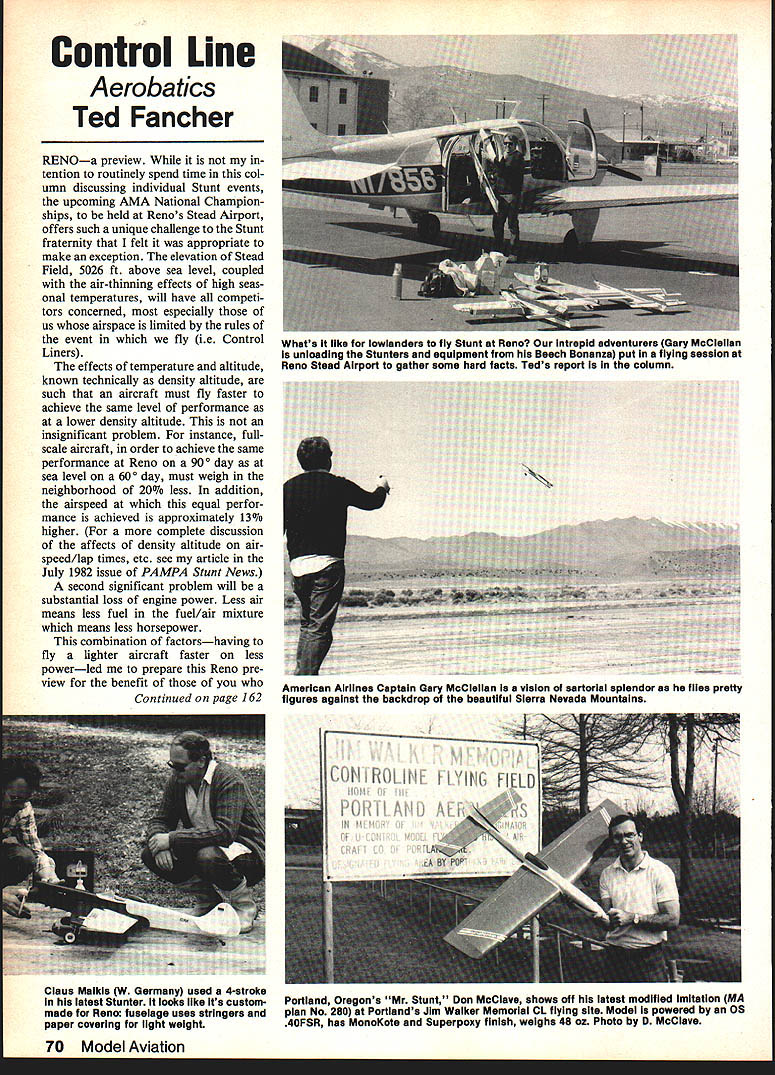
Because I live just across the Sierra Nevada Mountains from Reno, and since my good flying buddy Gary McClellan owns a beautiful six‑place Beechcraft Bonanza in which we sometimes fly to contests, it seemed logical that we should hop up to Reno and find out just what effect all these mysterious forces of nature were actually going to have on a Stunt ship.
Since we hadn't really flown since Semi‑Finals day at the Chicopee Nats last year, we decided to take a day at our local flying field to establish basic criteria with which to compare our Reno data.
The aircraft we used were very competitive conventional Stunters: Gary's OS .45FSR‑powered '82 Nats qualifier, based on a low‑aspect‑ratio Derringer wing, and my own Celebration, an ST .46‑powered derivative of the Excitation. The Celebration is a .660‑sq.‑in. airplane with a 59.75‑in. span (an aspect ratio of 5.4 to 1). Weighed on a very accurate triple‑beam balance scale, it weighed 52.3 ounces.
The line length for all flights was 66 ft. 4 in., measured from the handle grip to the aircraft centerline. All flights were made with a stock ST sprinkler‑type venturi with an enlarged intake diameter of .172 in. A standard quantity of fuel (six ounces) was added for each flight.
The prop used for all flights (until prop trials began) was a 12 x 5 Wide Rev‑Up, which had been re‑pitched for more pitch at the tips.
The baseline flight for the comparisons was made at sea level on a pleasant, 60° day at light winds — a perfect day for flying Stunt. Celebration performed excellently, with lap times of 5.6 seconds per lap both upright and inverted and ran for 5 minutes, 47 seconds. Subjective evaluation was of better‑than‑average line tension throughout, with an engine running in a strong but definite four‑cycle, with two‑cycle bursts in the corners. A textbook‑perfect setup.
Armed with this information, Gary and I met at the Bonanza early on a beautiful April morning. We loaded the two airplanes, assorted tool boxes, fuel jugs, and a coffee pot into the back seat and blasted off at 0800. At 0910 we touched down at Stead, and after sweet‑talking several very congenial airport employees, we were transported to a closed runway on which the local RC club flies. This runway was in very bad condition — cracks and missing chunks all about. However, we found an area which proved suitable and set to work on a five‑hour flying session. (Lest you become concerned about the surface, let me hasten to add that the official flying area for the Nats itself is impeccable: smooth blacktop and almost perfectly level.)
When we began to fly, the temperature was 55° with fairly steady winds of 6 to 10 knots. As the day progressed, temperatures increased to a maximum of 71°, and the winds varied from occasionally calm to gusts as much as 12 to 15 knots. For comparison’s sake, the density altitude at 55° was about 5,900 ft., and at 70° about 7,000 ft. At 90°, a normal August temperature, the density altitude will be about 8,000 ft.
Notes from the first flight showed the following: the Celebration was flown in exactly the same configuration as the baseline flight; the engine was very rich on start and required considerable leaning to reach the desired setting (no tachometer was used); lap times were six seconds upright and inverted; engine run was 7 minutes, 24 seconds!
The only surprise here was the increased lap times — obviously the result of decreased power. Maneuver performance was sluggish at best, requiring larger maneuvers and greater anticipation of ground level in cornered maneuvers. A brisk breeze tended to camouflage the lost horsepower until it came time to do the vertical and overhead maneuvers. Although I managed to struggle through them, I did chicken out on the stem of the Four‑Leaf Clover, as I knew a loss of line tension was inevitable going over the top and into the wind.
The first real surprise came when the engine stopped and the airplane landed. I say that literally: the airplane landed — I didn't land it. At the higher density altitude, the airplane perceived a lower‑than‑normal airspeed and, therefore, reduced lift from the wing. This resulted in a rapid sink rate at what appeared to the pilot to be a very reasonable speed — where he would expect a normal, flat glide. I caution all of you who attend to be aware of this on your first flights. It caught Gary by surprise to the point that he stalled in his strip trying to stretch the glide and did some minor cosmetic damage.
A second flight was made with the same setup, only leaning out the engine. This resulted in only minor improvement in line tension, but lap times were still in the 5.8‑second range. The engine was running much too fast, and yet power was still inadequate.
The second series of flights was made with the temperature rising to 62°–65°. I increased the nitro content of the fuel from 12½% to 18%. An interesting note indicates that the engine‑run time actually increased to 7 minutes, 34 seconds. I attribute this to the rising temperature. Lap times were down to 5.65 to 5.75 seconds on a strong four‑cycle. Line tension better, but still nothing to write home about. One scary thing happened: the wind totally quit during the Square Eight, and line tension nearly disappeared! This showed me that something more drastic had to be done.
Subsequent testing showed that the most promising area for improvement appeared to be the propellers. We became convinced that the key to achieving sea‑level performance was in getting the airplanes to fly fast enough for them to feel the air to be as thick as at home. Since we felt that the engines were already at or near their peak output, we opted to combine less diameter and more pitch. This seemed to work well. I used an 11 x 7 W/Zinger and got improved performance immediately. Unfortunately, when we got the performance we wanted, both of our ships were flying at 4.9 to 5.1 second laps, with the resulting difficulty in precise maneuvering. Going to longer lines to mitigate the speed increase will require more horsepower — and, unfortunately, your horsepower left town on the same ship as your lift! Turning extra diameter or pitch will be more of a problem than at home.
To sum up: You can fly Stunt at Reno! That's the good news. The bad news is that to do it competitively you'll have to make compensations. Most of these compensations will have to be done during construction to allow:
A) lighter weight, which will, in turn, require B) less airspeed to fly competitively — which, in turn, will require C) less horsepower, which is what you most certainly don't have.
Maximize lift potential by using only full‑span flaps. Reduce lift requirements by giving up that 20‑point finish and gain 50 flying points, instead. Have the following available if you find yourself unable to get the performance you need:
- Larger venturi intakes
- Access to nitromethane
- Props with more pitch
- Consider using solid lines, as the drag reduction will result in less required horsepower. The dry mountain air should make them comparatively trouble‑free.
All things considered, I think the Reno Nats will be one of the most exciting in years. I'd also be willing to bet that once we all get a taste of super‑light wing loadings, none of us will be able to stand our old lead sails.
Mine's going to weigh under 40 ounces with an OS .45FSR — how about yours?
If you fly Stunt, you should belong to PAMPA! Write to PAMPA Stunt Headquarters at 9 Union Avenue, Little Ferry, NJ 07643.
Ted Fancher 138 Flying Cloud Isle, Foster City, CA 94409.
Transcribed from original scans by AI. Minor OCR errors may remain.

