
Control Line: Aerobatics
Ted Fancher
Greetings
As I begin to write this, I am sitting in the San Francisco airport, awaiting an airplane to whisk me to Eugene, OR for the Annual Northwest Regional Championships, probably the biggest control-line event on the West Coast. It always attracts good participation in four PAMPA classes of Stunt, plus Old-Timer. This will be my first contest of the season, and I'm not remotely prepared. I won't be able to take my Celebration with me (not that it really matters, since I've only got those ten or twelve flights from the Reno experiment on it since last year's Nats). I'm going to fly a bird (the very first of the "Stationer" series) which I haven't seen or flown since 1978! It was in a retirement aerie in the basement of Bob Emmett's home in Seattle, and he agreed to scrape off the dust (and the enamel overspray from his son's newly painted exhaust system) and bring it to Eugene. Oh well—winning isn't everything.
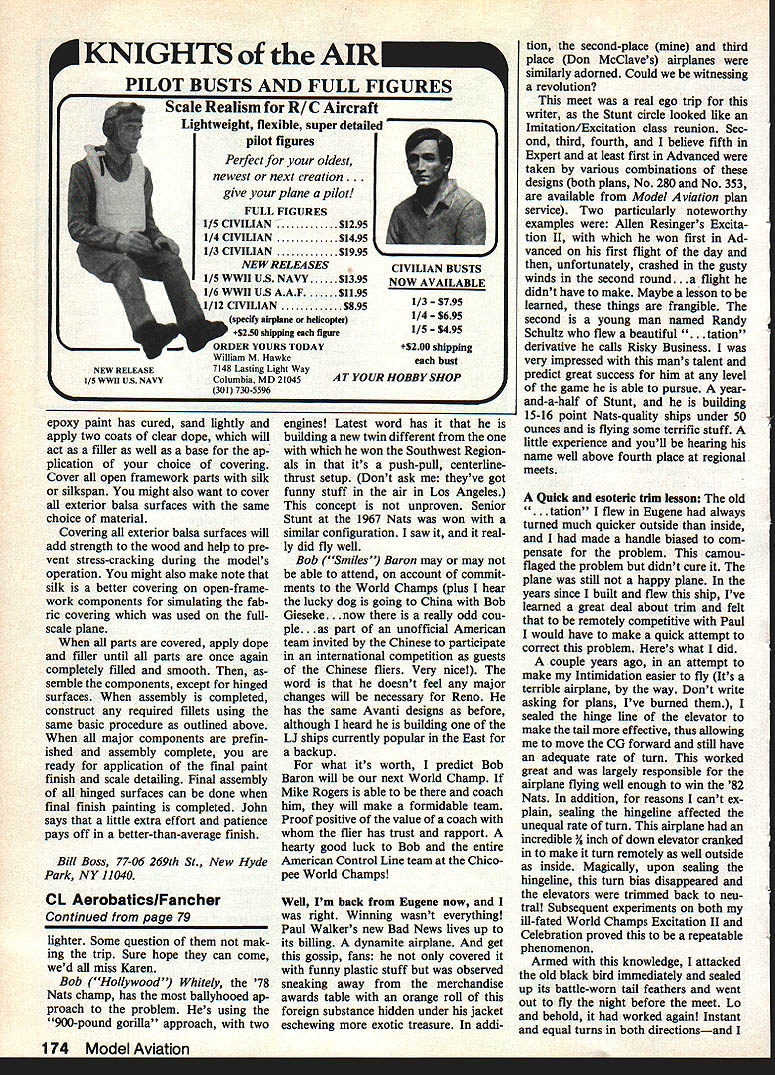
It will be interesting to see the airplanes at this meet, as they'll be my first exposure to some of the specially prepared Reno Nats ships. I've gotten pictures of Don McClave's new Imitation derivative, a light 47-ounce machine with OS .40 FSR power. Paul Walker, second at Chicopee last year, is bringing his new Bad News—rumored to weigh only 45 ounces with an OS .45 FSR, which should be a real change of pace for him. (Most of his earlier planes have served double duty as ballast tankers in the off season.) I flew his old Bad News after the Nats last year and found the line tension mind-boggling!
I'll have an addendum which will include results and comments on other interesting ships, along with some pictures (if my trusty Canon doesn't dryfire) at the end of the column.
Heard, through the grapevine
As Nats excitement builds, rumors are afoot about the efforts of some of the top dogs to cope with Reno's rarified atmosphere. To wit:
- Bob Gieseke is flying an old Nobler at .46 ST and has a new one built for the same powerplant—about 40 ounces, probably.
- Current National Champion Jim ("Travelin' Man") Casale has built either 12 or 15 new .60 ST-powered Spectra models in a larger size at what he hopes is the same weight as the old one for a lighter wing loading. I understand he will not—repeat: will not—pack the airplanes on the top of his car for the trip to Reno.
- (For those to whom that comment seems strange: Jimmy packed all of his worldly belongings on the top carrier of his car when he left New Jersey last year—and when he arrived in Chicopee, found that he had redistributed his wealth en route... very democratic of him.)
- Windy ("Pro Stunt") Urtnowski has really taken the density-altitude problem to heart. He swears he has a 44-ounce, .60 ST-powered Sweeper! (The cockpit alone weighed that much on the first Sweeper!)
- Glen Meador and Lou Dudka have ships similar to previous years'—only larger and a little lighter. There's some question whether they will make the trip. Sure hope they can come; we'd all miss Karen.
- Bob ("Hollywood") Whiteley, the '78 Nats champ, has the most ballyhooed approach: he's using the "900-pound gorilla" approach, with two engines! Latest word has it that he is building a new twin, different from the one with which he won the Southwest Regionals in that it's a push-pull, centerline-thrust setup. (Don't ask me; they've got funny stuff in the air in Los Angeles.) This concept is not unproven: Senior Stunt at the 1967 Nats was won with a similar configuration.
- Bob ("Smiles") Baron may or may not be able to attend, on account of commitments to the World Championships (plus I hear the lucky dog is going to China with Bob Gieseke... now there is a really odd couple) as part of an unofficial American team invited by the Chinese to participate in an international competition as guests of the Chinese fliers. The word is he doesn't feel any major changes will be necessary for Reno. He has the same Avanti designs as before, although I heard he is building one of the U-B ships currently popular in the East for backup.
For what it's worth, I predict Bob Baron will be our next World Champ. If Mike Rogers is able to be there and coach him, they will make a formidable team—proof positive of the value of a coach with whom the flier has trust and rapport. A hearty good luck to Bob and the entire American control-line team at the Chicopee World Champs!
Eugene report
Well, I'm back from Eugene now, and I was right: winning wasn't everything! Paul Walker's new Bad News lives up to its billing—a dynamite airplane. And get this, gossip fans: he not only covered it with funny plastic stuff but was observed sneaking away from the merchandise awards table with an orange roll of this foreign substance hidden under his jacket, eschewing more exotic treasure. In addition, the second-place (mine) and third-place (Don McClave's) airplanes were similarly adorned. Could we be witnessing a revolution?
This meet was a real ego trip for this writer, as the Stunt circle looked like an Imitation/Excitation class reunion. Second, third, fourth, and I believe fifth in Expert and at least first in Advanced were taken by various combinations of these designs (both plans, No. 280 and No. 353, are available from Model Aviation plan service). Two particularly noteworthy examples were:
- Allen Resinger's Excitation II, with which he won first in Advanced on his first flight of the day and then, unfortunately, crashed in the gusty winds in the second round—a flight he didn't have to make. Maybe a lesson to be learned; these things are fragile.
- A young man named Randy Schultz, who flew a beautiful Stationer derivative he calls Risky Business. I was very impressed with this man's talent and predict great success for him at any level of the game he is able to pursue. A year and a half of Stunt, and he is building 15–16 point Nats-quality ships under 50 ounces and flying some terrific stuff. A little experience and you'll be hearing his name well above fourth place at regional meets.
A quick and esoteric trim lesson
The old Stationer I flew in Eugene had always turned much quicker outside than inside, and I had made a handle bias to compensate for the problem. This camouflaged the issue but didn't cure it—the plane was still not a happy airplane. In the years since I built and flew this ship, I've learned a great deal about trim and felt that to be remotely competitive with Paul I would have to make a quick attempt to correct the problem. Here's what I did.
A couple years ago, in an attempt to make my Intimidator easier to fly (it's a terrible airplane, by the way—don't write asking for plans, I've burned them), I sealed the hinge line of the elevator to make the tail more effective, thus allowing me to move the C.G. forward and still have an adequate rate of turn. This worked great and was largely responsible for the airplane flying well enough to win the '82 Nats. In addition, for reasons I can't explain, sealing the hinge line also cured the unequal rate of turn. That airplane had an unbelievable 1/2 inch of down elevator cranked to make it turn remotely as well outside as inside. Magically, upon sealing the hinge line, this turn bias disappeared and the elevators were trimmed back to neutral! Subsequent experiments on both my ill-fated World Champs Excitation II and Celebration proved this to be a repeatable phenomenon.
Armed with this knowledge, I attacked the old black bird immediately and sealed up its battle-worn tail feathers and went out to fly the night before the meet. Lo and behold, it had worked again! Instant and equal turns in both directions—and I do mean instant. I didn't dare sneeze, or I'd crash it for sure. Remember, the initial reason for sealing the hinge gap was to get more lift from the tail (and boy, does that work!).
Since I didn't have my adjustable handle, I tried the old "throw some weight in the nose" trick. This slowed the response but resulted in an airplane that wouldn't stop turning, producing a phenomenon known in some nefarious circles as the Fancher Hop after each corner. That's no good, so out came the weight and a pocketknife. Just before the first official flight, I performed surgery on the basic Hot Rock control handle, moving both lines closer by an eyeballed 1/4 inch total to desensitize the response. In addition, a prop with less pitch was installed and the leadouts moved forward to my arbitrary 3° sweep point, which I discussed in my second column (June 1984 Model Aviation). The reduced prop pitch would slow response rate, and moving the lines forward (they had been changed by a variety of fliers over the years—improperly, I felt) would smooth out the hop. One thing at a time, right!
Well, lo and behold, after finally getting a good needle setting, all these changes worked out to make the old bird much better than it had been in 1978. Although I got beat, I wasn't embarrassed. In future columns, I plan to dwell in detail on some of the more exotic trim devices as well as on the basics. This seemed like an ideal opportunity for a preview.
New products
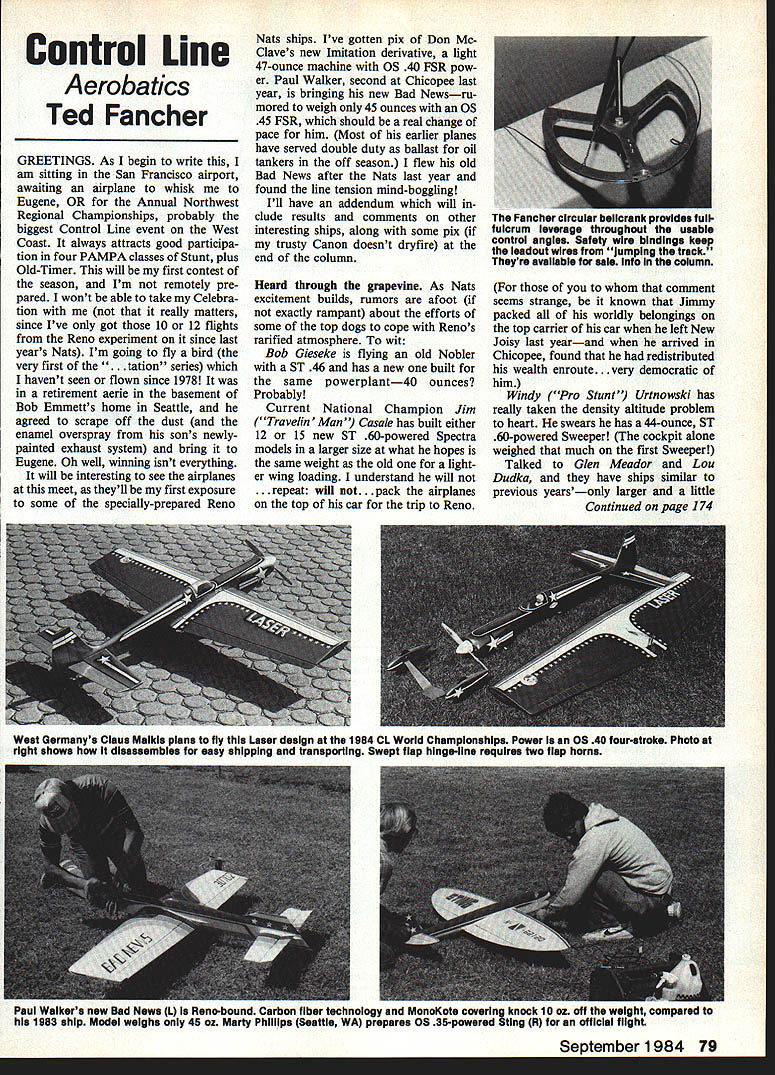
The famous (or infamous) Fancher 3½‑in. Circular Bellcrank is now available, very nicely machined by Mark Pollard, 5412 Brophy Dr., Fremont, CA 94536. Price is $10 (plus $3.75 postage and handling).
Ted Fancher 158 Flying Cloud Isle Foster City, CA 94009
Transcribed from original scans by AI. Minor OCR errors may remain.

