
Control Line: Aerobatics
Ted Fancher
Hello again, Stunt fans. I swear, between trying to get my Reno ship finished (it's now June 30th and I have just sprayed the clear over the Trim-Kote) and United Airlines insisting on my actually flying for my paycheck, I was beginning to wonder when (or if) I'd ever get a chance to get this thing written. So, barring Apple turning to cider, here goes.
After the meet in Eugene, OR was over last month, I was hanging around waiting for my return trip and noticed that the sharp young flier about whom I commented last month, Randy Schultz, was still at the contest site, apparently practicing. I went out to observe, and in so doing discovered a perfect subject for a column.
During the competition I had overheard Randy and Paul Walker discussing a trim problem with Randy's ship. When transitioning from insides to outsides (or vice versa), the aircraft would yaw noticeably with accompanying line-tension problems. Discussion and inspection of Randy's ship revealed it to be beautifully built, properly balanced, with the leadouts perhaps a little far forward, but in the ballpark. No readily apparent reason for the problem.
When I worked the leadouts, however, I was surprised to discover that the controls were set up with the front leadout as the Up line. Upon inquiring, I learned that this had been done on purpose and was intended to counteract "gyroscopic precession." Further discussion disclosed that the practice was nearly universal in the Northwest and apparently quite widespread throughout the country.
Wrong, methanol breath!
Stunt Glossary
- Roll: movement about the lateral (fore–aft) axis; wing tips going up or down.
- Pitch: movement about the horizontal (wing-tip-to-wing-tip) axis; nose going up or down.
- Yaw: movement about the vertical axis; nose going right or left.
- Dihedral: a design concept wherein the wingtips are higher than the root of the wing. Dihedral makes an aircraft stable in the roll axis — if one wing drops, its vertical lift component is greater than that of the raised wing and will naturally raise the low wing, maintaining a wings-level attitude.
- Positive-G maneuvers: insides.
- Negative-G maneuvers: outsides.
Gyroscopic precession was a term bandied about in Stunt circles a few years back when Al Rabe and his magnificent semi-scale Mustangs, Bearcats, and Sea Furies threatened to dominate the national competition scene. According to the theory propounded by Al, the mass of the spinning propeller acted as a gyroscope mounted to the front of the plane. A gyroscope, when displaced from its plane of rotation, propagates a force at 90° applied in such a manner as to cause yaw: right — aircraft pitched up; left — pitched down — thereby increasing line tension insides, decreasing outsides. Examples in this column will consider model flying normal anti-clockwise flight.
Applied in such a manner to cause yaw, the insidious force prompted Al to devise two gimmicks:
- The famous Rabe Rudder — connect the rudder to the elevator to apply right rudder on outside maneuvers.
- Front-Up leadout, rear-Down leadout — intended to cause the ship to yaw away from the pilot on outside maneuvers, thus neutralizing the evil precession.
First, let me make clear I defer no admiration for the accomplishments of Al Rabe. In Frank Sinatra's words, Bill Werwage and a handful of Stunt Masters feel Al sits very comfortably on that small list. However, with due respect, Al: gyroscopic precession effects are a real phenomenon, but the way a prop weighing under half an ounce, spinning at modest RPMs, simply isn't a significant trim problem on a three- to four-pound mass moving 50–60 mph. My estimation is the classic example of the right solution for the wrong problem.
Dihedral and the Real Cause
Al's ships did have a unique trim problem for which both of his devices were a clever solution. However, it wasn't gyroscopic precession!
All of Al's semi-scale ships were built with substantial amounts of dihedral. A wing with dihedral, while inherently stable in positive-G maneuvers (insides), is inherently "unstable" in negative-G maneuvers (outsides). This instability is unpredictable and may manifest itself as a roll to either the left or the right.
What both the Rabe Rudder and the front-Up line accomplished was to make the inevitable roll predictable and advantageous to the Control Line pilot by causing a yaw (and accompanying roll) away from the circle. As further evidence that these devices are best reserved for bending birds, see Al's own Mustang article (American Aircraft Modeler, February 1973), wherein he has endless trouble making the balanced rudder work on his basic and simple straight-winged Stunter and, in essence, ends up with almost no movement on the rudder.
'Nuff said? Well, no, not really, 'cause what I really wanted to discuss was "P-Factor."
P-Factor
What, you may well be asking yourself, is "P-Factor"? To direct the answer to this discussion: "P-Factor" is the reason that we should normally use a rear Up line and why, if we consider a right-wing rudder at all, we should hook it up to work the opposite of Al's — i.e., right rudder on insides!
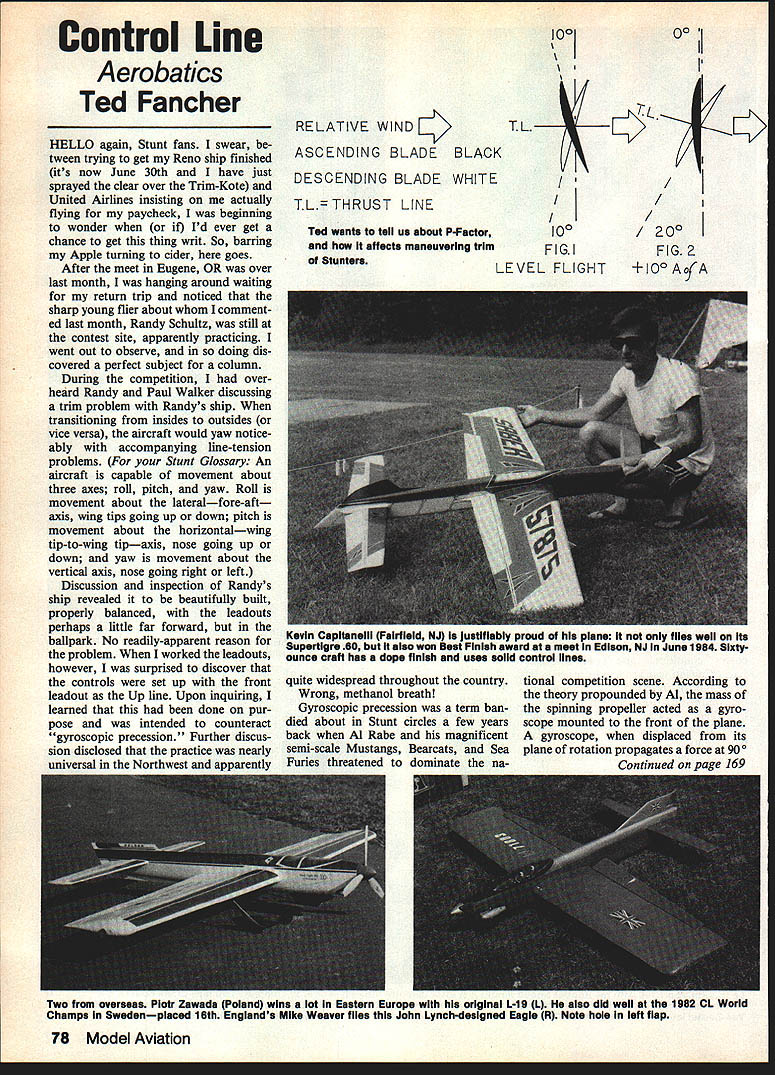
Any of you who are "real" plane pilots in addition to stunt jockeys are probably nodding knowingly to yourselves as the light dawns. Please refer to the drawings.
In level flight, both blades of a propeller are taking equal bites of the relative wind throughout their entire revolution, and thrust is therefore uniform at all points about the prop disc (see Figure 1). However, whenever the angle of attack of the aircraft is altered, the angle at which the relative wind strikes any given point on the aircraft — including any point on the prop disc — is changed in similar fashion (see Figure 2).
For example, let's say that in level flight a given point on the prop is taking a 10° bite out of the relative wind. It will do so throughout the entire 360° of propeller rotation, and the thrust developed by that point of the prop is constant throughout. Now, let's pitch up abruptly, as though entering a Square Loop. For simplicity's sake, let's say that the angle of attack thus achieved is also 10° and is sufficient to gain the lift needed for the rate of turn we desire. Now look at that same given point on the propeller and see what we have done to its angle of attack and, therefore, the thrust it delivers as it travels its 360° in its new relationship to the relative wind.
At the top and bottom of the prop disc, the angle of attack is unchanged, still at 10° to the relative wind and thus no change in thrust. However, at the right extreme (or descending) side of the prop disc we find that the prop is now striking the relative wind at an angle of attack of 20° and is thus producing much greater thrust than in level flight — approximately twice as much!
For an even greater surprise, check out our ever-popular "given point of the prop" at the left extreme (or ascending) side of the prop disc. Here, the 10° change of angle of attack of the aircraft has totally negated the 10° bite of the prop blade, and the propeller is, at that point, acting as a flat plate producing no lift (i.e., thrust) at all! Accepting that all points of rotation between those discussed are similarly affected in linear fashion, we must conclude that, although the thrust generated is equal to that produced in level flight, the center of that thrust — and therefore the point at which the thrust acts upon the airframe — has been shifted a significant distance to starboard. Since the center of drag has remained unchanged the net result will be a yaw to the left.
Solution? Use an aft Up line to cause a countering right yaw! Result? Right yaw cancels left yaw; therefore, there will be no yaw when properly trimmed. These forces are, of course, reversed in outside maneuvers. Thus, the Down line can be more forward to counteract the outboard yaw. Again, right minus left equals zero.
If you feel that "P-Factor" is an insignificant force, consider that a competitive Stunter has a thrust-to-weight ratio of approximately one to one and that even a minor center-of-thrust shift will, therefore, have a measurable impact. For verification, ask any real-plane pilot what he does with the rudder pedals of his prop-driven plane to maintain heading when climbing. You guessed it: right rudder!
One last test for the real doubting Thomases. After a practice flight when the CG is most aft (because most of the fuel has been consumed) and changes in line tension most obvious, do a series of both inside and outside Triangles. You will notice increased line tension in both sides, particularly in the top corners. Also, try some horizontal Hourglasses wherein the line tension on the outside loops isn't being reduced by the high elevation of a vertical maneuver. Again the "P-Factor" will be obvious.
Practical Hint
One last hint for those of you who have Stunters that hunt in level flight. What do you suppose happens if your leadouts are so far aft (in vain search of line tension) that the airplane is waving outward 10° from tangent? Vertical "P-Factor" at work! The bottom half of the prop disc is now producing more thrust than the top half and the result is a plane that quite logically wants to climb. Cute, huh?
Ted Fancher 158 Flying Cloud Isle Foster City, CA 94409.
Transcribed from original scans by AI. Minor OCR errors may remain.

