
Control Line: Aerobatics
Ted Fancher
Boy, do I have a lot to learn about writing things that can be interpreted a variety of ways and then sending them out to any and all persons of the Stunt persuasion! In my column for November 1984, wherein I discussed my visit with the Pro Stunt group in New Jersey, I teased the readers with a comment as to how I found Windy Urtnowski's lightweight ship impossible to fly. I then left it hanging with a vague promise to explain it the following month. Well, the last I heard, the Pro Stunt Mafia had put out a contract on my head for suggesting that one of their top hit man's pieces of equipment was less than full magnum in a rumble. Wrong, wrong, wrong, Godfather! Call off the troops, and I promise that with this column I will rectify all the misconceptions I appear to have sown from ocean to ocean. Listen up, guys, my life depends on it.
When I flew Windy's version of the L.J. design that afternoon, I flew it exactly as did Windy, with his trim setup, his lines, and most importantly, his handle. Therein lies the crux of my problem with the airplane—which obviously flies just fine, because I saw Windy do some very flashy patterns with it. The control handle, which sometimes is thought of as a simple device whose design is not very important, is in actuality an extremely important part of the entire Stunt package. Even more significant is the close personal relationship a flier of many years' experience develops with his handle and the feel of the aircraft which it delivers to his neuro-muscular system.
Windy's handle couldn't have been more different from mine. Whereas I have, since I was 11 years old, used a Hot Rock (or a modern adjustable variation thereof), Windy's handle was completely homegrown with, as I recall, narrower line spacing, significantly greater overhang, and a grip biased to achieve neutral with the "natural" hand position (slightly down), as opposed to the upright grip of the Hot Rock as neutral.
The net result of these differences was that the airplane felt totally foreign and unresponsive to me. The reason was the "man/machine interface"—the control handle. Let's examine handles closely and see if we can't all learn some things that will enable us to extract more performance from our Stunt package.
Handle design parameters
There are three separate and distinct design parameters built into any handle, and they interact with one another to deliver a certain feel to the flier:
- Response rate: Primarily a function of the line spacing, with a slight influence from handle overhang.
- Control feel: Primarily a function of handle overhang with some input from line spacing.
- Neutrality: A more vague parameter that depends on the interplay of spacing, overhang, grip angle, and subjective preference on the part of the pilot.
To start the study, let's define some terms and state the givens.
Definitions and givens
- Line spacing: The vertical distance from the Up line to the Down line with the handle in neutral. Specific examples addressed will be handles with spacing of 2, 4, and 5 inches.
- Overhang: The distance from the wrist hinge-point to the outermost point on the control handle where the leadout wires emerge from the confinement of the handle structure. For discussion purposes I assume the distance from the wrist hinge-point to the front of the handle grip is 3-1/2 inches.
- Plane reference: A horizontal line from the wrist hinge-point through the vertical center of the handle will be considered zero. Forces above this plane will be algebraically positive; below will be negative. This is simply the basis for some straightforward math used in the discussion of handle feel.
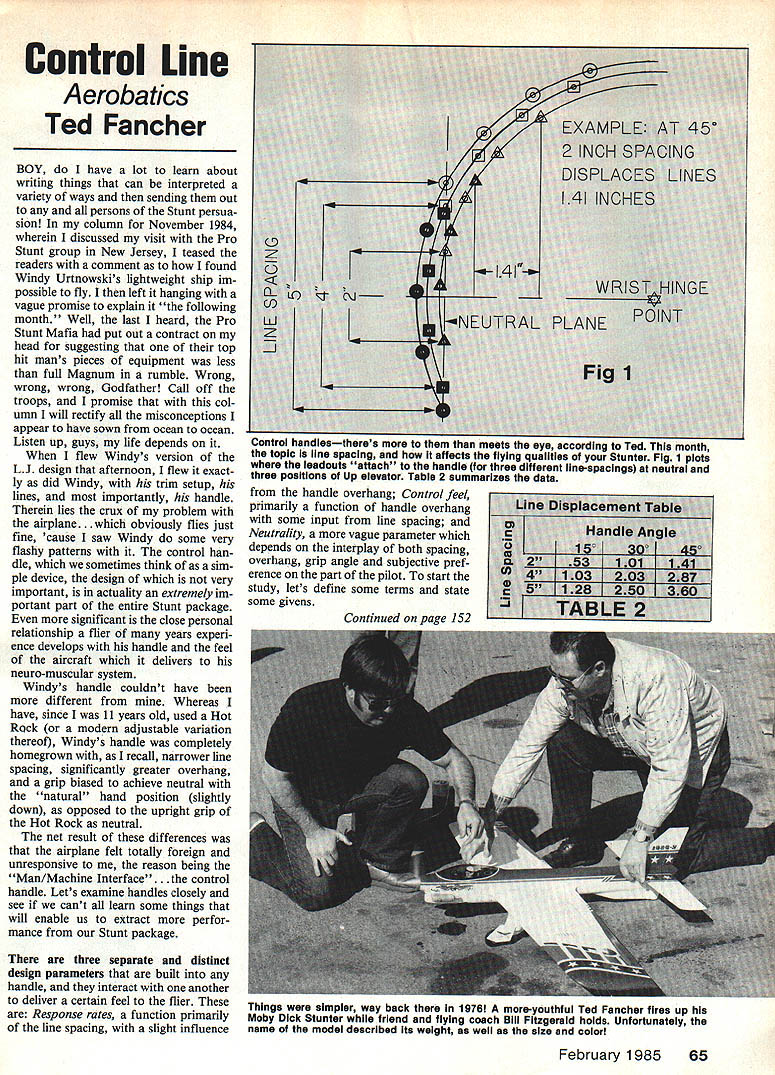
- Radius of rotation (handle deflection): Measured from the wrist hinge-point to the line-attach points. Thus, the greater the line spacing or overhang, the greater the radius of rotation. For brevity, only handle positions (rotations) of 0°, 15°, 30°, and 45° will be used.
- Line tension assumption: All force measurements assume a total line tension (pull) of 30 lb., divided equally between the Up and Down lines (i.e., 15 lb. per line).
- Pilot inputs: No consideration will be taken of the pilot's ability to use arm or body inputs to modify the handle's mechanically achievable capabilities. We'll assume such inputs apply equally to any handle and can therefore be ignored for comparison purposes.
- Control function simplification: Although the function of the handle is to deflect the flaps and elevators, a full study of the airborne control system is beyond the scope of this article. Therefore, we accept the function of the handle to be the moving of the leadouts at the wing tip; a line measurement of the movement will reflect the effects of inputs from our handle.
A friction-free control system will result in the load on the control lines being shared equally between the lines throughout all control deflections—but this holds true only up to the point that maximum control deflection is reached and you "hang the airplane" by a single line (a condition that is a sure sign of a poorly trimmed plane!).
Response rate (relative sensitivity)
Take a look at Figure 1 and its accompanying table (described here). The figure locates the position of the Up and Down lines at four different rotation angles—0°, 15°, 30°, and 45°—for three different line spacings of 2, 4, and 5 inches. The solid symbols indicate Down line position and open symbols the Up line. The plot is for Up elevator, and it is assumed that Down elevator or motor would produce identical plots but in reverse.
From this figure, the line-attach point differential between Up and Down lines was plotted and measured. The results were then posted in Table I. The numbers reflect the control line displacement from neutral at the handle and, therefore, at the wing tip. The larger the number, the greater the line displacement and the resulting control deflection for a given airplane. Clearly, the wider the line spacing, the greater the line displacement for a given angle of rotation; thus, the more sensitive the handle. No surprises here for most of us.
One important item to remember is that the maximum line displacement available from a handle is equal to the line spacing. No matter what you do with your hand, your leadouts cannot be separated by more than the line spacing.
Control feel is primarily a function of handle overhang with some input from line spacing. Neutrality is a vague parameter and depends on the interplay of both spacing and overhang and, of course, the grip angle—subjective preference is part of the pilot's choice.
(To be continued next month.)
Transcribed from original scans by AI. Minor OCR errors may remain.

