
Control Line: Combat
Gary Frost
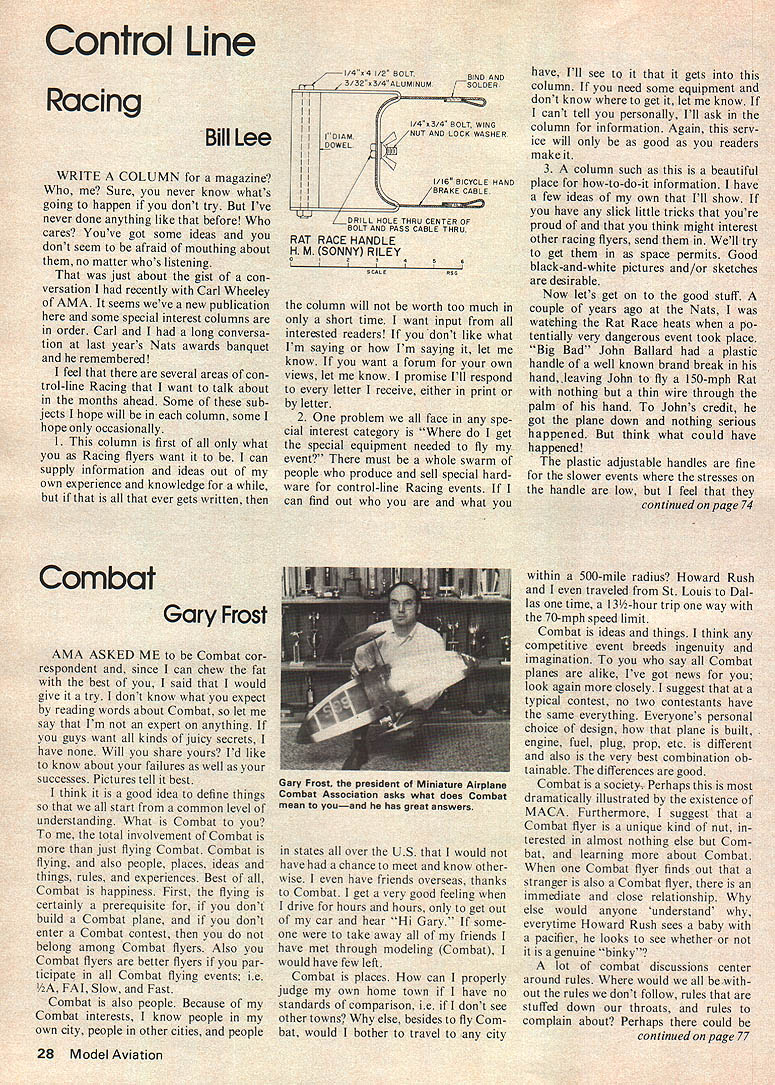
AMA ASKED ME to be Combat correspondent and, since I can chew the fat with the best of you, I said that I would give it a try. I don't know what you expect by reading words about Combat, so let me say that I'm not an expert on anything. If you guys want all kinds of juicy secrets, I have none. Will you share yours? I'd like to know about your failures as well as your successes. Pictures tell best.
I think it is a good idea to define things so that we all start from a common level of understanding. What is Combat to you? To me, the total involvement of Combat is more than just flying Combat. Combat is flying, and also people, places, ideas and things, rules, and experiences. Best of all, Combat is happiness. First, the flying is certainly a prerequisite for, if you don't build a Combat plane, and if you don't enter a Combat contest, then you do not belong among Combat flyers. Also you Combat flyers are better flyers if you participate in all Combat flying events; i.e. 1/2A, FAI, Slow Combat.
Combat is also people. Because of my Combat interests, I know people in my own city, people in other cities, and people in states all over the U.S. that I would not have had a chance to meet and know otherwise. I even have friends overseas, thanks to Combat. I get a very good feeling when I drive for hours and hours, only to get out of my car and hear "Hi Gary." If someone were to take away all of my friends I have met through modeling (Combat), I would have few left.
Combat is places. How can I properly judge my own home town if I have no standards of comparison, i.e. if I don't see other towns? Why else, besides to fly Combat, would I bother to travel to any city within a 500-mile radius? Howard Rush and I even traveled from St. Louis to Dallas one time, a 13 1/2-hour trip one way with the 70-mph speed limit.
Combat is ideas and things. I think any competitive event breeds ingenuity and imagination. To you who say all Combat planes are alike, I've got news for you; look again more closely. I suggest that at a typical contest, no two contestants have the same everything. Everyone's personal choice of design, how that plane is built, engine, fuel, plug, prop, etc. is different and also is the very best combination obtainable. The differences are good.
Combat is a society. Perhaps this is most dramatically illustrated by the existence of MACA. Furthermore, I suggest that a Combat flyer is a unique kind of nut, interested in almost nothing else but Combat, and learning more about Combat. When one Combat flyer finds out that a stranger is also a Combat flyer, there is an immediate and close relationship. Why else would anyone "understand" why, every time Howard Rush sees a baby with a pacifier, he looks to see whether or not it is a genuine "binky"?
A lot of combat discussions center around rules. Where would we all be without the rules we don't follow, rules that are stuffed down our throats, and rules to complain about? Perhaps there could be improvements to existing rules, but I suggest that, no matter how much we change the rules, that someone will always be unhappy. Perhaps that can be good, for if you take the time to complain, at least you are interested. If you are not interested, you will say nothing, and do nothing, regardless of what happens. I submit that if you are passive, even though you may have silent feelings, your time as a Combat flyer is limited, and for that, I feel sorry for you.
Combat is experiences. I have a few trophies of my own which I proudly display on specially made shelves. Their material value is small, but to me they are worth a fortune. I can look at each one and recall the people, places, and events that took place for me to achieve that particular trophy. The memories of each one are just as clear now, as they were the day it all happened.
We also need to put Combat in a proper perspective. How does it fit into the total picture, and how does it compare with other events? The typical Combat flyer necessarily has the highest standards of engine and plane performance of anyone in any event. You say that speed planes go faster? That's true, but we place more of a total demand on the engine. First we flip that prop all the time. Second, the thrust loads on Combat engines may be higher than on speed engines. Why else would a bronze bearing retainer hold up in Speed flying, but an identical one quickly and consistently disintegrate in a Combat engine? Also, I believe that there are big differences in setting up an engine for fast turning consistency as well as top speed, as compared to setting up an engine merely for fast straight and level flight. A 120-mph Combat engine that allows the plane to lose 30 mph in a turn is no good! How many other engines are asked to take high ratios of nitro and high rpms, and then after a crash, and in the middle of a proceeding match, and all pull off dirt, be restarted by hand flipping?
How about the Combat airplane? We would not win any appearance awards; but what other event forces one to not only build for flyability—that means keep the weight down—but also for impact strength, and for mid-air collision strength? What other 16- to 22-ounce plane has to take a 35-pound pull test?
Combat is the only event I can think of where quantity is as important as quality.
In spite of what I have said in the preceding paragraph, the pilot who enters a contest with six pieces of junk, is better off than the pilot who enters just one plane, regardless of how good it is. And here comes the builder of model rule into the picture. If you kill me with a borrowed plane, what difference does it make? Combat is not a building contest. And yet the control-line Contest Board, with all of its infinite wisdom says, "No, you need the builder of model rule, keep it for I know what is best for you. Besides, if I give in I'll have to give in everywhere!"
Wynn Paul of PAMPA fame, and World Aerobatic champ, Bob Gieske, both mentioned how hard it is to psyche up twice, in close order, and fly at your best both times. I believe that, and I'm not trying to take anything away from Bob, but isn't this exactly what a Combat flyer must do all the time? We must fly again and again, always on the same day. If we enter more than one Combat event, we double or triple the entire sequence. And all the time we must not think only of ourselves, but also help others by pitting in between our own flights/rounds. and there is no fly off again of finalists where you can place higher than you did in your qualifying heat. In short, as compared with other control-line events, there is no second chance. Now isn't that the highest degree of difficulty?
Typically, the Combat pilot has an exceptionally strong desire to win. Why else do you think we argue so much? And no wonder: look at what we must go through every time we fly. We must psyche up for each match, and detach ourselves from the importance of our planes, even though we just finished them. In what other event are there so many things one can do wrong, so many chances for your being immediately disqualified, even for accidental and unknowing acts by your own pit crew? Combat pilots necessarily must have a quick and correct reaction to any situation. We can't come to a contest with merely one game plan, but several, because everyone has his own unique style that has to be reckoned with. And we must execute those plans, at the right moment, in a split second, and maybe several times, and always correctly. There is no second chance. At your first mistake, you are likely to be done for the entire day. Is that good or bad?
The pilot must put up with all of the above possibilities, and even though he does so correctly, there still appears to be an element of luck involved. Should several big names appear to a Stunt contest, I think generally one can predict the winners. Not so in Combat. Who among you can always beat anyone, at any time?
Well, these are some of my ideas about Combat. My goal is to educate all readers of this column about Combat. I've got a hang-up about people talking about events they don't fly. Write and let me know what you think about what I've said. What would you like to see in this column, and will you please contribute something? Send to Gary Frost, 22 Glynn Dr., Florissant, Mo. 63031.
Transcribed from original scans by AI. Minor OCR errors may remain.

