
Control Line: Combat
Gary Frost
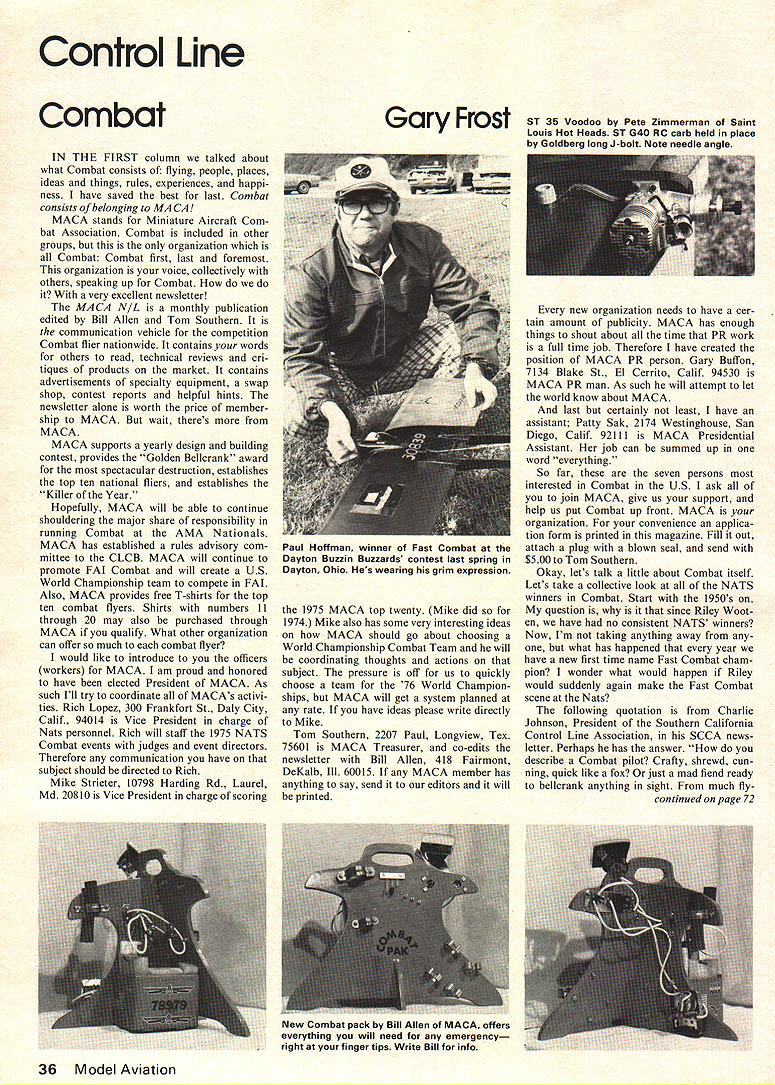
IN THE FIRST column we talked about what Combat consists of: flying, people, places, ideas and things, rules, experiences, and happiness. I have saved the best for last. Combat consists of belonging to MACA.
MACA stands for Miniature Aircraft Combat Association. Combat is included in other groups, but this is the only organization which is all Combat: Combat first, last and foremost. This organization is your voice, collectively with others, speaking up for Combat. How do we do it? With a very excellent newsletter!
The MACA N/L is a monthly publication edited by Bill Allen and Tom Southern. It is the communication vehicle for the competition Combat flier nationwide. It contains your words for others to read, technical reviews and critiques of products on the market. It contains advertisements of specialty equipment, a swap shop, contest reports and helpful hints. The newsletter alone is worth the price of membership to MACA. But wait, there's more from MACA.
MACA supports a yearly design and building contest, provides the "Golden Bellcrank" award for the most spectacular destruction, establishes the top ten national fliers, and establishes the "Killer of the Year." Hopefully, MACA will be able to continue shouldering the major share of responsibility in running Combat at the AMA Nationals. MACA has established a rules advisory committee to the CLCB. MACA will continue to promote FAI Combat and will create a U.S. World Championship team to compete in FAI. Also, MACA provides free T-shirts for the top ten combat flyers. Shirts with numbers 11 through 20 may also be purchased through MACA if you qualify. What other organization can offer so much to each combat flyer?
I would like to introduce to you the officers (workers) for MACA. I am proud and honored to have been elected President of MACA. As such I'll try to coordinate all of MACA's activities. Rich Lopez, 300 Frankfort St., Daly City, Calif. 94014 is Vice President in charge of Nats personnel. Rich will staff the 1975 NATS Combat events with judges and event directors. Therefore any communication you have on that subject should be directed to Rich. Mike Strieter, 10798 Harding Rd., Laurel, Md. 20810 is Vice President in charge of scoring. Tom Southern, 2207 Paul, Longview, Tex. 75601 is MACA Treasurer, and co-edits the newsletter with Bill Allen, 418 Fairmont, DeKalb, Ill. 60115. If any MACA member has anything to say, send it to our editors and it will be printed.
Every new organization needs to have a certain amount of publicity. MACA has enough things to shout about all the time that PR work is a full-time job. Therefore I have created the position of MACA PR person. Gary Buffon, 7134 Blake St., El Cerrito, Calif. 94530 is MACA PR man. As such he will attempt to let the world know about MACA.
And last but certainly not least, I have an assistant; Patty Sak, 2174 Westinghouse, San Diego, Calif. 92111 is MACA Presidential Assistant. Her job can be summed up in one word: everything. So far, these are the seven persons most interested in Combat in the U.S. I ask all of you to join MACA, give us your support, and help us put Combat up front. MACA is your organization. For your convenience an application form is printed in this magazine. Fill it out, attach a plug with a blown seal, and send with $5.00 to Tom Southern.
Okay, let's talk a little about Combat itself. Let's take a collective look at all of the NATS winners in Combat, starting with the 1950's on. My question is, why is it that since Riley Wooten we have had no consistent NATS winners? Now, I'm not taking anything away from anyone, but what has happened that every year we have a new first-time name as Fast Combat champion? I wonder what would happen if Riley would suddenly again make the Fast Combat scene at the Nats? The following quotation is from Charlie Johnson, President of the Southern California Control Line Association, in his SCCA newsletter. Perhaps he has the answer. "How do you describe a Combat pilot? Crafty, shrewd, cunning, quick like a fox? Or just a mad fiend ready to bellcrank anything in sight. From much fly- ing, and even more observing, I think the latter is a better description of 90 percent of the pilots now flying. You can win once in a while by charging in and aiming for the other guy's plane, or wrapping lines and hoping to either somehow kill him, or win on air points, but you never become a Riley Wooten or Carl Berryman with such tactics.
"Take a look at other sports. Seldom does a boxer finish a match in 15 seconds or a chess player win in a five-move blitz. Most Combat matches last less than 15 seconds after the second plane is airborne and, in the majority of cases, one or both of the planes is destroyed. Neither pilot really got to use his skill or reflexes (if he has any), and more important is the fact that neither pilot learned a darn thing from the experience! The loser thinks he could have won if he'd had the latest Elephant motor in his plane, or it could turn three-foot loops, etc. Winner, of course, thinks it was all skill that brought him through the line tangle and subsequent mid-air that he won.
"If you fly 'Combat' you don't lose a plane every night and you learn something from your mistakes because you fly like the fighter and chess player. Take your time—there's five minutes. Fake a little, stay away until you get a shot at your opponent without giving him a chance at your streamer. When you trade blows you've got about a 50 percent chance of a win, much less the chance you take in losing a good flying airplane. So what if you want to box, and the other guy wants to slug it out? I guess I'm lucky here in San Diego because there are several really good pilots who enjoy a good long match where winning isn't so important, but how they flew is. These matches are almost always better than in contests because we pass up cuts and kills to avoid a mid-air.
"Of course, you've got to expect to lose a lot of the time, too. I once lost nine straight matches because I just flew around and played target plane. Some guys have to win every match to keep their image; they usually get to watch us fly because no one will fly with them because losing a plane in practice isn't too neat. There is something called sportsmanship, too."
FAI Equipment: "I'd like to call your attention to the AMA rulebook, page 65, Item 5, 4th sentence. 'The distance from the axis of the handle to the point of attachment of the control line shall not exceed 400 millimeters (16").' That means if you are using an E-Z Just Handle you are illegal!"
I received a letter from Dave Clarkson in response to a question I asked him: "What kind of handles do they use in FAI combat in Europe?" I told him that I had been using the E-Z Just handle. (Why is it called "Hot Rock"? — no, actually less sensitive than the "standard" handle.) Dave replied, "Your handle should be 50 cm, the 40-mm rule has never been enforced — I would reckon at least 50 percent fly with illegal handles etc." I'm relieved that someone else recognizes the difficulty of this 40-mm rule. What is really disgusting to me is that no where can one purchase a "legal" FAI handle, which means we are on our own. Individually constructing handles is distasteful; the novice can undoubtedly construct something unsafe. I've seen a few boom-handles used, and, personally, that lacks class. I'm for making the road like the map: We ought to do things by the book the way the book reads. So, in this case, we either need a special handle made readily available, or we need a rule change to allow the use of something more common. I cannot understand why only 1 1/2 inches; and would like to see this rule changed to be uniform with our standard equipment. If any of you agree with me, or have any other ideas you would like to see incorporated into FAI rules, or dropped from FAI rules, John Worth is the one to write to. To have your ideas considered for the next CIAM meeting you must have your ideas submitted to AMA (John Worth) no later than Sept. 1, 1975. I have been using the AMA rules change proposal form and getting two endorsements (one a C.D.) on it. Also, send a carbon copy to Dr. Laird Jackson, 523 Meadowbrook, St. David's, PA 19087, as Doc is a member of the CIAM CL subcommittee and he may be able to get that group to consider new ideas aside from any proposals from the U.S.A.
Transcribed from original scans by AI. Minor OCR errors may remain.

