
Control Line: Combat
Charlie Johnson
The Miniature Aircraft Combat Association recently announced the Overall Top Twenty Combat Pilots for 1976. Here are the results for your information and admiration:
- Bob Burch, Forest Park, Ill.
- Marlin McGee, Oklahoma City, Okla.
- Phil Cartier, Palmyra, Penn.
- Jordan Segal, Niles, Ill.
- Gary Frost, Florissant, Mo.
- Dan Rutherford, Bothell, Wash.
- Gary Stevens, Seattle, Wash.
- Bob Naville, New Albany, Ind.
- Paul Curtis, Jeffersonville, Ind.
- Greg Hissem, Rose Hill, Kan.
- Mike Strieter, Laurel, Md.
- Paul Smith, Wichita, Kan.
- Bill Budzioch, Palatine, Ill.
- George Connors, Manville, N.J.
- Neal Rose, Hammond, Ind.
- Chuck Rudner, Gainesville, Fla.
- Charlie Johnson, San Diego, Calif.
- Mike Guthamson, Kingsbury, Tex.
- Falcon McAllister, Amarillo, Tex.
- Howard Rush, Hampton, Va.
- Steve Sacco, Norwell, Miss.
The above list was compiled by Mike Strieter who promises the MACA Top Ten, in Fast, Slow, and FAI Combat soon. Only MACA members are listed and only contests entered while a MACA member are counted. Only WAM and AMA sanctioned meets were included.
Getting the latest news is just one of the benefits of being a MACA member. To join the world's largest combat organization send $6.00 to the new MACA Treasurer, Pat Sak, 309 S. Kansas, Edwardsville, IL 62025 ($10.00 if overseas). By the way, Gary Frost has been re-elected as President and Ben Sasnett remains newsletter editor.
What to do and where to go for the Fourth of July holiday? The USA team selection will take place in St. Louis, July 2 and 3, so if you would like a position on the U.S. team better send your $25.00 entry fee to AMA HQ pronto. Also, purchase the $5.00 type FAI stamp and tell a friend. Two double eliminations meets will be held with the winner on Saturday assured of a team spot as well as Sunday's top placer. The other top finishers fly off for the remaining position and first and second alternate. Don't worry about the details, just bring lots of planes and your favorite pit person. The entry deadline is June 15 so get your bucks to AMA right away—after this date it's $50.00! All the entry money goes into the FAI travel fund.
The MACA N/L has been alive with proposals on how to run and select the team complete with diagrams, sketches and 8 x 10 glossies. With the exception of about a half dozen MACA members, no one else has even participated in an international contest. Where were all the big talkers last summer when we needed them at the Preliminary World Championships in Holland? Unfortunately, it looks like the Dutch International will be held about the same time as our Nationals and no date has been set for the British Nationals as yet. So how do you get your feet wet in some big time FAI Competition? The California Criterion will be held in Los Angeles over the Memorial Day weekend, and the Nationals in August. That's it!
Slow Combat and the man in the street.
With the exception of Profile Carrier there has never been an event that has generated so much in the way of proposals and bickering. The great majority want to make it a simple event with as much difference in the way of technique, style and procedure to make it on its own rather than as Fast Combat's little brother. So let's differ... the event is easier on equipment if only paper cuts are counted (string cuts do not end the match nor do they count 100 points). When only cuts count, the pilots soon learn that following and nibbling are the only ways to get those big scores, the head-on pass and quick (and lucky) kill soon are a thing of the past. Proposals have been made to allow a one-minute starting period before the 5-minute air time phase. Either the pilot or pit person could start and tune the engine, the plane launched at the 5-minute bell with a full load of fuel. The emphasis would be on the 5-minute flying portion, not on starting the engine and getting into the air first.
The canopy, wing area, fin, and landing gear on a Slow Combat ship don't make a lot of difference in performance. Wing area restrictions have had no effect on current plane design since there isn't one competitive plane at 300 sq. in. The biggest performance limiter is weight. It is possible to build sub-20-ounce Slow Combat planes with the engine against the leading edge and a lightweight tail assembly with a token stab and hinged stabilator. Even if this combination turns no better (you better believe it will) than its longer nosed rival it will still out-perform it where weight really makes a difference, climbing and acceleration out of turns. Okay, so the short nosed planes are cheaper to build and stronger, but they require an inboard tank that is a lot more trouble than a tank in the conventional location behind the engine; they can be made to work but it's a lot more trouble. If there were a minimum length from the LE to the thrust washer—like 6 or 7 inches—it would allow everyone to build conventional planes with large tanks in the outboard position. Longer and heavier noses would require a longer and/or heavier tail assembly to get the thing to balance. The net result would be to be up the total weight of the plane several ounces, especially at the start where the all-up weight is increased by 4 ounces of fuel. This type of plane wouldn't be as dazzling as current varieties but would put them back in the ballpark with the kit-type Flite Streak. The original intent of the Slow Combat event was to have an easy event where a guy could purchase a kit-type airplane and have a fair chance of placing, if his skills were up to it. There is a movement in some areas to build one-design combat planes with minimum weights, the idea being that pilot skill will determine the winner and not the airplane.
Gentlemen, Start Your Engines:
Recently a letter was circulated among the Advisory and Contest Boards arguing the case against requiring pilots to start their own engines (especially Junior age pilots). Safety and frustration being main points, with an analogy about Air Force pilots having to start their own engines and thus losing the war. Both little and big kids could use a stick to flip the prop if they're that frightened or have such a nasty engine. How about getting the kid an engine he is capable of starting? If someone is incapable of starting a model engine, do you think he is capable of flying a potentially dangerous missile at over 100 mph? If we have to decide a match on air points, it would seem that the pilot should have earned them, right? And now for those of you who say that it doesn't make any difference who starts the engine. The next time one of the super pit crews starts your opponent's engine before you get yours fired, just ask them to hold it on the ground until you get going since there's no advantage. Good luck.
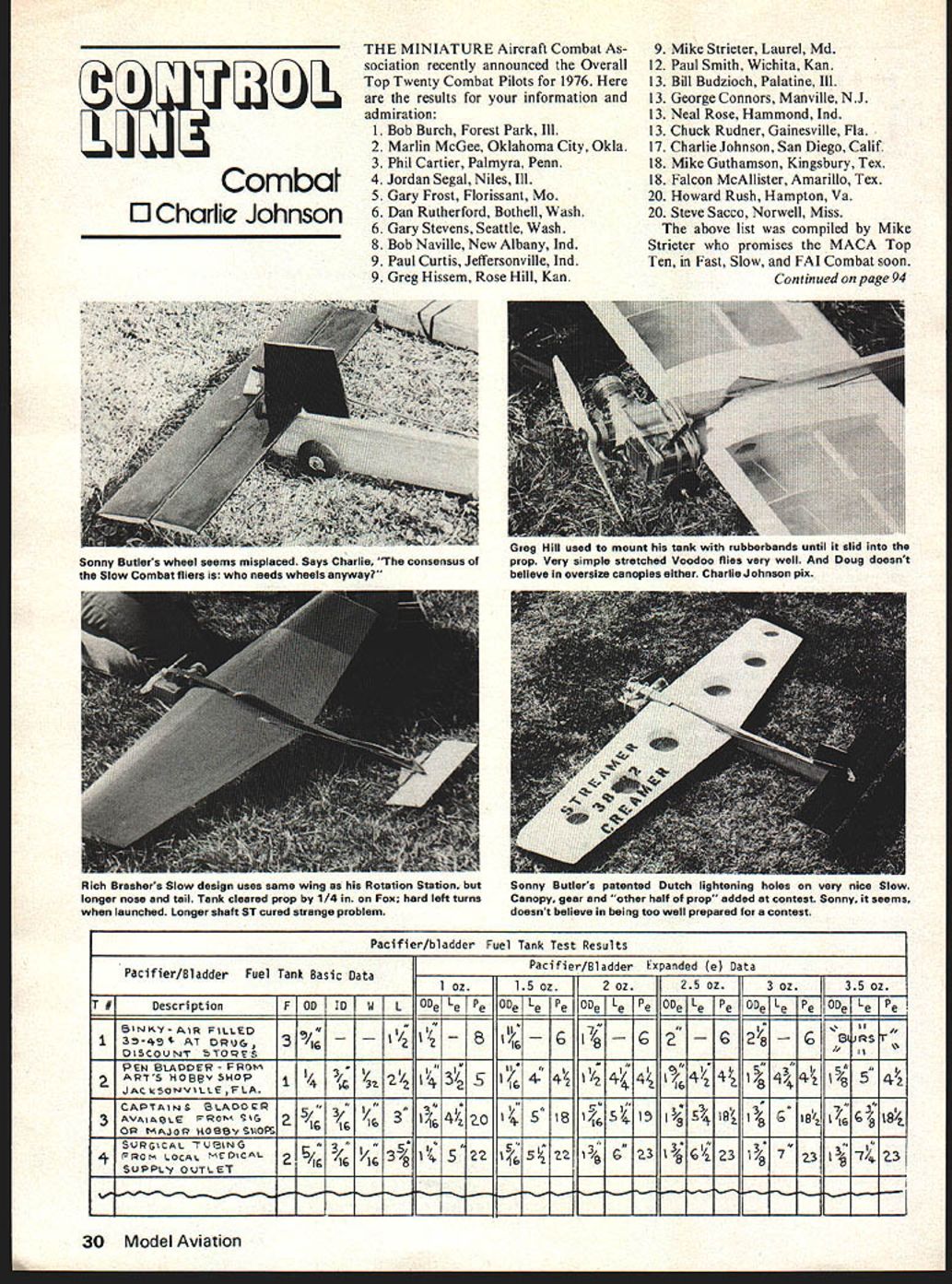
Howard Shenton had a very interesting report in the February 1977 issue of the MACA N/L concerning various bladder/pacifier tanks. According to Howard, the surgical tubing bladders seem the way to go. They're cheaper and can be tailored to your requirements by selecting the proper diameter and wall thickness tubing. He's making up an even more accurate and reliable metering system and will check your bladder/pacifier system and report the findings to the MACA N/L for publication.
Notice the tremendous difference in pressure when each is filled with 3 ounces of fuel. All the way from 4½ psi to 23 psi. The heavy walled tubing rarely breaks, even in a crash, but is critical on needle settings. If you have a system you want tested send a couple samples to: Howard Shenton, 310 Drury Lane, Mauldin, SC 29662.
A Buck's Worth: A challenge recently appeared from two-time Nationals winner Sherwood Buckstaff. In his letter to MACA he asks that anyone interested in taking up his challenge bring along a few extra airplanes and several hundred dollars to this year's Nats "just to make it interesting." Those Texans not only want all the gold but our greenbacks too! Can anyone beat the Texans this year? Brasher, Strieter, Rush, Danny Dirt hisself? The combat world's reply will appear in the next column.
Closing thoughts (finally). The next time you're at a contest be sure to give all the officials a hard time because "you pay their salaries." Abuse in direct proportion to the salary you pay them. Just so you don't take me seriously, let me tell the great many of you that have never even helped at a contest, much less CD'd one, that officials don't receive a penny for their efforts. Keep this in mind, especially at the
Nationals this summer. When was the last time you thanked the host club for putting on a good contest?
Please send friendly letters and inquiries to me, nasty notes go to the MACA Newsletter, write:
Charlie Johnson, 3716 Ingraham St., San Diego, CA 92109.
Transcribed from original scans by AI. Minor OCR errors may remain.

