

CONTROL LINE: COMBAT
Rich von Lopez 8334 Colegio Drive, Los Angeles, CA 90045
Many pilots use 1/2A Combat as a means to sharpen their reflexes for the larger-displacement Combat events. The nimble, quick, and light-on-the-lines 1/2A models require that you think fast.
The 35-foot lines have you spinning in the pilot's circle at a rapid rate. Provided you are flying on a plush field and your five- to six-ounce model was built with solid structural integrity, most encounters with mother earth will result in no damage.
For years, the only serious 1/2A engine available was the Cox Tee Dee .049. These were fine as long as you did not exceed the red line of about 24,000 rpm. I used these engines for years, and broke many of them—broken cases, crankshafts, pistons, rods, and ball-and-socket joints. These engines have also given me countless hours of fun for very little cost.
Now there are several alternatives to the Cox .049; two of these options come from Russia.
Stels .049
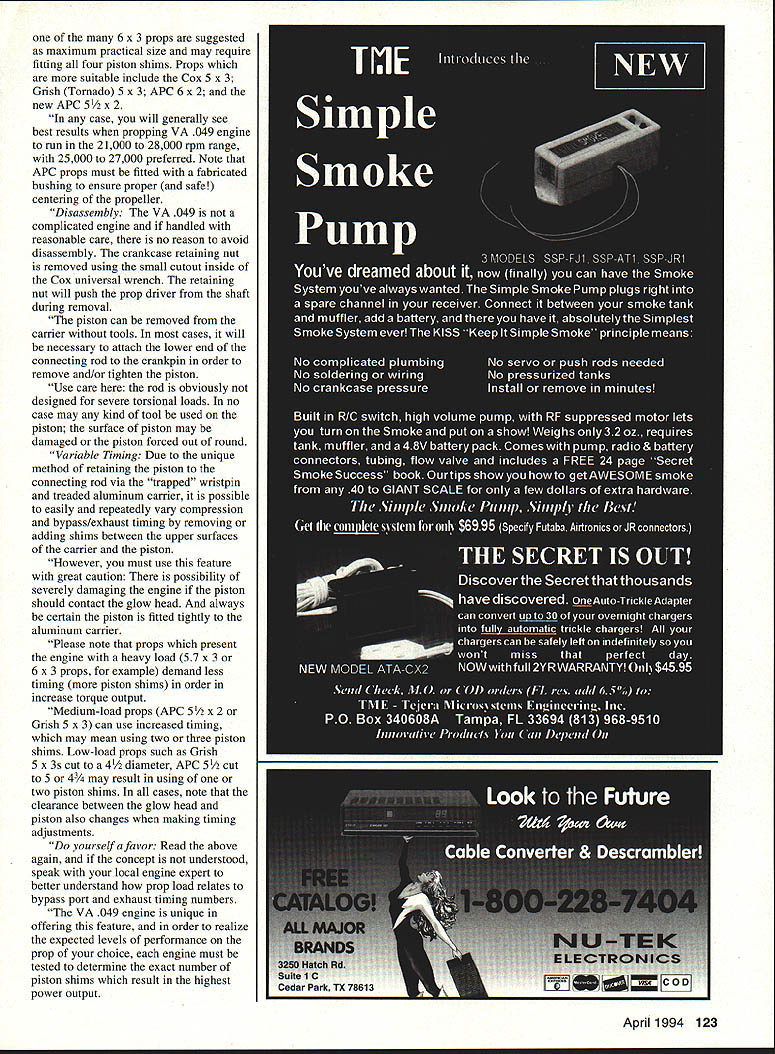
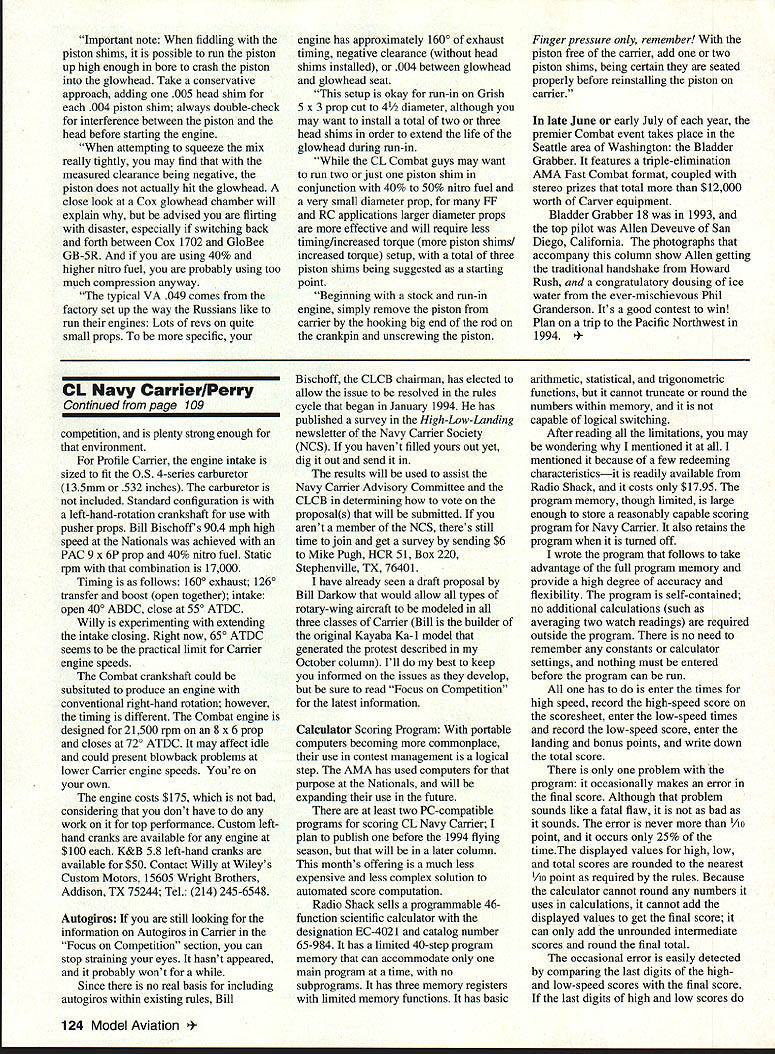
The Stels .049 has been developed and manufactured by Alexander “Sasha” Gieviesky, the engine man behind two-time World Champion Slava Believ. These beautiful little engines feature twin rear exhausts that angle over and under the leading edge.
- The mounting lugs have the same bolt pattern as a Cox Tee Dee .049.
- The engine is designed to take Cox Tee Dee glow heads as well as GloBee two-piece racing heads or an aftermarket adapter for Nelson glowplugs.
A problem I encountered was that the copper shims which come with Cox heads have an outside diameter that is just a little too large for them to fit comfortably in the cylinder seat. A little careful sanding on the gasket fixes this.
These engines respond well to 40% to 50% nitro fuel and small 4-1/2- or 4-1/4-inch-diameter props. I have been using the Grish 5 x 3 cut to the above-mentioned diameters. I also true up the hubs and balance the blades.
The cylinder on the Stels is integrated with the cooling fins, and is attached to the case with three slotted bolts. I replaced these with Allen bolts. I did not attempt to lap-fit the piston to the cylinder. It was hard to start for the first few runs, but then so were most of the Cox engines I have owned.
I use a Nelson glowplug adapter with two gaskets and 40% nitro fuel on my two engines. Neither engine has much time on it, but they both show great potential. It would not be fair to give any numbers on rpm or speeds until they are fully broken in. Look for this data in future columns.
The engines are available from Scott Newkirk of Race Force, Inc., P.O. Box 342, Edmonds, WA 98020-0342; Tel: (206) 774-6456; Fax: (206) 775-1869. Their price is currently $80. Plan to spend an extra $10 for a Nelson glowplug adapter.
There is also a special Stels .049 glowplug available for $4 or 10 for $36. I have some of these, but have not yet tested them. These engines are about the same weight as a Cox .049, so you can bolt them right onto existing models and have them perform the same.
VA .049 (another option)
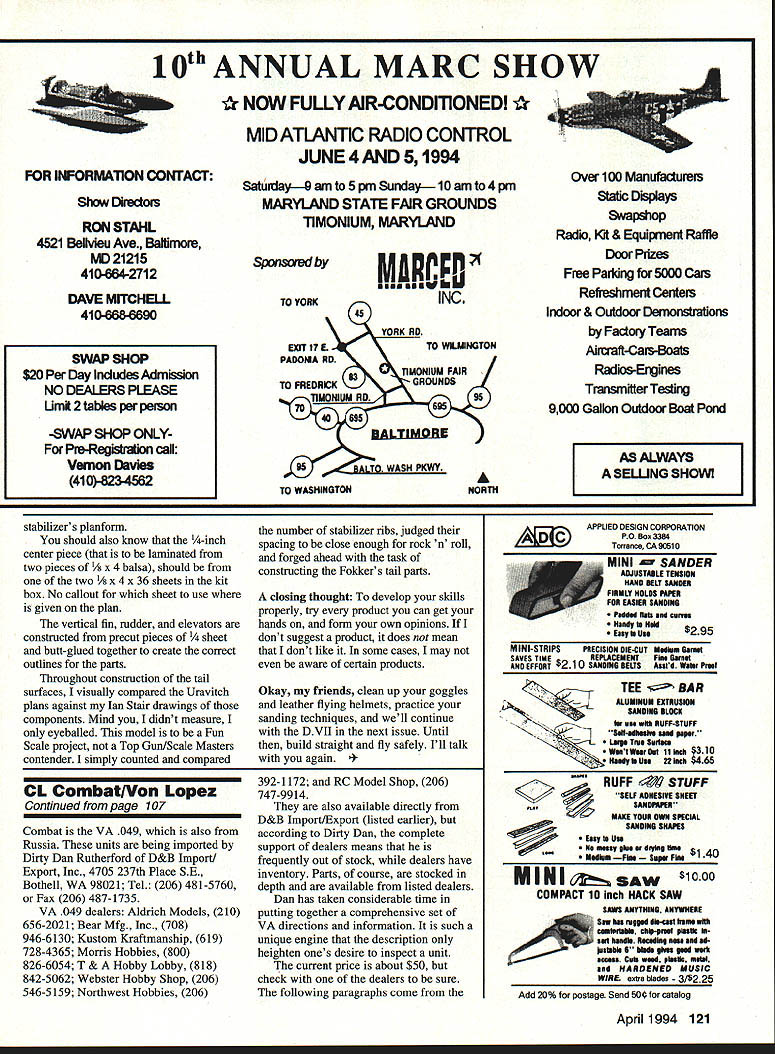
The other engine to consider for 1/2A Combat is the VA .049, which is also from Russia. The units are being imported by Dirty Dan Rutherford of D&B Import/Export, Inc., 4705 237th Place S.E., Bothell, WA 98021; Tel: (206) 481-5760; Fax: (206) 487-1735.
VA .049 dealers:
- Aldrich Models, (210) 656-2021
- Bear Mfg., Inc., (708) 946-6130
- Kustom Kraftmanship, (619) 728-4635
- Morris Hobbies, (800) 822-6054
- T & A Hobby Lobby, (818) 842-5062
- Webster Hobby Shop, (206) 546-5159
- Northwest Hobbies, (206) 392-1172
- RC Model Shop, (206) 747-9914
They are also available directly from D&B Import/Export (listed earlier), but according to Dirty Dan, the complete support of dealers means that he is frequently out of stock while dealers have inventory. Parts, of course, are stocked in depth and are available from the listed dealers.
Dan has taken considerable time in putting together a comprehensive set of VA directions and information. It is such a unique engine that the description only heightens one's desire to inspect a unit. The current price is about $50, but check with one of the dealers to be sure.
The VA .049 (0.8cc) Engine
The VA .049 has been designed to be a very lightweight, high-performance competition engine suitable for many 1/2A events. The goal is to supply modelers with an engine lighter than any other available while using current technology and materials to offer increased power when compared to US-produced standard engines.
As design work progressed, the need for a more reliable method of attaching the piston to the rod was apparent. The elegant solution seen in the VA .049—an externally threaded carrier for the wristpin screwing into the internally threaded piston—gives excellent reliability and is regarded as superior to all other designs. The option of shimming the piston to offer variable compression and timing was added as well.
Further details:
- The VA .049 is very light (35 grams / 1.25 ounces), powerful, and versatile.
- The piston is manufactured from high-silicone-content aluminum, as is the crankcase.
- The case (cylinder) bore is plated with nickel/phosphorus. This combination is referred to as AAN construction and has been shown to offer superior power, long engine life, and improved glowhead life.
Suggested uses include:
- FF
- AMA 1/2A Gas
- FAI
- Scale
- Combat (CL: 1/2A Combat, 1/2A Racing, 1/2A Sport, 1/2A Proto Speed, Sport)
- RC (1/2A Pylon Racing, 1/2A Pattern, ducted fans, Glider Power Boost, Sport)
Initial Setup
The VA .049 as supplied is set up for high-speed operation (27,000 rpm and higher) on relatively small propellers (Grish, Tornado) such as 5 x 3 cut to 4-1/4, or APC 5-1/2 x 2 cut to 4-1/4.
While this setup can be used during run-in, it is suggested that you disassemble the engine and install a total of three piston shims along with a total of four head shims. Extensive testing has shown resulting timing and compression will give excellent power on many commonly used 1/2A props. Please review the engine disassembly section prior to performing this operation.
Suitable propellers:
- APC 5.7 x 3 or some of the 6 x 3 props are suggested as maximum practical sizes and may require fitting all four piston shims.
- Props more suitable include the Cox 5 x 3; Grish (Tornado) 5 x 3; APC 6 x 2; and the APC 5½ x 2.
- In any case, you'll generally see best results when propping the VA .049 to run in the 21,000 to 28,000 rpm range, with 25,000 to 27,000 preferred.
- Note: APC props must be fitted with a fabricated bushing to ensure proper (and safe) centering of the propeller.
Disassembly
The VA .049 is not a complicated engine and if handled with reasonable care, there is no reason to avoid disassembly. The crankcase retaining nut is removed using the small cutout inside of the Cox universal wrench. The retaining nut will push the prop driver from the shaft during removal.
The piston can be removed from the carrier without tools. In most cases, it will be necessary to attach the lower end of the connecting rod to the crankpin in order to remove and/or tighten the piston.
Use care here: the rod is not designed for severe torsional loads. In no case may any kind of tool be used on the piston; the surface of the piston may be damaged or the piston forced out of round.
Variable Timing
Due to the unique method of retaining the piston to the connecting rod via the "trapped" wristpin and treated aluminum carrier, it is possible to easily and repeatedly vary compression and bypass/exhaust timing by removing or adding shims between the upper surfaces of the carrier and the piston.
However, use this feature with great caution. There is a possibility of severely damaging the engine if the piston should contact the glow head. Always ensure the piston is fitted tightly to the aluminum carrier.
Prop load vs. timing guidance:
- Heavy-load props (5.7 x 3 or 6 x 3, for example) demand less timing (more piston shims) to increase torque output.
- Medium-load props (APC 5½ x 2 or Grish 5 x 3) can use increased timing, which may mean using two or three piston shims.
- Low-load props such as Grish 5 x 3s cut to a 4½ diameter, or APC 5½ cut to 5 or 4¾, may result in using one or two piston shims.
- In all cases, note that the clearance between the glow head and piston also changes when making timing adjustments.
Do yourself a favor: read the above again, and if the concept is not understood, speak with your local engine expert to better understand how prop load relates to bypass port and exhaust timing.
The VA .049 engine is unique in offering this feature, and in order to realize the expected levels of performance on the prop of your choice, each engine must be tested to determine the exact number of piston shims which result in the highest power output.
The engine has approximately 160° of exhaust timing, negative clearance (without head shims installed), or about .004" between the glowhead and glowhead seat. This setup is okay for run-in on a Grish 5 x 3 prop cut to 4½ diameter, although you may want to install a total of two or three head shims to extend the life of the glowhead during run-in.
While CL Combat pilots may want to run two or just one piston shim in conjunction with 40% to 50% nitro fuel and a very small diameter prop, for many FF and RC applications larger diameter props are more effective and will require less timing / increased torque (more piston shims). A total of three piston shims is suggested as a starting point for heavier-propped applications.
Starting procedure for shim changes:
- Beginning with a stock and run-in engine, remove the piston from the carrier by hooking the big end of the rod on the crankpin and unscrewing the piston.
- Use finger pressure only. With the piston free of the carrier, add one or two piston shims, being certain they are seated properly before reinstalling the piston on the carrier.
Events
In late June or early July of each year, the premier Combat event takes place in the Seattle area of Washington: the Bladder Grabber. It features a triple-elimination AMA Fast Combat format, coupled with stereo prizes that total more than $12,000 worth of Carver equipment.
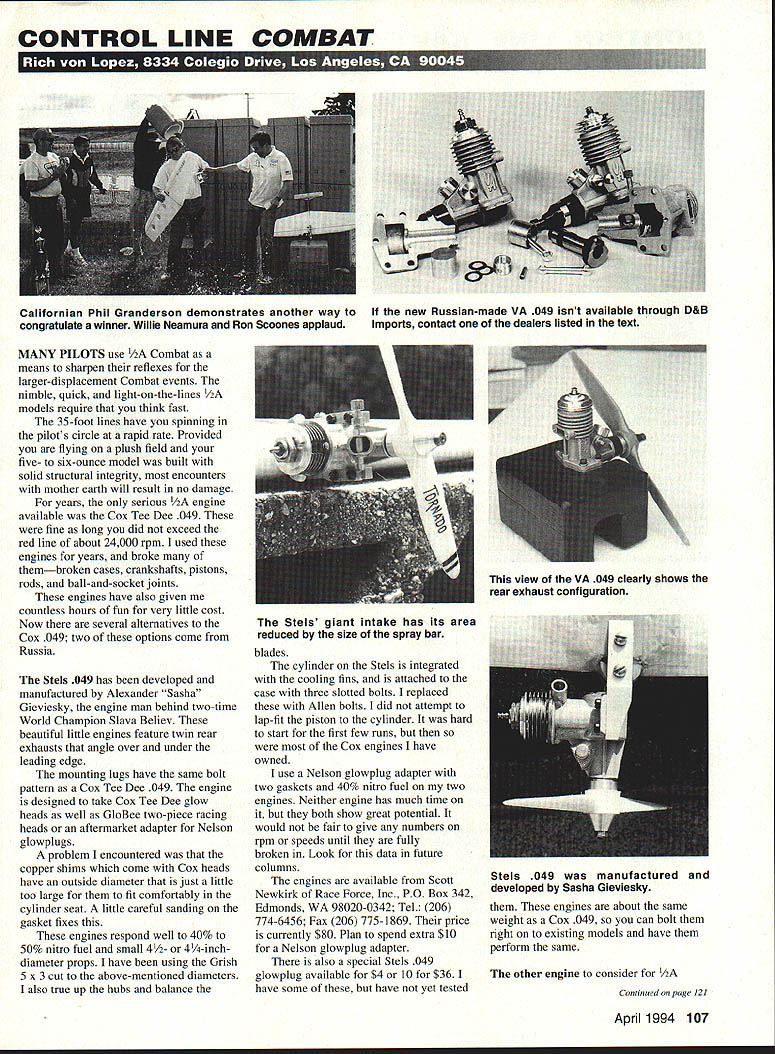
Bladder Grabber 18 was in 1993, and the top pilot was Allen Deveau of San Diego, California. The photographs that accompany this column show Allen getting the traditional handshake from Howard Rush and a congratulatory dousing of ice water from the ever-mischievous Phil Granderson. It's a good contest to win! Plan on a trip to the Pacific Northwest in 1994.
Transcribed from original scans by AI. Minor OCR errors may remain.

