
CONTROL LINE COMBAT
Rich von Lopez 8334 Colegio Drive, Los Angeles, CA 90045
Introduction
Control Line Combat must be one of the most entertaining and exciting aeromodeling activities in the country—or the world. Only Team Race and RC Pylon Racing offer a similar level of excitement to spectators and competitors. The element of danger attracts both competitors and spectators to the Combat circle.
The danger stems from the expendability of the model aircraft. When there is risk of damage to one's model, the flow of adrenaline increases. This adrenaline high is why some people are drawn to Combat. It is hard for some modelers to imagine that hours of labor can be destroyed in an instant or that an investment in a competition engine can be rendered worthless in a nanosecond.
There is also a remote element of physical danger to participants and spectators in the immediate vicinity. In my thirty-plus years of CL Combat involvement, I have seen some injuries to competitors from flyaways, but none life-threatening. Care needs to be taken to prevent even one injury.
Safety and Fuel Shutoffs
We are rapidly approaching the time when fuel shut-offs and fuel dumps will be required equipment before anyone can enter a Combat competition. These devices have been developed to the point where they are reliable and relatively easy to obtain.
Now that fuel shutoffs and fuel-dumps are available from several sources, we all should at least be testing them. I can foresee mandatory use of fuel shutoffs/fuel-dumps in the near future.
Developers and Devices
Several people have pioneered the development of shutoffs and fuel-dump devices:
- Norm McFadden
- John Thompson
- Chuck Rudner
- Steve Hills
- Bill Maywald
- Bob Burch
- Frank von Boden
- Alexander (Sasha) Gievesky
I credit all of these pioneers for their fabrication, testing, and refinement work.
Steve Hills came up with at least five variations of fuel-offs and fuel dumps, always with an eye to keeping them light and inexpensive. Were they simple? No—Steve's creations required an expert's hand at fabrication. Were there failures? Yes; but that's how progress takes place.
Scott Newkirk of Race Force, Inc. has the Stels (St. Petersburg, Russia) units available at $30 each. Race Force, Inc.: P.O. Box 342, Edmonds, Washington 98020-0342; Tel.: (206) 774-6456; Fax: (206) 775-1869. These devices were developed by Alexander Gievesky—one of the key people at the Stels factory.
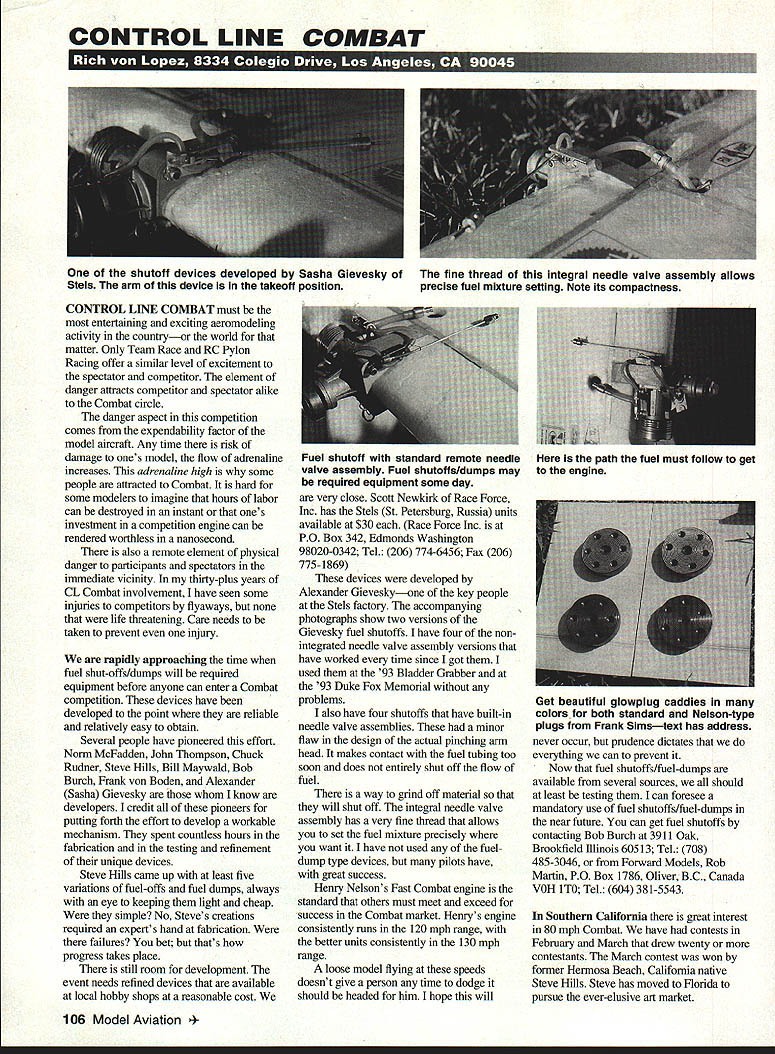
The accompanying photographs in the original article show two versions of the Gievesky fuel shutoffs. I have four of the non-integrated needle valve assembly versions that have worked every time since I got them; I used them in the 1993 Bladder Grabber and in the 1993 Duke Fox Memorial without problems.
I also have four shutoffs that have built-in needle valve assemblies. These have a minor flaw in the design of the pinching-arm head: it makes contact with the fuel tubing too soon and does not entirely shut off fuel flow. There is a way to grind off material so that they will shut off. The integral needle valve assembly has a very fine thread that allows precise fuel mixture adjustment. I have not used any of the fuel-dump type devices, but many pilots have had great success with them.
Engines and Speed
Henry Nelson's Fast Combat engine is the standard that others must meet and exceed for success in the Combat market. Henry's engine consistently runs in the 120 mph range, with the better units consistently in the 130 mph range.
A loose model flying at these speeds gives a person almost no time to dodge if it is headed for them. I hope this will never occur, but prudence dictates that we do everything we can to prevent it.
Availability and Contacts
Sources for fuel shutoffs and related devices:
- Race Force, Inc. (Stels units): P.O. Box 342, Edmonds, WA 98020-0342; Tel.: (206) 774-6456; Fax: (206) 775-1869.
- Bob Burch: 3911 Oak, Brookfield, Illinois 60513; Tel.: (708) 485-3046.
- Forward Models, Rob Martin: P.O. Box 1786, Oliver, B.C., Canada V0H 1T0; Tel.: (604) 381-5543.
80 mph Combat in Southern California
In Southern California there is great interest in 80 mph Combat. We have had contests in February and March that drew twenty or more contestants. The March contest was won by former Hermosa Beach native Steve Hills. Steve has moved to Florida to pursue the art market.
Steve's artistic talents led to many innovative building methods; I owe my foam-building skills to him. Back in 1979 we built many foam models at his workshop—this was a time when many modelers were still using all-balsa construction.
Steve is responsible for the SlySir series of designs and the state-of-the-art Arrowplane. He used an old magnesium Cox Speed pan as the mounting unit for a Shuriken .049-powered 1/2A Combat model. Steve also created artwork for many of the T-shirts sold at Combat contests. We will miss his unselfish and helpful talents.
Steve will need flying partners in Florida. If you live in that part of the country, seek him out—your modeling activities will advance during your interactions.
Local Practice and Growth
The 80 mph Combat event has caught on because it is easy and fun. The number of local fliers who use the Whittier Narrows facility in South El Monte, California seems to keep growing. With the help of Greg Carter and his super-quality kits, many more pilots have joined the ranks of those who fly practice matches every weekend.
If you fly regularly over a period of a couple of years, you get very good. There is no speed advantage for anyone, since exceeding the speed limit will cause you to lose the match. I will report how the April 24, 1994 contest turned out.
Local Suppliers and Products
Frank Sims is one of our Sunday regulars who has created specialized products for the Combat pilot. He offers custom-made flight boxes, glowplug caddies for both standard and Nelson-type plugs, and prop reamers specially designed for Nelson engine users. Contact Frank Sims at 2817 Mansa Drive, Norwalk, California 90650; Tel.: (310) 921-6881. I have purchased all of his products and can attest to their high quality.
Events and Competitions
The famous Howard Rush of Bellevue, Washington, was in town recently. He informed us that the Bladder Grabber Contest, which ran 18 straight years, will not take place during 1994. The reasons are a bit unclear at this time.
The loss of the Los Angeles Money Nats gives greater importance to the AMA Nationals, the Duke Fox Memorial Contest in Chicago, and the Combat Classic in Houston. The door is now open for someone to put together a package for a big triple-elimination money meet.
Transcribed from original scans by AI. Minor OCR errors may remain.

