

CONTROL LINE COMBAT
Rich von Lopez 8334 Colegio Drive, Los Angeles, CA 90045
AMA's 1994 Nats at Lubbock, Texas had one of the largest Control Line Combat turnouts in recent years. All events were flown with a full double-elimination format.
- Slow Combat: 29 entries
- FAI: 13 entries
- 1/2A: 21 entries
- Fast: 32 entries
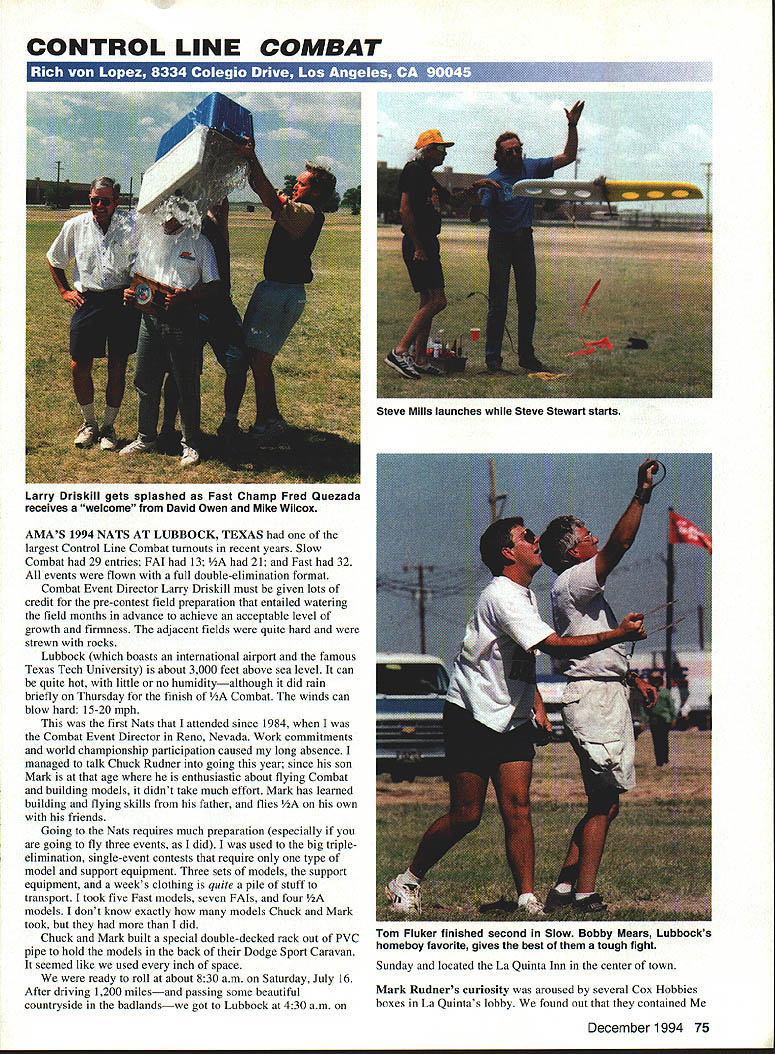
Combat Event Director Larry Driskill must be given lots of credit for the pre-contest field preparation—he watered the field months in advance to achieve an acceptable level of growth and firmness. The adjacent fields were quite hard and strewn with rocks.
Lubbock (which boasts an international airport and Texas Tech University) is about 3,000 feet above sea level. It can be quite hot, with little or no humidity—although it did rain briefly on Thursday for the finish of 1/2A Combat. The winds can blow hard: 15–20 mph.
This was the first Nats I had attended since 1984, when I was the Combat Event Director in Reno, Nevada. Work commitments and world championship participation caused my long absence. I managed to talk Chuck Rudner into going this year; since his son Mark is at that age where he is enthusiastic about flying Combat and building models, it didn't take much effort. Mark has learned building and flying skills from his father and flies 1/2A on his own with his friends.
Going to the Nats requires much preparation (especially if you are going to fly three events, as I did). We used to be the big triple-elimination, single-event contests that required only one type of model and support equipment. Three sets of models, the support equipment, and a week's clothing is quite a pile of stuff to transport. I took five Fast models, seven FAIs, and four 1/2A models. I don't know exactly how many models Chuck and Mark took, but they had more than I did.
Chuck and Mark built a special double-decked rack out of PVC pipe to hold the models in the back of their Dodge Sport Caravan. It seemed like we used every inch of space.
We were ready to roll at about 8:30 a.m. on Saturday, July 16. After driving 1,200 miles—and passing some beautiful countryside in the badlands—we got to Lubbock at 4:30 a.m. on Sunday and located the La Quinta Inn in the center of town.
Mark Rudner's curiosity was aroused by several Cox Hobbies boxes in La Quinta's lobby. We found out that they contained Me 109 Stunters that were to be given away for use in the 1/2A fun-fly later in the week; Mark ended up participating. The wind blew so hard that many models were ruined, but the fliers had fun, thanks to Cox Hobbies and their representative, Larry Renger.
We were anxious to check in at AMA Headquarters that Sunday. It is always a pleasure to encounter old friends and acquaintances milling around the registration trailer. Lots of Combat pilots—Fluker, McKenzie, Silva, Quezada, Wiley, Mejzlik, and Cartier, to name a few—were already testing their equipment. Since we were still a bit groggy from our 18-hour drive and four hours of sleep, we opted to test that afternoon.
James Mears and Riley Wooten rounded up $500 each for the Slow and Fast winners. LoneStar Models, James Mears Mazda-Volvo, and the First National Bank of Texas were the primary donors. Fox Manufacturing awarded new Mk. 7 Combat Specials to the second-place finishers in Slow and Fast. This sort of incentive makes for better Combat during any contest (too bad it wasn't advertised in advance).
1/2A Combat
The smallest of the Combat classes drew 21 entries, with one dropping out prior to the start. Many pilots love to tinker with the minuscule models and engines. There are several power plants acceptable for this class, including the Russian-produced VAs and Stels, the U.S.-made Shuriken and Cox Tee Dee series.
The event was designed with the Cox Tee Dees in mind and went along that vein for decades. These engines are still contenders and can be used with great effectiveness. Cox Hobbies' Larry Renger was on hand to watch the happenings and lend factory support to Tee Dee users—the trunk of his rental car was full of extra parts.
Over the years, Cox has been a strong supporter of 1/2A Combat through generous sponsorship. When 1/2A Combat was an unofficial event at the Nats, Cox supplied engines to be given out to the top finishers.
The Shuriken engines arrived on the scene and escalated the weaponry and cost of 1/2A. They are currently difficult—if not impossible—to obtain. If you have a good Shuriken, you have a definite advantage.
Eric Tomchik came out on top in 1/2A using a very mediocre Shuriken that appeared no better than a good Tee Dee, but it flew consistently and matched the VAs in power this year.
The VAs were out in force, with Event Director Larry Driskill having one of the better units. The Minor brothers were using VAs with remote needle valves. They found the stock VA needle valves difficult to adjust to the proper setting. I saw other pilots using an ACE needle valve and spray bar that had been removed from the blue plastic body and carefully press-fitted into the VA case.
The VA is lighter than the Tee Dee and requires a different model that can be a bit smaller. Tee Dee–sized models will need their noses extended so the balance point will be accurate.
I may have been the only person sporting a Stels .049. I still have some work to do before I am comfortable with it and can get it to restart. My two Stels need plenty of running before they are broken in. One of the two shows great potential as a fast engine.
The 1/2As are not as forgiving as the .36s. A little too much prime and it won't start. A slightly weak battery will give you fits. You also must be able to needle it right on.
Slow Combat
Slow Combat drew 29 entries, most flying top-notch equipment. Slow Combat is defined these days as 100+ mph. I happened to clock Dave Henderson's Nelson-powered Slow at 18.02 seconds for seven laps—not bad for a large structural-system model.
These models have evolved from mass-produced kits to refined, scratch-built designs with composite structures. Wing areas of 500 square inches are not uncommon. Many models use arrow-shaft fuselages.
Most Slow Combat models use GRW chicken-hopper fuel tanks manufactured by Glen Wells. They hold enough fuel to fly the entire five-minute match. Roughly half of the competitors used metal engine mounts for easier engine mounting and changing.
The fuselage of a Slow model seems to be anywhere from 12 to 18 inches from the trailing edge of the wing to the stabilator. Much experimentation is required to get all the systems to work right. The venturi size is critical: if it's too small, you lose power; if it's too large, you can never get the needle setting correct.
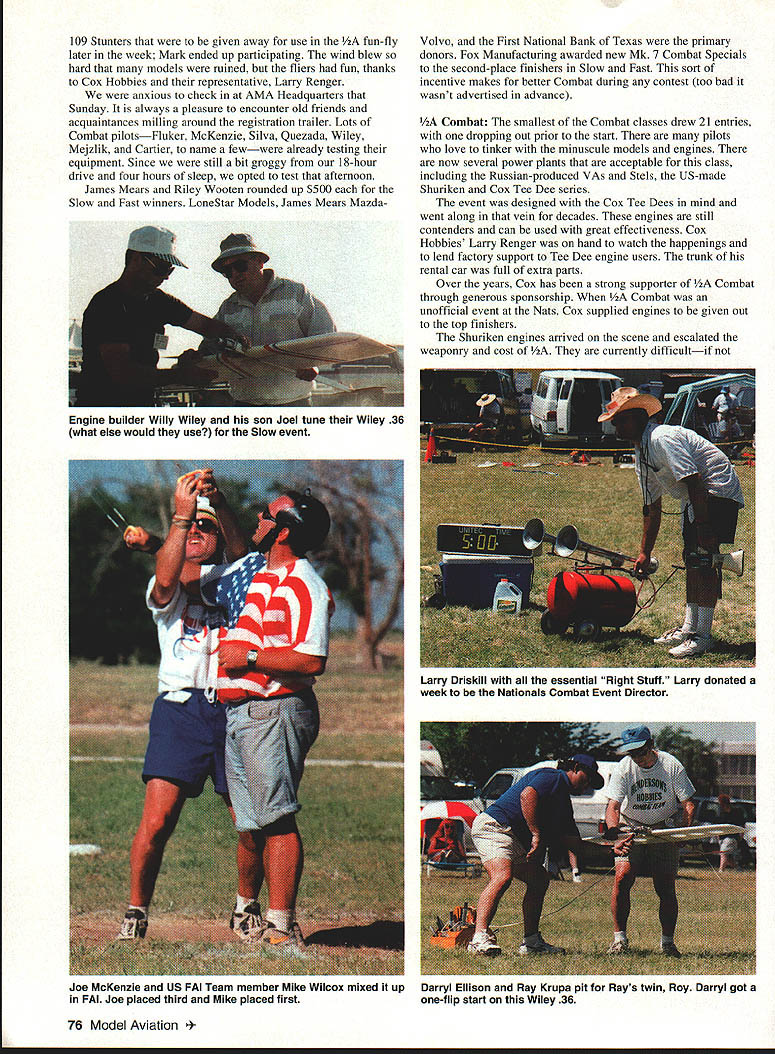
The prize for the oldest model goes to Chuck Rudner for his two antique Nimblers. These were all-balsa and were built with Ambroid glue. (Remember the old days when we used pins while the glue dried?) Folks got a closeup look at the one that ended up in the trash can.
See results in "Focus on Competition."
Throughout the Nats, Mike Wilcox showed why he is on the U.S. FAI Team. He would get on someone's tail and they could never shake him off, taking cuts seemingly at will. Mike did a number on Tom Fluker during his final bout. Tom needed some practice to shake some of the rust off his flying handle.
Cary Minor has developed into a competent and aggressive pilot, showing the most growth and improvement of all the pilots. (C. Minor comes from the famous musical family that includes A. Minor and G. Minor—their tune was heard at the 1994 Nats.)
The Krupa twins, Roy and Ray, are known around Texas as Ground Hog and Gopher. Their antics were endless in the pits and in the circle.
FAI Combat
The number of F2D entries was the most since the days prior to 4mm venturis and mufflers. This could be partly due to the availability of ready-to-fly models at inexpensive prices: $30 or $31 plus $8 shipping from Thomas Mejzlik.
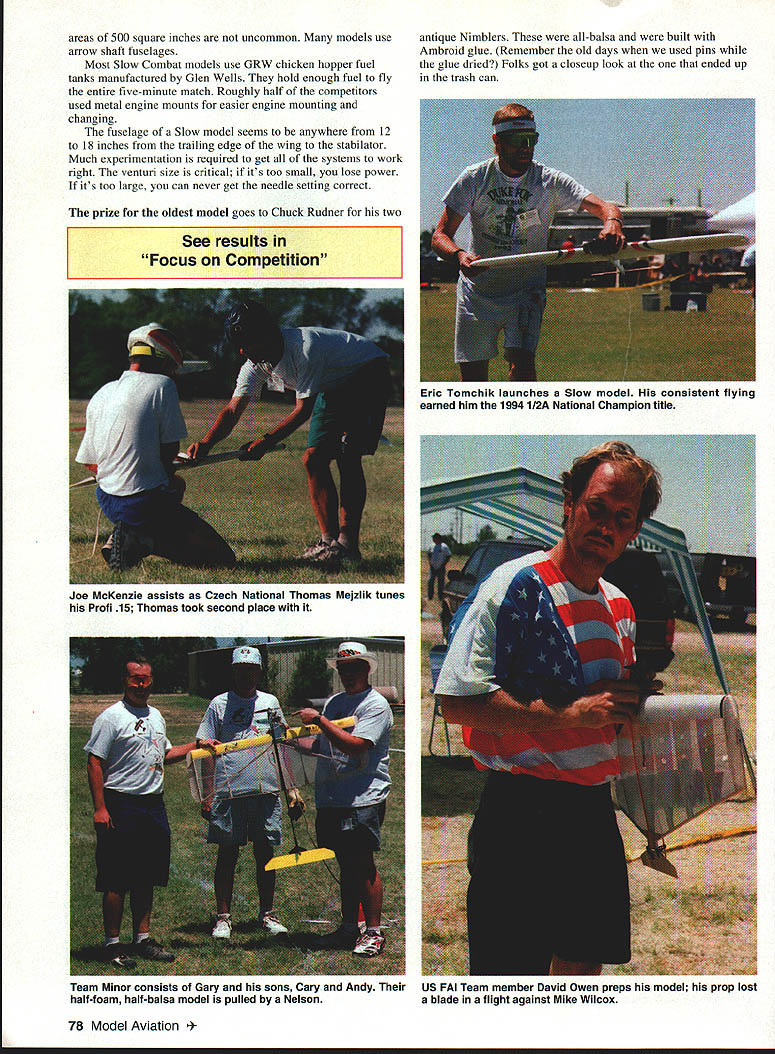
Thomas was at the Nats with props, mufflers, models, mounts, and other items for sale. Joe McKenzie was Thomas' host before, during, and after the Nats. Mike Wilcox and David Owen, the 1994 USA World Championship Team members, introduced Thomas to Texas cuisine and culture during the evening hours.
I was most frustrated in FAI—I cannot remember the last time I was unable to start a muffled FAI engine. Chuck Rudner and I were unable to start in one of our matches. Others, such as former world champion Tom Fluker and former team member Pat Wilcox, had difficulty getting the muffled engines to light up. A combination of factors prevented us from doing our best.
Lubbock's 3,000-foot elevation, extreme heat (about 105°F), and not using our regular LuCon 625-109 fuel mixture contributed to our F2D fiasco on Wednesday. The engines were not just sitting on the ground and tended to flood easily. We also theorized that there weren't enough oxygen molecules in the intake at elevation to ignite the fuel mixture and that some of the oil residue ran back into the engine from the muffler. Hindsight suggests that we should have kept the engines cool by using ice cubes on the cylinder and muffler. Although we did not try this, no theory seemed beyond reason.
The thirteen pilots who flew FAI were well-prepared and used a variety of engines, such as Nikolaï Nechuekens, Oleg Doroshenkos, Profis, Stels, and Nelsons, front- and rear-intake designs. Soft and hard mufflers were seen on various types of equipment.
Tom Fluker used his familiar rectangular large-square-inch Force-type models. Chuck Rudner uses his Yellow Warpers and Nechuekin Russian Dogs.
Roy Krupa had his store-bought Czech Faizov models, as did Joe McKenzie and Czech entrepreneur Thomas Mejzlik. The Stewart brothers used some home-grown designs. I broke out my old 1989 and 1990 FAI models. The '89s are honeycomb-boom models, while the '90s are carbon-arrow-shaft types with L-shaped mounts.
Mike Wilcox got some breaks from Lady Luck on his way to his FAI win. In his first match (with me) he took the whole streamer—normally the kiss of death. But I was not patient enough and returned the favor, bouncing off the lines in the process, which resulted in a broken bellcrank and a subsequent crash.
Mike lost his whole streamer against David Owen, but Mike proceeded to take David's in return. During the level fly-out-the-time stage, David's prop threw a blade that caused him to lose on air time. Nonetheless, Mike was "on" and deserved the win through some skillful flying.
AMA Fast Combat
AMA Fast Combat is the main Combat event. This event determines Quién es más macho? (Who is the baddest of them all?) Unlike FAI or Slow models, Fast models are unlimited in fuel requirements, model type, and fuel-feeding systems. There is no muffler rule or restriction in the venturi. The rule is 40% and 50% nitro in the hopped-up Foxes, Wilvies, or Nelsons. Only Iskender Taib is bold enough (or possibly eccentric enough) to enter an underpowered BRAT 28 in the event.
AMA Fast is exciting and fast, and the possibility of a kill has a final outcome. No one can argue with a kill. If your knot is gone, you lose. It is a done deal—no ifs, ands, or buts. The new seven-foot-string rule had an impact on the number of kills. Many of the matches were determined by a kill (in my case, all three were).
Betty Fox and John Lowery of Fox Manufacturing were ready to show off their new AAC Mk.7 Combat Special, which will sell for $150. It is a whole new engine with a new case, crankshaft, backplate, piston, and liner setup. (I brought one back with me and will be doing extensive tests on it; look for this report in future columns.)
Willy Wiley spent the entire week at the Combat site with his son Joel running and tuning his custom .36 Combat engines. The ones I saw ran more than respectably, producing lots of power. These engines are well-made with precision fits. A .36 costs about $185; Wiley stands behind the product.
I brought one of these engines back for extensive testing, and I will do a full-blown report on the Wiley .36 for the February 1995 column. I intend to run it in Fast Combat trim with a variety of props and fuel combinations.
The skill in Fast was quite good in most matches, with only two flyaways for the entire contest. Several of us use fuel shutoffs for safety reasons and because we love our equipment.
The Stewart brothers modified the Canadian-style fuel-dumps by adding an .020 music-wire spring that functions as a fuel shutoff; a clever idea, though I have not seen it in action.
Chuck Rudner was seen talking to Thomas Mejzlik about the possibility of having a Czech Republic–manufactured fuel shutoff. Thomas' answer was "no problem." Let's see what comes from his foray into fuel-shutoff land.
There was nothing new in the area of models—most were foam, with and without metal engine mounts. Two pilots used Russian-style models.
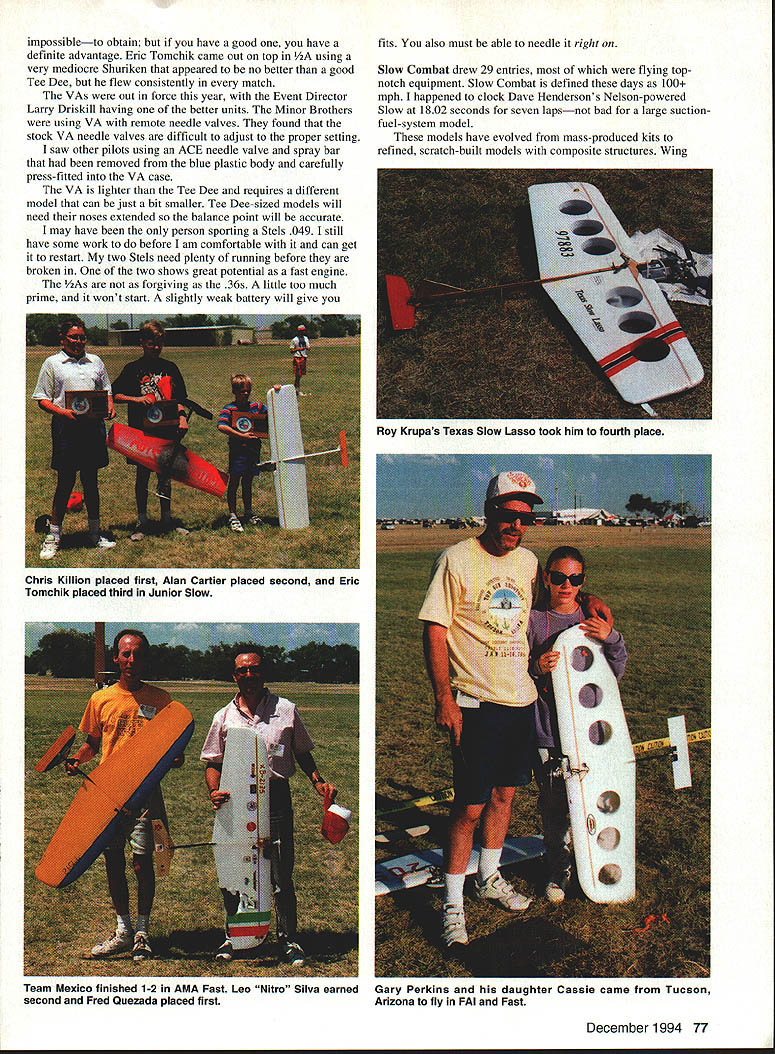
The surprise of the contest was that the Mexican team of Fred Quezada and Leo "Nitro" Silva finished first and second, respectively.
Baltimore native Leo Silva was a resident combat student of the Southern California Combat Team, under the professorship of Steve Hills. He is now a cattle-raising orange and papaya farmer in Tuxpan, Mexico. Fred is an engineer; he is in the business of importing pumps for corrosive liquids for Mexican industry.
Both pilots used state-of-the-art Steve Hills–designed Arrowplanes, with Fred's built from Greg Carter's cores. The final match was a bit anticlimactic: Fred made two quick cuts on Leo, who got too close to Fred's model. The resulting collision broke the fiberglass boom and ended the match.
The match for third and fourth place was between Dennis Keeton and Mike Wilcox. Wilcox got the better of Keeton and pushed his Nelson-powered model into third place. Keeton was running with a Fox.
Both Fred and Leo ran custom Foxes with lots of aftermarket parts. Fred's was a Ron Repp Mark VII; it was a special unit built for Pete Athans by Don as a favor. Pete sold it to Ernie Delgado, who sold it to Fred. Little did he know how good it was!
Leo's engine was built by Mark Smith of Fort Worth, Texas. Mark is noted for quality and precision engine work. Both ran 40% nitro and were using modified Rev-Up props.
Betty Fox and John Lowery were quite happy to have their engines show so well at the AMA Nationals, and were quick to give the top Fox flier T-shirts for the winners' circle photos.
Combat at the 1994 Nats was successful due to efficient contest management and the high number of entries. Thanks must be given to the judges and workers, who put in many hours of arduous labor under the hot Texas sun. Mary Carter (Phil's better half) worked nonstop to record match information and answer competitors' requests. Combat still draws crowds of spectators, and this year we provided them with some exciting bouts.
Transcribed from original scans by AI. Minor OCR errors may remain.

