
CONTROL LINE COMBAT
Rich von Lopez — 8334 Colegio Drive, Los Angeles, CA 90045
It is time for me to reflect on the 1994 Combat season, and all of the activities that went along with it.
It is early October as I write this column, the weekend before the United States team leaves for Shanghai, China to compete at the World Championships. I can only speak for the effort Chuck Rudner has put forth in preparation to represent his country. We have been at it every weekend, with only a few exceptions, since we made the team back in September of 1993. Chuck has developed some new designs and has used every trick in the book to extract maximum horsepower from his engines.
His arsenal will include both American-style foam models that utilize carbon-fiber arrowshaft tailbooms, and Russian-style half-foam, half-wood open-bay-type models. His engines include the fastest Nelson .15s on the planet, and some very strong Russian engines from various manufacturers.
The selection of equipment is delayed until it's known whom he has drawn to fly. Our practice sessions usually include two to three full-length bouts with each sparring partner. It has usually been Don Repp, Mark Rudner, and me who try to work Chuck over. Occasionally the San Diego guys come to Los Angeles, or we go down there to fly at their plush field. Their field is a sod farm just a mile or two from the Mexican border. It is easily the best Combat field in the country, if not the world.
We are all very excited about the upcoming trip, and are trying to make all of those last-minute decisions about what to take and what to leave home.
Buying ready-to-fly models
One thing worth mentioning again for anyone who is interested in participating in this rather eccentric hobby of ours is a place to buy ready-to-fly models that are of high quality and relatively low in cost: Mejzlik Modellbau, Jurkovicova 19, 638 00 Brno, Czech Republic (Europe); Tel. 01142 5 529400 (from the US only).
Tomas Mejzlik is a member of the Czech Combat team and is also the brains behind this company. Many fliers in the Southern California area (and in other parts of the country) are using models purchased through this company. Tomas' new catalog has a number of new items that you might be interested in; write to him to get a copy.
I have some of the Faisov I, Faisov II, and Beljaev models that the manufacturers make. They are top quality and are indeed ready to fly. The base price for the models is $30 or $31, depending on the style you select. Then you must add in the shipping, which is about $8 per model.
Building vs. buying
You may find that it is more cost-effective for you to purchase models rather than build them. Have you ever tried to figure out how much time you have in each model that you build? I have tried, but only come up with an approximate number: 12–15 hours per model.
I take into account setup time for each operation involved in each phase of the construction project. I also count the time spent driving to and from the hobby shop to get that one item needed to finish a model.
If I am only building two models, but know that I will build more of the same design in the future, I may cut out some of the parts for future models at the same time I am building the two models. I use mass-production techniques whenever possible.
For instance, I fuelproof rocket tubing one time when I build a batch, but when I build a future batch at a time, I will most likely do 20, so they are ready for future building projects. It helps in the long run. Give it a try — it may save you time as well.
Notable pilots and contests in 1994
A few pilots really stood out in competitive situations in 1994:
- Tom Thompson of Tucson, Arizona — dominant in the first money contest of the year (the Top Gun meet, hosted by his hometown folks) and winner of a second money contest in Morgan Hill, California. Belicranker II (sponsored by the Smith brothers, Steve and Dave) was the second notch in Tom's control handle. It is rare to see a pilot win back-to-back triple-elimination money meets.
- Neal Rose — came out of seclusion to win the Duke Fox Memorial contest in DeKalb, Illinois this past summer. Neal was flying consistently and showed no sign of pressure the entire weekend.
- Mack Henry of Nashville, Tennessee — managed a second place at the same contest, his best in a long time. This second place cost Mack a good Nelson .36 that got cut loose and made its way into the nearby cornfields. There is almost no chance to recover a model that makes its way into ten-foot-tall corn. It will be interesting to see if Mack uses fuel shutoffs in the future.
In Los Angeles we had the annual Seebree Hayes Contest, which featured a double-elimination 80-mph event. There were sixteen entries on a perfect fall day.
- Allen DeVeuve — dominant and victorious once again; he has some of the best reflexes of any pilot currently flying.
- Russ Graves — second place, coming off a three-month layoff; a pilot who has come of age.
- Pete Athans — third place in a lightweight version; you knew it was the same old Pete because he was mooching models and props from Don Repp and Allen DeVeuve.
Some pilots who have moved from beginner to journeyman: Ron and Gary Cash, Brian Choquette, and Greg Carter.
On 80-mph Combat
I have to get a plug in for 80-mph Combat. I am convinced that this is the event that should be offered to entry-level competitors. The speeds are not so high that models get away from people, and not so slow that the models fall out of the sky. After watching the East Coast version of Super Slow Combat at the AMA Nationals this past summer in Lubbock, Texas, I know that is not the answer. Modifications were made to the line length so that the models would not crash due to wind. If you have to carry both 60-foot calm-day lines and 52-foot windy-day lines, something is wrong.
I do not intend to propose rules to make 80-mph Combat a supplemental event as I have done once before; I'd rather let the pilots who fly the event speak to its merits.
Engine evaluations and options
There are two projects that I intend to work on as soon as I return from the China trip: one is a full evaluation of the Willie Wiley .36 Combat engine; the other is a review of the new Fox Mk VII Combat engine.
I have one of each engine, and have run them only three times each on mild 10% nitro fuel just to give them a bit of break-in time. Both engines show lots of potential and make good power, even on low-nitro fuel.
Right now, Fast Combat pilots have lots of options in selecting engines. Tomas Mejzlik has an FM Fast engine that I know nothing about. He lists it for $220 with another $12 for a wrench to get the head off. If anyone out there is adventurous and buys one of these, drop me a line on the performance so that we can get the word out.
Transport, storage, and shop gadgets
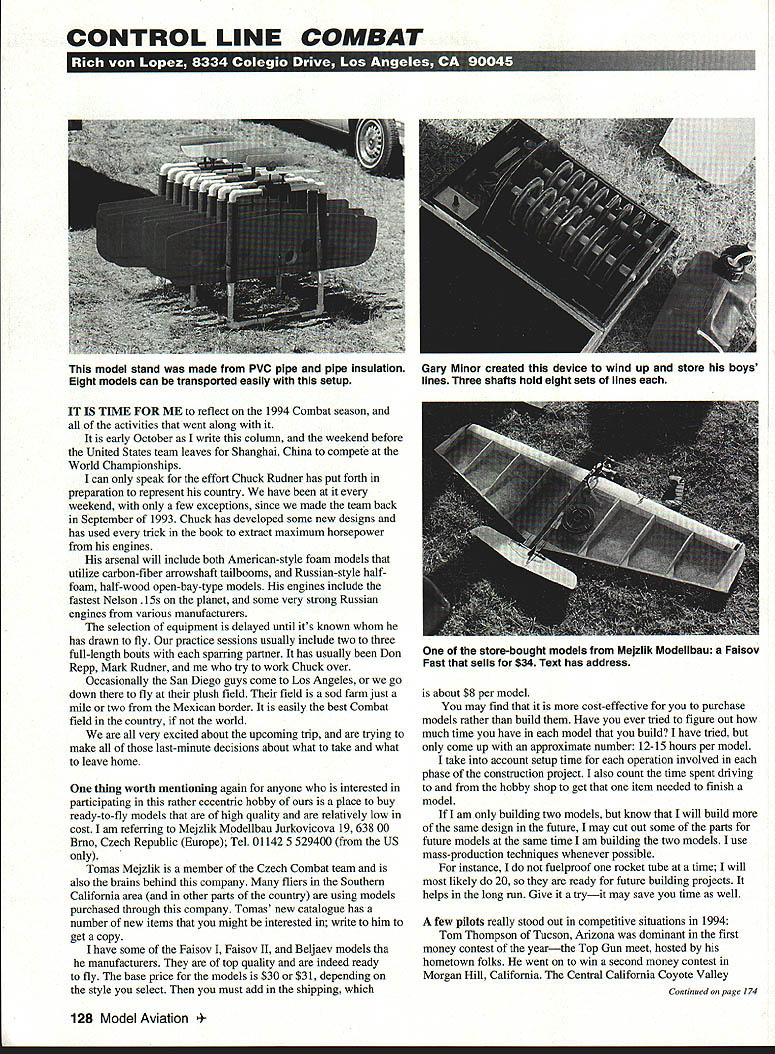
Transporting models can be a problem, and once you are at the contest site, keeping the models clean and out of harm's way is another concern. One of the pilots from Texas constructed a model stand from PVC pipe and pipe insulation. Eight models can be easily transported with the device.
I have included a photograph that will give you a clear idea of how the stand works.
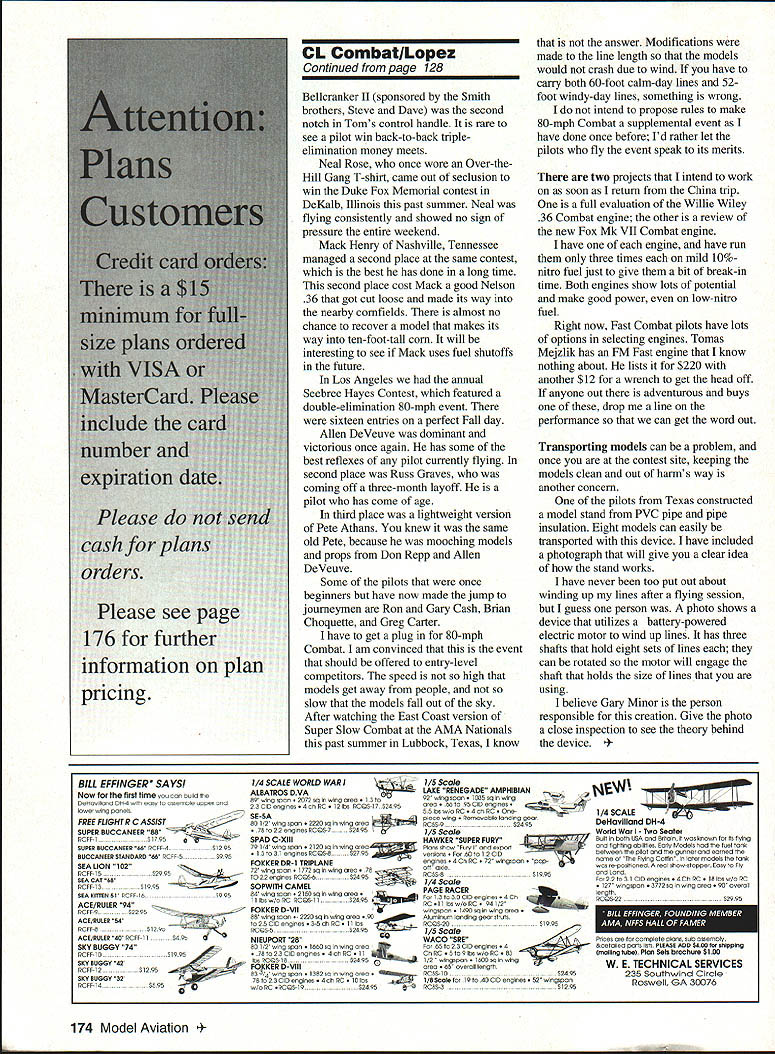
I have never been too put out about winding up my lines after a flying session, but I guess one person was. A photo shows a device that utilizes a battery-powered electric motor to wind up lines. It has three shafts that hold eight sets of lines each; they can be rotated so the motor will engage the shaft that holds the size of lines that you are using.
I believe Gary Minor is the person responsible for this creation. Give the photo a close inspection to see the theory behind the device.
Transcribed from original scans by AI. Minor OCR errors may remain.

