
CONTROL LINE COMBAT
Rich von Lopez 8334 Colegio Drive, Los Angeles, CA 90045
Background
In my last column I mentioned that I had been experimenting with one of the new Fox Mark VII Combat Specials. This month I have some concrete data that you might find of interest.
The engine I have been running is from the batch that was available at the 1994 AMA National Championships in Lubbock, Texas. John Lowery of Fox Manufacturing worked long and hard to get the Mark VII ready for its debut at the Nats. Betty Fox was also pleased that she could introduce a new and improved version of the Combat Special with so many people looking on. Rumors had been flying (long before the Nats) that a new, more powerful Fox Combat Special was being developed at the Arkansas factory.
For those new to the Combat scene, here is a bit of history about the support Fox has given to Combat:
My first Nats was 1974 at Chennault Air Force Base in Lake Charles, Louisiana, where I first met Duke Fox. He was at the Combat site with his new no-head F.M. Combat Special (it preceded the Mark III). It had a tumbled case and was so shiny that it almost sparkled. Some of these engines were being passed out to name-brand Combat pilots. Phil Granderson was one of the first to put up a test flight with the new hot-rod power plants. It showed lots of promise, with a couple of real fast runs. Minor problems kept the engine out of the competition, but it was exciting to see the factory owner testing his new creation with the assistance of some of the best pilots in the country.
Doss Porter of the Clovis (CA) Controliners nicknamed the Fox engines "Arkansas Ferraris." This was ironic, since many of us were using engines made in Bologna, Italy.
Duke's car trunk was filled with engines, parts, and glow plugs. All one had to do was ask for assistance or a spare part and it was given at no charge and with a smile. Duke spent the entire week at the Combat site, watching the happenings and even launching models if anyone asked. We all knew Duke was not making money from sales of the Combat engine. His love for the event was greater than the capitalistic ideal of profitmaking.
At every subsequent AMA Nationals I attended, Duke Fox was there with his trunk full of parts and words of advice to both veterans and novices. From time to time he would invite a contingent of Combat pilots out to dinner, tell interesting stories, and answer technical and historical questions. Duke's philosophy was to provide aeromodelers with affordable engines that were reliable and competitive.
I took this detour to let prospective buyers know they are getting a quality product with a long history in the Combat market.
Engine tests (February 5, 1995)
On February 5, 1995 I conducted more serious experiments with the Mark VII. Don Repp and Chuck Rudner assisted with the tach readings and the speed timings.
Any Fox engine I use in competition is taken apart and carefully fitted, with all clearances measured and recorded. To give an accurate picture of the Mark VII's performance, I left everything stock except for the addition of a 0.003-inch aluminum head shim. The propeller was a Top Flite 8-1/2 x 6-1/2 Pylon Racing prop cut to 7-3/4 inches.
Test results:
- On 10% nitro fuel the engine turned 21,000 rpm and its airspeed was clocked at 15.52 for seven laps (116.08 mph).
- On 25% nitro fuel with the same prop we got 21,100 rpm and an airspeed of 15.44 (116.84 mph).
The model was a Hulan Matthies–built Reaper from the 1980s. (Lou Scavone produces his own Reaper design, but only the name is similar.)
Specifications and setup
The new Fox Mark VII as tested:
- Weight: 262 grams (9.26 ounces), including an O.S. Max .10 needle valve assembly, tubing, needle valve, venturi, and filter. (Old four-gram needle valve assemblies are unobtainable.)
- I also use a small nylon bracket that weighs very little; weights will vary depending on the needle valve assembly you choose. My engine did not come with a needle valve assembly.
- Head shim: 0.003-inch aluminum added to the head button.
Measured clearances (measured after running the engine and completing tests):
- Natural head clearance without shim: 0.010 inch.
- Distance from top of liner to top dead center: 0.173 inch.
- Large double-bubble head button depth: 0.163 inch.
- With the 0.003-inch head shim added to the head button, you get 0.013-inch head clearance.
Notes on running clearances:
- I have always run competition engines at 0.020 or 0.021 inch; Chuck and Don prefer theirs at 0.018 inch. For future tests I intend to try 0.018 inch.
- Don thought that because the engine gained 100 rpm on 25% nitro, the head might have been too close. I tend to concur, based on the sandblasted look of the head button and the fact it was blowing glow plugs.
Engine construction highlights:
- The Mark VII has an AAC piston and liner setup.
- It comes with Allen head cap screws for the cylinder head clamp.
- The crankcase, crankshaft, backplate, bearings, piston and cylinder set, and head button are new.
Performance and impressions
The engine is very competitive and runs reliably in the air. It pulls the model well through the turns on both 10% and 25% nitro fuel. Price is $150, which is much cheaper than all-out Mark VIs fitted with aftermarket parts.
Planned modifications to reduce weight:
- Replace the crankshaft stud with a titanium bolt.
- Replace the steel prop washer with an aluminum washer.
I will report results of these changes in a future column.
Competition notes and events
There have been two bids to host the 1995 FAI Combat Team Trials:
- Houston, Texas — August 19–20, 1995 at Scobee Field. Contest Director: Sheila Cranfill.
- Detroit, Michigan — August 26–27, 1995 at one of four possible sites. Contest Director: Art Adamisin.
By early March we should know which site was selected. I believe we will have the largest entry of any Team Trials because of the availability of ready-to-fly equipment. It should be a very competitive contest; you may want to start making plans to compete or spectate.
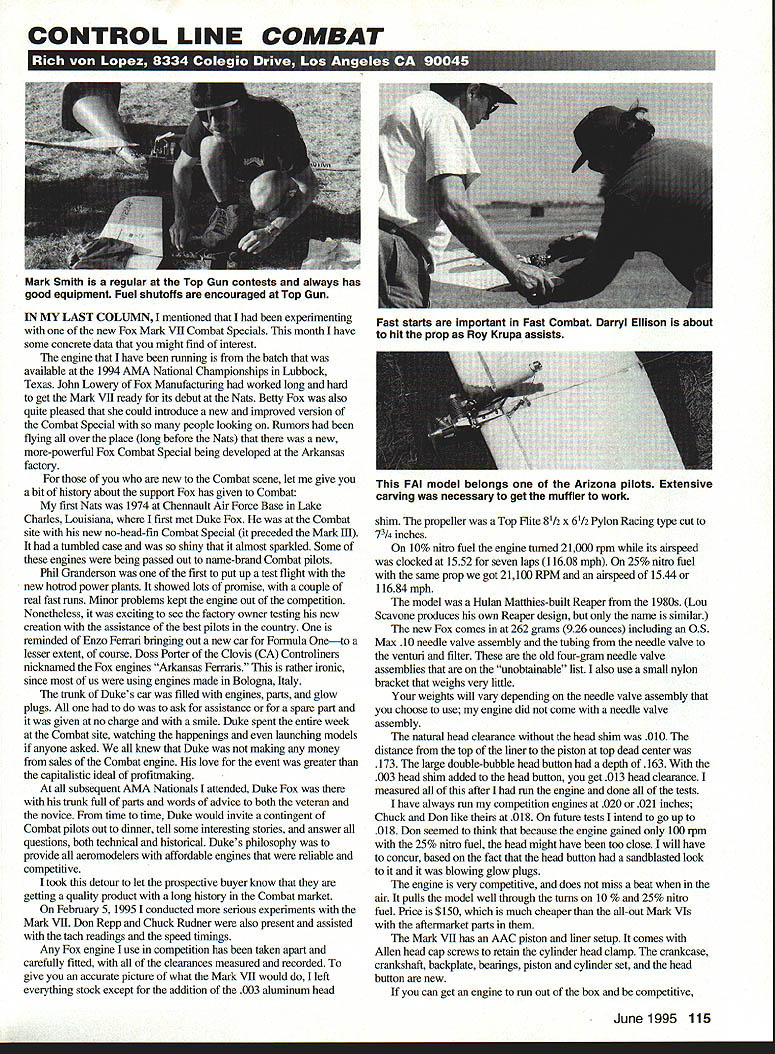
The Tucson, Arizona combat group will again host the first major contest of the year: Top Gun. This is a triple-elimination Fast Combat contest that draws competitors from all over the country. Fuel shutoffs are encouraged at this meet. The contest will bring out all of the new equipment developed during the winter layoff.
Advice for beginners
If you are just starting out in FAI Combat, I suggest using some of the Russian or Czechoslovakian engines designed to be muffled. Making adapters or headers to connect mufflers can be a pain. We have adapted both solid and rubber mufflers to earlier-generation Nelson .15s, but the rear-exhaust configuration (coupled with older models) caused some problems. All problems can be overcome if you take the time to design a model that allows the muffler to be mounted at a shallow angle.
Local flying
If you happen to be in the Los Angeles area, come out to the Whittier Narrows National Recreation Area in South El Monte to see the control line activity or the RC happenings.
Transcribed from original scans by AI. Minor OCR errors may remain.

