
CONTROL LINE COMBAT
Mark Rudner 1352 Foothill Blvd., Santa Ana CA 92705
Introduction
We prepared for the long trek ahead of us on Friday evening. Packing for a Nats is always a big ordeal. This was my second Nats, my first being the Nats in Lubbock last year. Since there are so many Combat events to participate in at the Nats, it is necessary to take a lot of airplanes — it would be pointless to go to the Nats for a whole week and only participate in one event. Don Repp, my dad (Chuck), and I all flew three events: Fast, FAI, and 1/2A.
Site and weather
We arrived in Richland on Sunday, July 9 in the early afternoon. Even though the contest didn't start until Monday, we went to the official site to check it out. The site was at the Horn Rapids Athletic Complex and consisted of four beautiful softball fields with full, dark-green grass. The ground was very soft; crashing airplanes tended to lawn-dart into the ground instead of bouncing off or breaking.
This field was quite a contrast to Lubbock, where the ground was dry, hard, and full of weeds (in spite of the contest management's efforts to water it in the weeks before the contest). This site was ideal for Combat.
There was a beautiful grass practice site at the yacht club, adjacent to where Racing and Speed were held. We put up a few practice flights, but our flying was cut short by the mother of all thunderstorms — rain came down sideways, with drops the size of golf balls. After the storm the weather cooperated for the rest of the week, with the exception of gusty winds on Thursday.
Slow Combat
Slow Combat started the week on a good note. The matches were fast-paced and took place one right after the other, even with only one official circle. The contestants and judges cooperated to keep everything flowing. There were only eight entries in Slow, so it was flown as a triple-elimination tournament, rather than the usual double-elimination format.
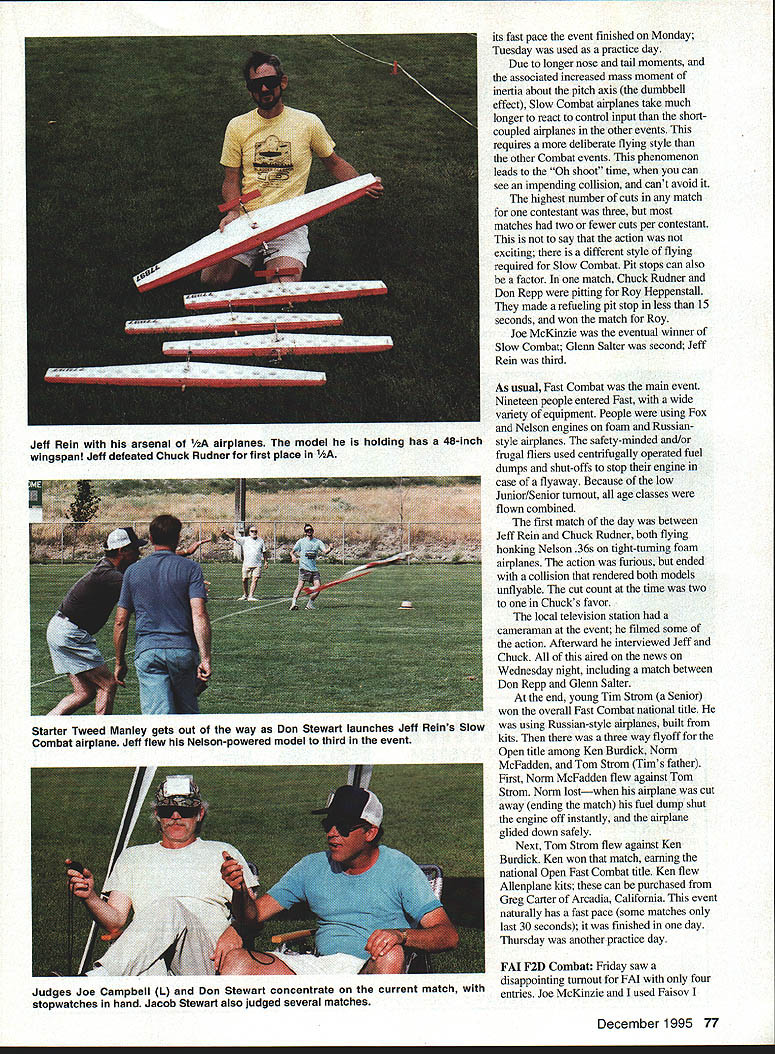
Multitime Nats winner Joe McKinzie dominated this competition. He was the only Texan to show up, but he had good equipment, and a super pickup-pit crew: Don Repp and Chuck Rudner. He was using airplanes of his own design, which can be purchased prefabricated from Tomas Mejzlik of the Czech Republic. Joe was using Nelson .36s with APC props to power his airplanes. For a tank, he used a GRW chicken-hopper.
The other contestants, for the most part, had equipment that we (Southern Californians) would consider to be in the original spirit of Slow Combat. These airplanes are about the size of a Flite Streak, with a full profile fuselage and an outboard tank completely forward of the leading edge. These models are powered by older engines, not by new, ferocious Nelson .36s.
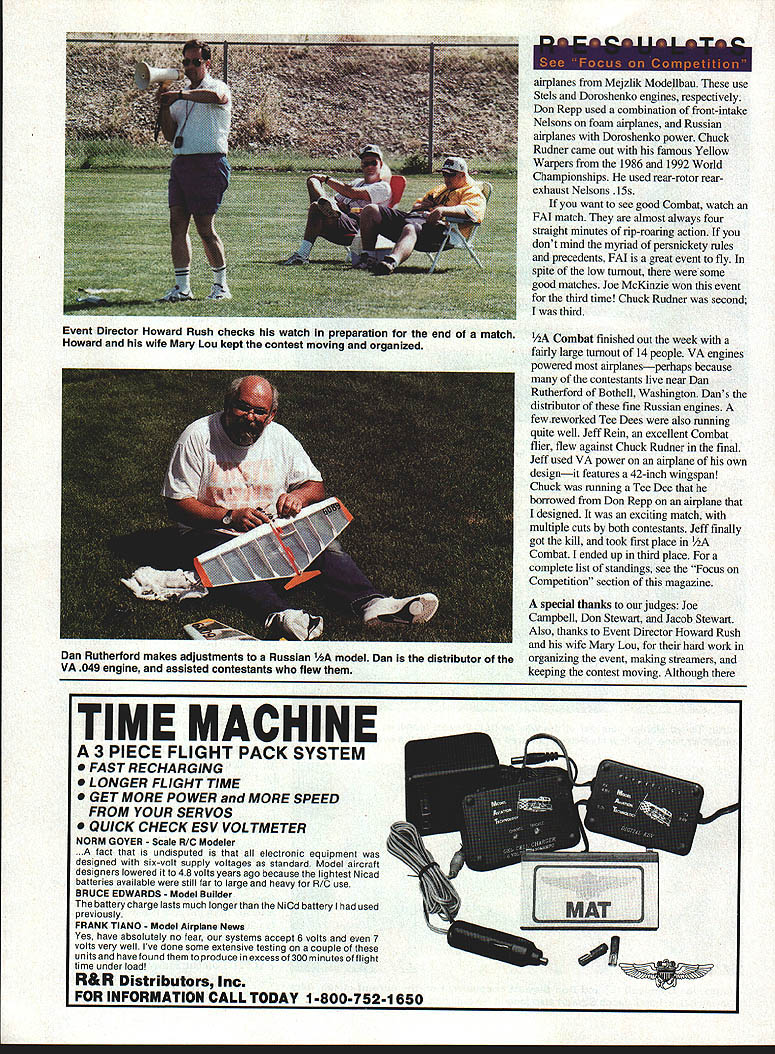
One exception was Jeff Rein of the Seattle area. He used a Nelson on an original airplane that has 700 square inches of wing area!
With its fast pace the event finished on Monday; Tuesday was used as a practice day.
Due to longer nose and tail moments, and the associated increased mass moment of inertia about the pitch axis (the dumbbell effect), Slow Combat airplanes take much longer to react to control input than the short-coupled airplanes in the other events. This requires a more deliberate flying style than the other Combat events. This phenomenon leads to the "Oh shoot" time, when you can see an impending collision and can't avoid it.
The highest number of cuts in any match for one contestant was three, but most matches had two or fewer cuts per contestant. This is not to say that the action was not exciting; there is a different style of flying required for Slow Combat. Pit stops can also be a factor. In one match, Chuck Rudner and Don Repp were pitting for Roy Heppenstall. They made a refueling pit stop in less than 15 seconds and won the match for Roy.
Joe McKinzie was the eventual winner of Slow Combat; Glenn Salter was second; Jeff Rein was third.
Fast Combat
As usual, Fast Combat was the main event. Nineteen people entered Fast, with a wide variety of equipment. People were using Fox and Nelson engines on foam and Russian-style airplanes. The safety-minded and/or frugal fliers used centrifugally operated fuel dumps and shut-offs to stop their engine in case of a flyaway. Because of the low Junior/Senior turnout, all age classes were flown combined.
The first match of the day was between Jeff Rein and Chuck Rudner, both flying honking Nelson .36s on tight-turning foam airplanes. The action was furious but ended with a collision that rendered both models unflyable. The cut count at the time was two to one in Chuck's favor.
The local television station had a cameraman at the event; he filmed some of the action. Afterward he interviewed Jeff and Chuck. All of this aired on the news on Wednesday night, including a match between Don Repp and Glenn Salter.
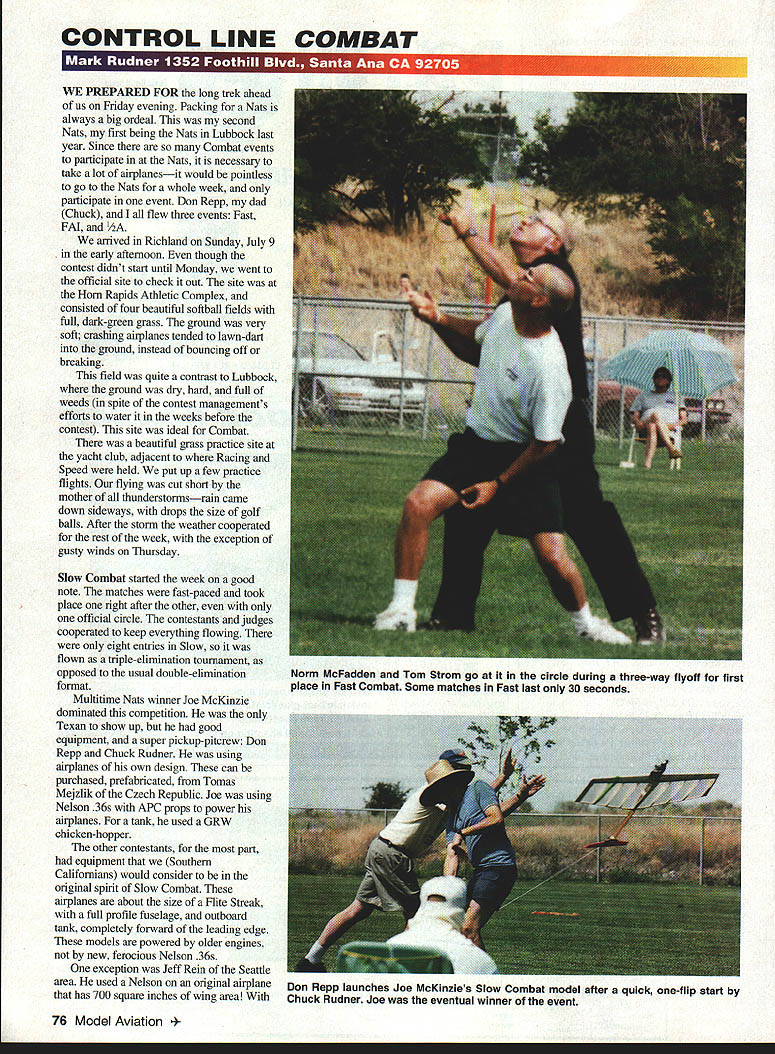
At the end, young Tim Strom (a Senior) won the overall Fast Combat national title. He was using Russian-style airplanes, built from kits. There was a three-way flyoff for the Open title among Ken Burdick, Norm McFadden, and Tom Strom (Tim's father). First, Norm McFadden flew against Tom Strom. Norm lost—when his airplane was cut away (ending the match) his fuel dump shut the engine off instantly, and the airplane glided down safely.
Next, Tom Strom flew against Ken Burdick. Ken won that match, earning the national Open Fast Combat title. Ken flew Allenplane kits; these can be purchased from Greg Carter of Arcadia, California. This event naturally has a fast pace (some matches only last 30 seconds); it was finished in one day. Thursday was another practice day.
FAI (F2D) Combat
Friday saw a disappointing turnout for FAI with only four entries. The entrants used airplanes from Mejzlik Modellbau, powered by Stels and Doroshenko engines respectively. Don Repp used a combination of front-intake Nelsons on foam airplanes and Russian airplanes with Doroshenko power. Chuck Rudner came out with his famous Yellow Warpers from the 1986 and 1992 World Championships; he used rear-rotor rear-exhaust Nelson .15s.
If you want to see good Combat, watch an FAI match. They are almost always four straight minutes of rip-roaring action. If you don't mind the myriad of persnickety rules and precedents, FAI is a great event to fly. In spite of the low turnout, there were some good matches. Joe McKinzie won this event for the third time! Chuck Rudner was second; I was third.
1/2A Combat
1/2A Combat finished out the week with a fairly large turnout of 14 people. VA engines powered most airplanes — perhaps because many of the contestants live near Dan Rutherford of Bothell, Washington. Dan's the distributor of these fine Russian engines. A few reworked Tee Dees were also running quite well.
Jeff Rein, an excellent Combat flier, flew against Chuck Rudner in the final. Jeff used VA power on an airplane of his own design — it features a 42-inch wingspan! Chuck was running a Tee Dee that he borrowed from Don Repp on an airplane that I designed. It was an exciting match, with multiple cuts by both contestants. Jeff finally got the kill and took first place in 1/2A Combat. I ended up in third place.
For a complete list of standings, see the "Focus on Competition" section of this magazine.
Thanks and contest notes
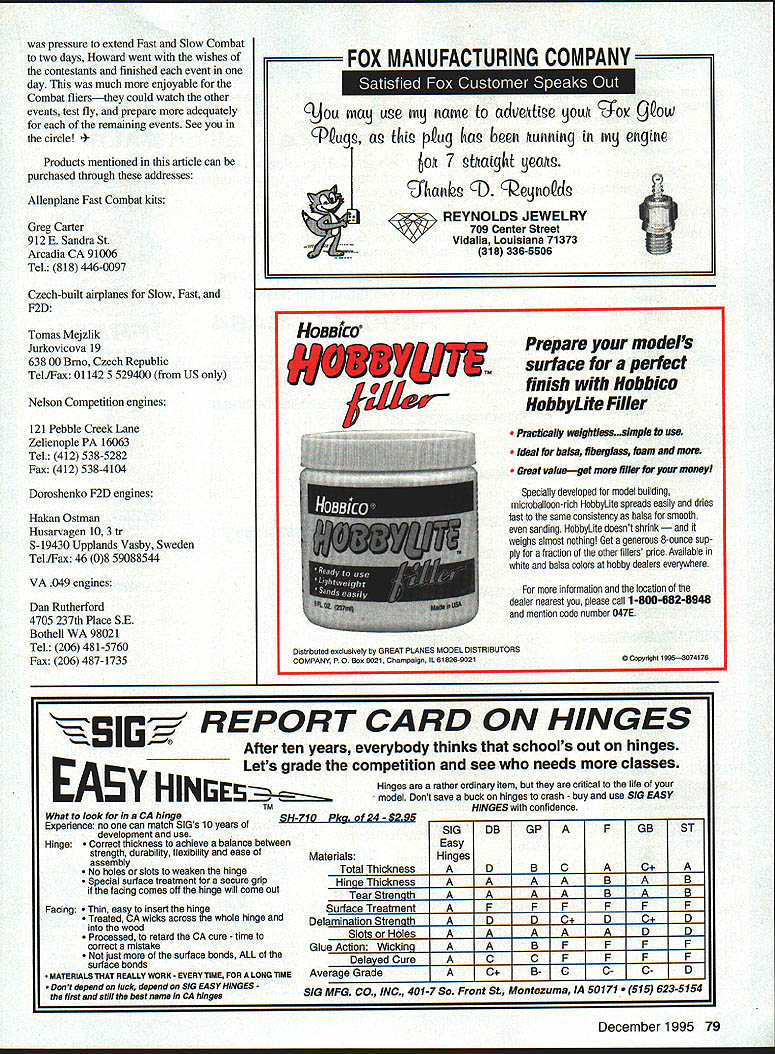
A special thanks to our judges: Joe Campbell, Don Stewart, and Jacob Stewart. Also, thanks to Event Director Howard Rush and his wife Mary Lou for their hard work in organizing the event, making streamers, and keeping the contest moving.
Although there was pressure to extend Fast and Slow Combat to two days, Howard went with the wishes of the contestants and finished each event in one day. This was much more enjoyable for the Combat fliers — they could watch the other events, test fly, and prepare more adequately for each of the remaining events.
See you in the circle!
Products mentioned
- Allenplane Fast Combat kits:
Greg Carter 912 E. Sandra St. Arcadia, CA 91006 Tel.: (818) 446-0097
- Czech-built airplanes for Slow, Fast, and F2D:
Tomas Mejzlik Jurkovicova 19 638 00 Brno, Czech Republic Tel./Fax: 01142 5 529400 (from US only)
- Nelson Competition engines:
121 Pebble Creek Lane Zelienople, PA 16063 Tel.: (412) 538-5282 Fax: (412) 538-4104
- Doroshenko F2D engines:
Hakan Ostman Husarvagen 10, 3 tr S-19430 Upplands Vasby, Sweden Tel/Fax: 46 (0)8 59088544
- VA .049 engines:
Dan Rutherford 4705 237th Place S.E. Bothell, WA 98021 Tel.: (206) 481-5760 Fax: (206) 487-1735
Transcribed from original scans by AI. Minor OCR errors may remain.

