

CONTROL LINE COMBAT
Rich von Lopez
8334 Colegio Drive, Los Angeles CA 90045
1995 United States Control Line Combat Team Trials — Detroit, Michigan
In 1995 the United States Control Line Combat Team Trials were held in Detroit, Michigan at the famous Rouge River Park. For years I had heard stories about this site and how it was where the Detroit Combat Team was founded. My good friend and flying partner Chuck Rudner got his start there, as did:
- Ron Colombo
- Steve Kott
- Mark Daniels
- Edwin Brzys
- Ron Marchioni
- Paul Smith
- Ray Kryza
- Louis Scavone
- many others
I suppose you could call it a historic Combat site.
The United States Team Trials are really the only time Combat pilots from across the country come together to fly in a true FAI Combat contest. Yes, the event is offered at the AMA National Championships, but the Team Trials always has a greater number of entrants. This year there were 32 entries.
The T-shirts for this event had an "IROC" Combat logo printed on the back. IROC stands for the International Race of Champions, where the best drivers from various forms of auto racing compete in equally prepared automobiles. The implication was that most of the pilots at the Team Trials were using similar "store-bought" models and engines.
I can be counted among those who were using Russian-designed, Czech-built models. This was the first Team Trials since 1979 where I didn't use models I had built myself. I am not saying that this is good or bad; it's just different. These models enable more people to enter, and put the emphasis on flying skill rather than building skill.
On the other hand, the pride associated with building and competing with your own model has been lost. Many considered the building portion of our hobby to be the paying-your-dues part. We're in a different age, and I don't think we will ever return to a Builder of the Model rule.
Engines and Equipment
Even though most of the models were similar, there was still a great difference in the performance levels of the various competitors.
The Profi engine was seen on at least half of the competitors' models. It sells for about $140 and seems to run strong and hold up well. It's available from Mejzlik Modelbau, Jurkovicova 1963, 800 Brno, Czech Republic, Europe. Tel/Fax: 01142-5-529400.
There were also various versions of the Doroshenko Combat engines. These come in AAC and ABC versions; both run very well.
Joe McKenzie, Mike Wilcox, and Chuck Rudner had some of the first versions of the new Faizov Combat .15. These arrived in the country two weeks before the Team Trials and carried a price tag of $250. From what I saw these seem to be strong-running engines. In my opinion, Boris Faizov had the best equipment at the 1994 World Championships. I don't think he would put out a bad product.
I had a Kalmnikov .15, and it shows great promise. It weighs 112 grams and has been running strong so far. Right now it falls into the "unobtainium" category.
Very few Nelson engines were seen. They are still powerful, but they require models that are specially built for them. Unless Henry Nelson develops a new muffled version of his .15, I'm afraid this event will have nothing but Eastern-European engines.
The Russian and Czech engines are very easy on glow plugs. It is not unusual to get more than 30 runs on one glow plug. If you want to have a ball sport flying, you may want to get your hands on one of these models and engines.
Event logistics and judging
FAI Team Trials usually start with a Friday-night group dinner; this is where a lot of the business gets taken care of. This includes drawing numbers for the matrix, introducing the judges, discussing (arguing) over rules, and a bunch of other stuff.
Copies of the matrix were passed out; it was up to the competitors to figure out who they were flying against in each of the first three rounds. If you are Chuck or Mark Rudner, you try to match your equipment to your opponent's to make sure it's ready to go the next morning.
You may also need some large boards for the rounds; instead, 8-1/2 x 11-inch sheets of paper taped to a table were used. Also needed was some audible method for starting and stopping matches as required by the rules. A large match clock would have been nice to have.
Items we have used in the past should be used in future competition. We could have also used a full-time jury to monitor judges' decisions so blatantly bad calls could have been avoided. I know judges give up weekend time to help out competitors and deserve accurate scoring and timing. No contest is perfect; however, a bad call stays with a competitor a long time.
Team selection and notes
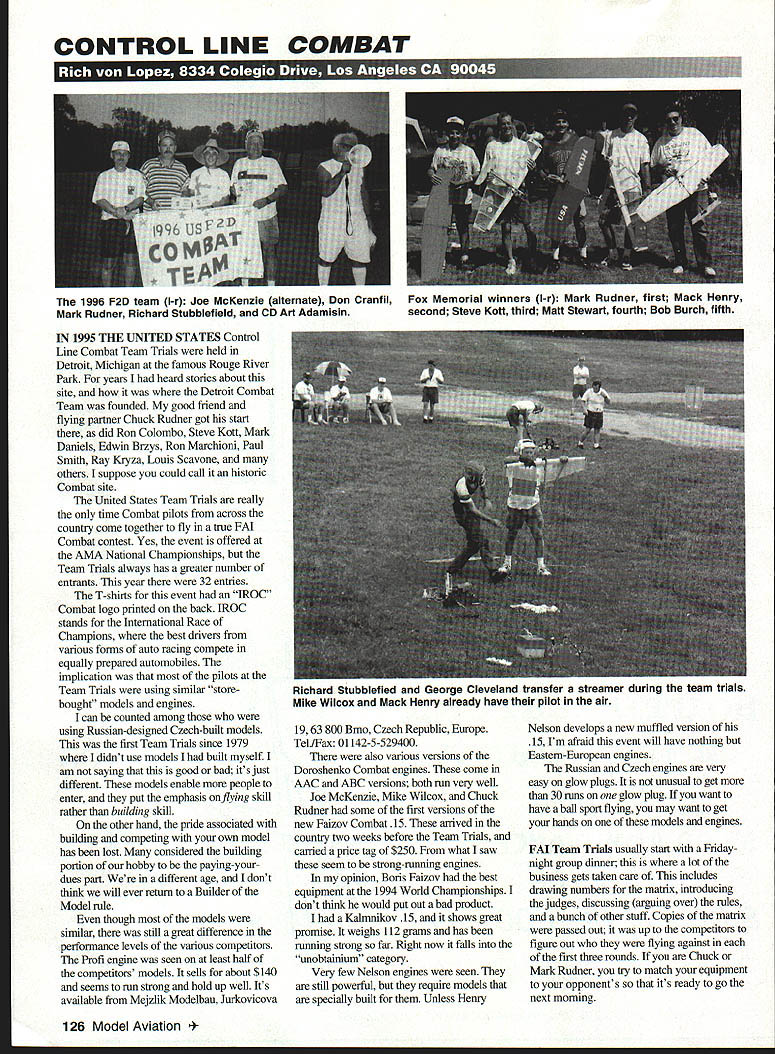
None of the 1994 team members were able to repeat as members of the 1996 team. Mark Rudner earned a spot on the regular team, beating the big boys. Yes, the 1994 team had appointed him a spot as a junior member. After showing at the meet, he can no doubt prove his abilities to rightfully represent the United States.
Standout performers included Mack Henry and Don Cranfil. They flew consistently, with high-caliber equipment, were well prepared, and remained calm and collected during matches. They deserve to be on the team, and I am certain they will take the obligation of representing the United States very seriously.
The last member of the team is no stranger to international competition, or to Sweden — he was a member of the 1982 team. Richard Stubblefield has been "around the horn" more than once and has been a top competitor year after year. He will be more than prepared for his return visit to Sweden. I think he might still remember the way to the Baltic Sea beach we liked to visit in the early '80s.
The first-alternate spot went to Joe McKenzie. Joe really had his act together and was flying as well as I have ever seen him. He may still end up going as a team member — depending on what happens to Mark Rudner. Mark is the defending Junior World Champion and has the right to go and defend his title regardless of his team status. There are some monetary concerns to weigh, as well as the FAI regulations.
This is a strong team that will do a fine job. There's a rumor that Don Cranfil has never been on an airplane. Now he's got his chance!
Anecdotes and flypaper humor
Roy Krupa wanted me to mention my match against Bob Burch in this report — he said we looked like two football linemen going at it in the center circle! Or was it two sumo wrestlers trying to knock each other out of the ring?
In response, I should tell the world that Roy flew two of his matches with his prop on backward — not once, but twice. His twin brother Ray says he wears his shorts with the tags on the outside.
The Detroit Combat Team guys must have way too much time on their hands, judging from the cute painted pillowcases they use to cover their models in the pits. (They had matching T-shirts to go with them!)
Duke Fox Memorial Contest — Schiller Park Forest Preserve
The Duke Fox Memorial Contest was held at the Schiller Park Forest Preserve near Chicago's O'Hare International Airport. Chris Gay did a great job of organizing this contest — the event went so far as to have a barbershop quartet start the contest by singing the Star-Spangled Banner for the contestants.
This contest had 22 entrants, the same number the Money Nats had in Los Angeles earlier in the year. The contest site was very good.
In one of my matches against David Owen, I had the opportunity to give my fuel shutoff a real test. We were in a line wrap and my lines broke. The engine shut off just as the model exited the circle. Unfortunately it was high enough to glide into the waiting branches of a tree about 50 feet above the ground!
"When you're hot, you're hot" is a line that applies to Mark Rudner. He won this competition and didn't even break a sweat. He pocketed another $800 of summer earnings.
Final standings:
- Mark Rudner — champion
- Mack Henry — second place
- Steve Kott — third place
- Matt Stewart — fourth place (rookie)
- Bob Burch — fifth place
Transcribed from original scans by AI. Minor OCR errors may remain.

