
CONTROL LINE COMBAT
Rich von Lopez, 8334 Colegio Drive, Los Angeles CA 90045
IT HAS BEEN A LONG TIME since a club wanting to run a competition with a large entry of Combat participants has surfaced. Anytime you want to run a competition, it takes a lot of planning and cooperation among the organizers.
In general, Combat fliers are an easygoing lot; they can get along with matches posted on a clipboard that's passed from judge to judge. Most of the time, Combat matches won't have organizers sitting in an RV, with computers printing round-by-round results. Combat pilots are content with just finding out who won the match — the exact score is not of much interest.
It is refreshing to see someone like R.W. Howe, who goes all-out to attract as many pilots as possible to his big showdown in Muncie, Indiana.
Las Vegas Fast Combat
Another group has made it known that they are interested in running a large-purse Fast Combat contest in a location that has never (to my knowledge) been used for Combat: Las Vegas, Nevada.
Doug Ellis (Tel. (702) 368-6328), Fred Reese (Tel. (702) 876-4718), and Roy Heppenstall have been working with the Dust Devils club to organize a large-dollar triple-elimination Fast Combat contest for the spring of 1996. The site will be the practice football field of Sam Boyd Stadium. We were invited to Las Vegas on November 19, 1995 to participate in an 80-mph contest so the host club could get some training on judging and running a contest.
We were very curious about the field conditions and the weather. Las Vegas is at an altitude of approximately 2,500 feet — this means that engines may run a bit off their normal settings.
The field was more than adequate for a large meet. There was enough room to have approximately eight circles going at once, over some very nice turf.
The November weather was perfect — approximately 75°F. However, you'll definitely want to bring shade tents and sun block; there are no trees or buildings to provide shade. Las Vegas can be brutal in the summer, with temperatures regularly reaching 115°F plus. Keep in mind that most Las Vegas visitors spend most of their time (and money) inside some of the most luxurious hotels and casinos in the world.
The November contest drew some 17 entries from Arizona, California, and Nevada. All of the fliers said that they would return for the big one. The final results for this contest were:
- Rich Lopez, first
- Greg Hill, second
- Ron Cash, third
- Chuck Rudner, fourth
- Mark Tiret, fifth
Doug Ellis has been having conversations with representatives of various casinos and hotels in order to get some financial sponsorship. As of early December I do not have details on the amount of money involved. The target date for the contest is sometime late April or early May 1996.
When I mentioned a money contest in Las Vegas at the Team Trials and the Duke Fox Memorial contests, I drew quite a bit of interest from both pilots and their wives. I plan to assist the Vegas club and help them have a successful contest. Keep your eyes and ears open for details on exactly when this will happen.
The Miniature Aircraft Combat Association (MACA) newsletter tends to have the most current information. If you are not a member, you may want to consider joining. You can send your $15 annual dues to:
- Ross Leightliter, 3007 Pirates Cove, Aurora OH 44022
Equipment and suppliers
Someone wanting to start out in Combat will have a difficult time finding kits, engines, and supplies at the local hobby shop. Combat has almost turned into a mail-order event.
One of the best kits for beginners comes from Carter's Custom Cores:
- Carter's Custom Cores, 912 East Sandra Street, Arcadia CA 91006; Tel: (818) 446-0097
- Product: Allenplane kit (designed for Fast and 80-mph Combat), sells for $29. Contact Greg Carter for other supplies.
Other suppliers:
- Lou's Wings and Things — Louis Scavone, 41312 Memphis Drive, Sterling Heights MI 48313; Tel: (313) 739-3058. Produces models including the Reaper, Weekend Warrior, Predator II, and Predator III.
- Mejzlik Modellbau — Jurkovicova 19, 638 00 Brno, Czech Republic; Tel/Fax: 01142-5-529400. Ready-to-fly models and high-quality workmanship; good option if you don't want to build.
- Engines Russia / Profi engines — Dave Clarkson, 100 Lowfield Road, Stockport, Cheshire SK3 5JR, England; Tel/Fax: 061 477 7395. Profi engines offer good value (approx. $140); company supplies CL Combat equipment plus Speed Team, Race, and Free Flight products.
- Bear Enterprises — 28305 South Yates, Beecher, IL 60401; Tel: (708) 946-6130. Extensive stocks of Control Line products.
If you want to read about Control Line Combat, the MACA newsletter and Flying Models are the only other consistent sources of information outside of this column. The advent of the Internet has given Combat pilots another way to share information.
My suggestion for beginners is to contact all of the above companies and request a listing of the products they offer and their current prices.
International scene
In mid-November I received a phone call from Ian McIntosh, manager for the Spanish Control Line team. Ian is in the air travel business, and he was in Los Angeles for a convention. We were able to link up for dinner and an outing to the flying field.
We were also able to catch up on what has been happening on the European circuit. The availability of ready-to-fly models has affected the number of fliers in many European countries. Spain has more people flying Combat than ever — so much so that the Junior European Champion is a Spaniard who worked with an all-Junior pit crew. The number of German participants has also increased significantly; many of them are from the eastern part of Germany.
The prices of the once-considered-exotic Russian engines have been dropping; an abundance of them are available. The Russians appear to be getting a trial-and-error lesson on the laws of supply and demand. Let's hope that the quality level does not drop along with the price.
Ian was taken to the Whittier Narrows flying site (in South El Monte, California) for a look at American Combat. I let Ian get on the handle of a Nelson-powered Fast Combat model; it's a representative example of Nelson power.
I told Ian that the FAI models seem (to quote Howard Rush) "almost ladylike," when compared to the brute force of AMA Fast models. I think that Ian went home to Mallorca with a healthy respect for American Combat. I hope to catch up with Ian during the summer in Sweden at the next World Championships.
Engine-mount construction and model choices
Engine-mount construction has changed quite a bit since the days of the Voo Doos. Those models required massive amounts of maple stock compared to what we use now.
The trend is to use:
- A very short piece of maple for the mount
- An even shorter piece of pine (or very hard balsa) as the center block
- Plywood as a doubler on one side of the unit
High-tech builders are using carbon-fiber plates on both sides to sandwich the mount unit. The cautious builder will also use dowels to tie the unit together.
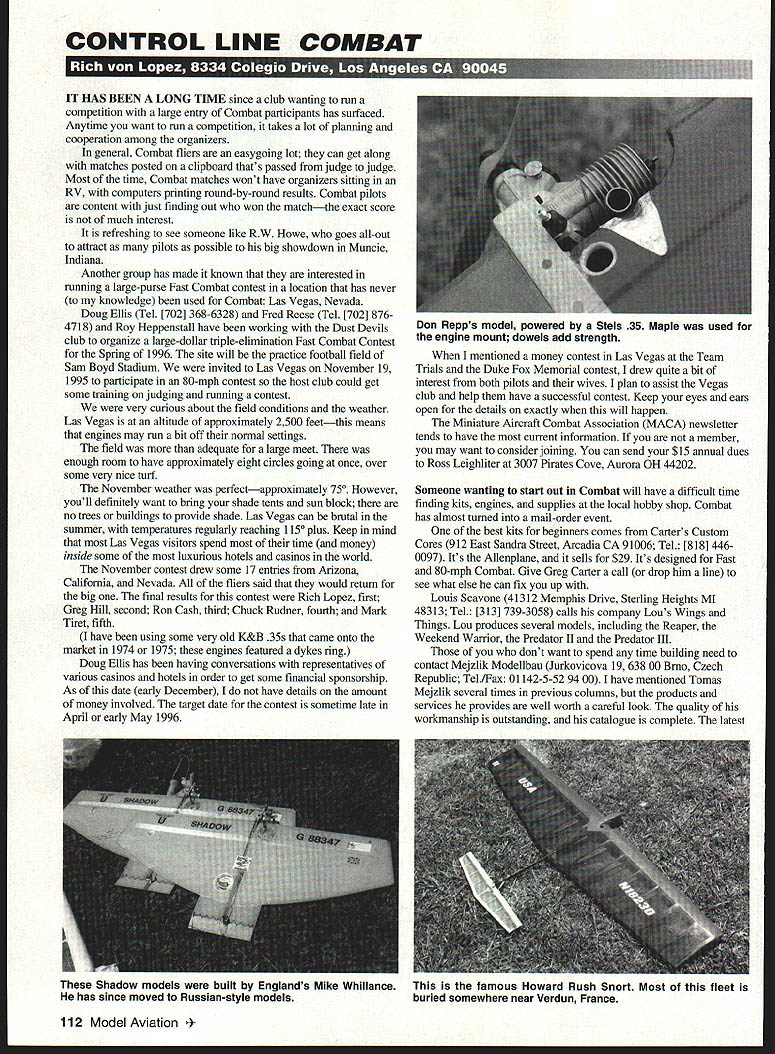
I included a photograph of the model that Don Repp built to illustrate what I mean when I speak of short engine mounts. There are two other details you should note:
- A bead of microballoon-filled epoxy is used to seal the access hole to the bladder compartment.
- Thin aluminum tape shields the foam from the heat of the engine exhaust.
This photo shows a Stels .35. The Stels .35s were only available for a short time and were not developed to the point where they would consistently produce an acceptable level of power. They came with a piston-and-cylinder fit that was far too tight for consistent runs. The head combustion chamber was also too small and too close to the top of the piston.
If you took the time to correct these defects, you would have an engine that could run with the best of the Fox Combat Specials — with the added advantage of light weight.
An alternative to standard wooden engine mounts is to use metal mounts. These tend to be a bit heavier, but they are more durable. It's your choice.
Another choice you will have to make regards the model's construction: open-bay or Mylar-over-foam. There are advantages and disadvantages to each.
An open-bay model with a tear in the covering can be a nightmare to fly, as I found at the 1995 Team Trials. The model's performance suffers greatly, and the once-right turning radius disappears.
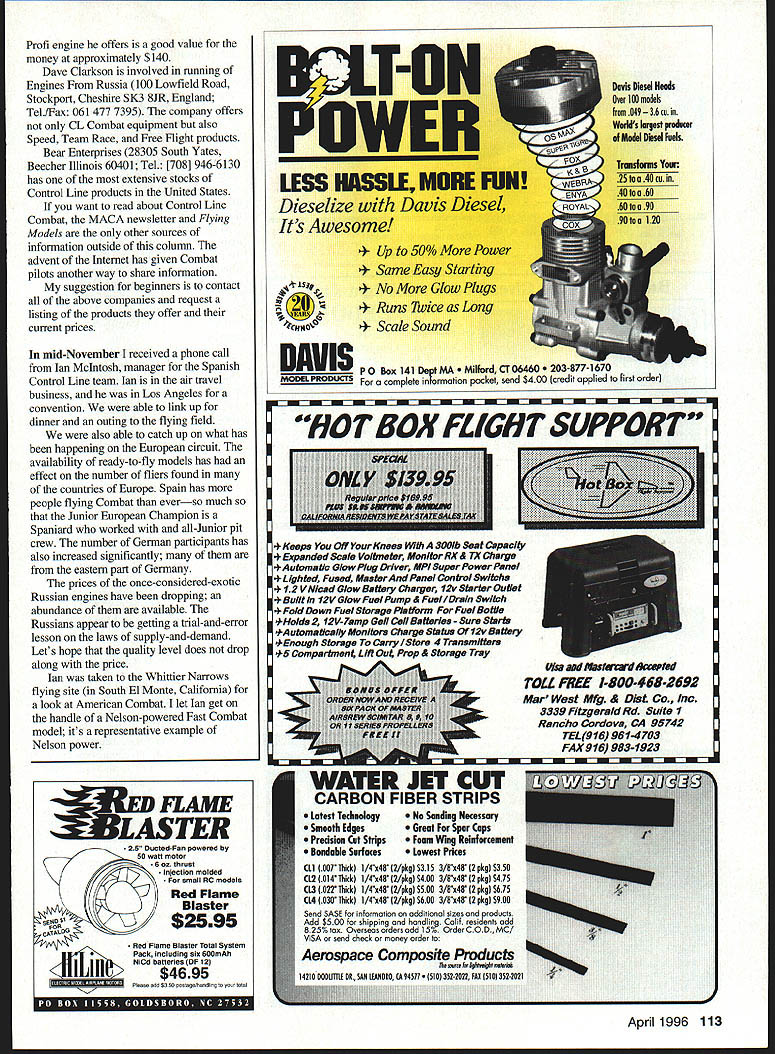
England's Mike Whillance was one of the last to use large foam models; apparently he has been convinced to use Russian-style models.
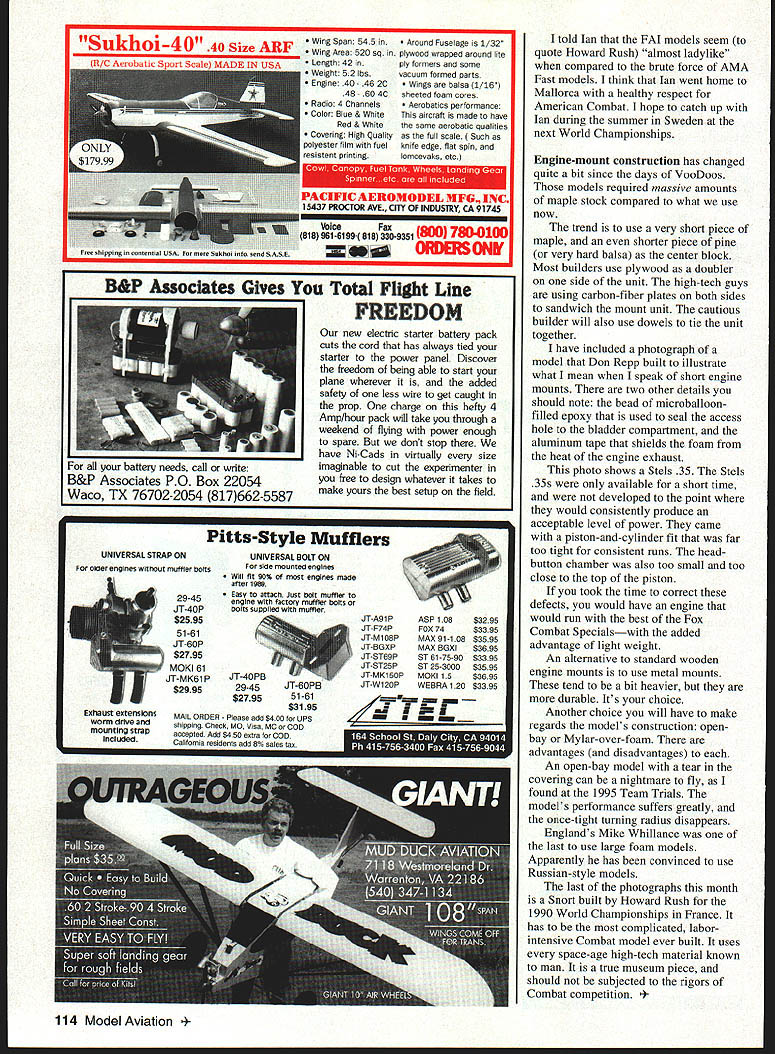
The last photograph this month is of a Snort built by Howard Rush for the 1990 World Championships in France. It has to be the most complicated, labor-intensive Combat model ever built. It uses every space-age high-tech material known to man. It is a true museum piece and should not be subjected to the rigors of Combat competition.
Transcribed from original scans by AI. Minor OCR errors may remain.

