
Control Line Combat
Rich von Lopez 8334 Colegio Drive, Los Angeles, CA 90045
Introduction
This month’s column focuses on the Combat novice. Control Line Combat can take a great deal of time and effort, but there are many good ways to get started and to find help and equipment.
Resources and reading
Some model airplane magazines include sections devoted to Control Line flying. Good ones to check are:
- Flying Models, Box 700, Newton, NJ 07860-0700
- Model Builder (c/o Gallant Models, Inc.), Box 2459, Capistrano Beach, CA 92624-0459
- Model Aviation
- Aero Modeller (c/o Wise Owl Worldwide Publications), 4314 West 238th Street, Torrance, CA 90505-4509 — published in England; contains lots of Control Line information
Hobby shops and clubs
If you live in an urban area you likely have a hobby shop or two listed in the telephone directory. Shops are a good place to ask about local clubs. Owners can supply basic materials and equipment to begin a building project and often help novices get started. It’s human nature to continue with experiences that are fun and give you some adrenaline.
If you live in a rural area, you may have no problem finding flying sites but might not know anyone nearby who flies Control Line Combat. Read the “Contest Calendar” section of this magazine to locate meets near you. Once you’ve found a meet, try to get a neighbor or friend to go with you. Any contest with modelers is useful — you can ask questions, get leads, and meet former Control Line fliers who might return to the discipline.
Even if the modelers you meet at Sailplane, Scale, RC, or Helicopter contests aren’t former Control Line pilots, they may know fliers who are. Some fliers drive long distances to fly on weekends and might be willing to make a weekday practice flight at a local site. RC modelers’ techniques can often be applied to Control Line models.
Find out about club or regional swap meets and auctions. Having some used equipment to fly while your construction projects are underway is a good idea so precious flying time isn’t wasted.
Building, workshop habits, and practice
The building process has therapeutic value and can help you forget the day’s problems. I enjoy going out to the workshop in my garage even if it’s just to clean up a project or rearrange tools and materials. Most Combat pilots are always building new models or rebuilding aircraft damaged in competition or practice. Any good Combat pilot will tell you you can never have too many models ready to fly.
Anything I can do at home I do before I go to the flying field: making lines, bolting on engines, balancing props, and finishing the model. With these tasks completed at home, you can concentrate on flying and practicing. To fly Combat well you need to observe many matches and attend as many contests as you can.
Buying used equipment and engines
At Combat contests you can ask questions and get leads on used equipment. If you are serious about buying someone’s used engine, ask for a demonstration “test drive.” Most pilots will be glad to let you see how their engine runs and starts. Many experienced fliers have perfectly good engines sitting in drawers waiting to be used; the careful ones will have each engine pickled in 3-In-One oil during storage.
When I built engines, I wrote down all the details — head clearance, head-button type, main-bearing type, and other modifications. If you can purchase an engine with a traceable history, you’ll save time and energy. I have recently been selling off excess Combat engines so other fliers can use them. My old Fox Combat Specials had lots of extra work in them, and buyers usually get accurate information about what parts they contained and what speeds they ran.
Many pilots cut the engines off their dead models and leave the carcasses for the “vultures” (kids or curious modelers). This can be a good way to study internal structure and sometimes rebuild a discarded model.
Practice alternatives and media
At one time Charlie Mackey offered tow-line controllable kites that flew like Combat models except with 100-foot lines and only working on the downwind side of the circle. Last I heard these kites were marketed by Bear Model Products, 28305 South Yates, Beecher, IL 60401; Tel.: (708) 946-6130. They’re worth ordering for practice on windy days. The handle movement is the same as a Control Line model, so you gain free “stick time” and avoid wrecking models — though be prepared for line tangles, which teach you line sense.
Almost everyone I know owns or has access to a video camera. Film Combat matches to get a closer look at what pilots are doing in the center of the circle. You can also buy ready-made videotapes from top Combat pilot Mike Willcox. Mike has five videos available:
- R.W. Howe 1995 Slow contest
- 1995 Los Angeles Money Run
- 1994 World Championships at Shanghai, China
- 1995 Top Gun at Tucson, Arizona
- 1994 R.W. Howe Slow contest
Price per tape (including shipping) is $22. Contact Mike Willcox at 1927 Running Springs, Kingwood, TX 77339; Tel.: (713) 358-1750.
The Miniature Aircraft Combat Association (MACA) newsletter publishes a page listing Combat equipment suppliers and occasional notices from people selling equipment. A one-year MACA membership costs $15 in the U.S.; $18 in Canada and Mexico; $25 elsewhere. Send payment to MACA treasurer Ross Leightier, 3007 Pirates Cove, Aurora, OH 44202.
Recommended kit
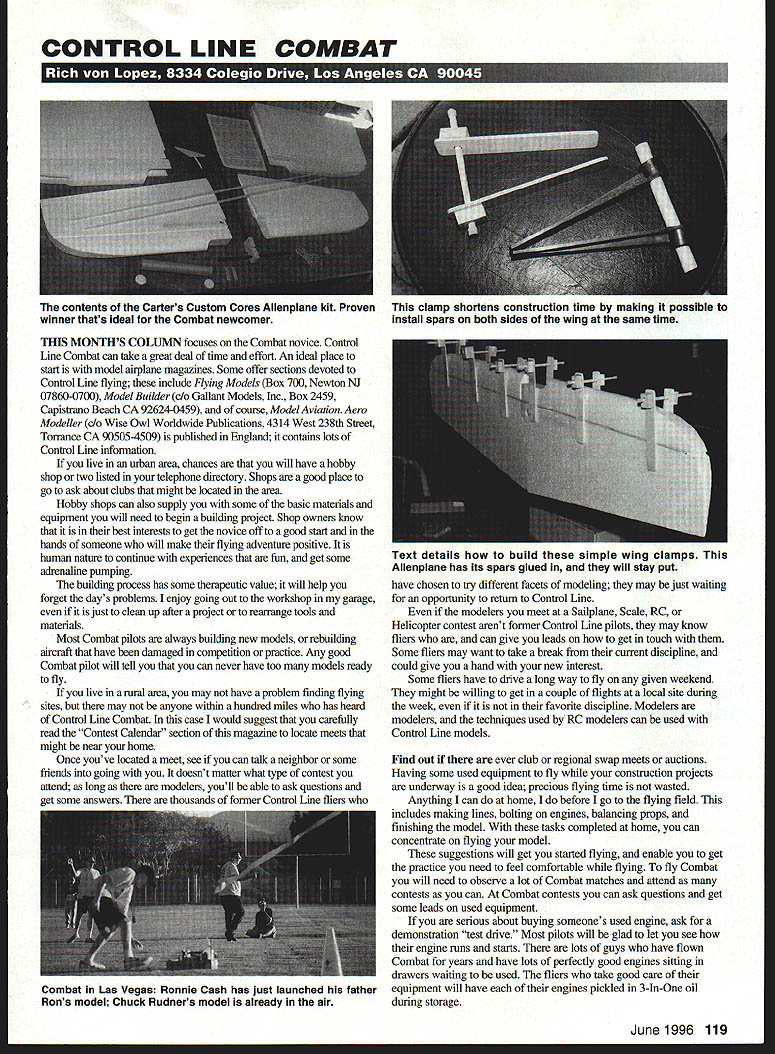
One of the best Combat model kits on the market is the Allenplane, offered by Carter’s Custom Cores, 912 East Sandra Street, Arcadia, CA 91006; Tel.: (818) 446-0097. The kit arrives practically assembled and is ideal for newcomers. Everything fits well, the spars are tapered, and it’s a proven winner favored by many Southern California pilots.
Building tip: simultaneous spar glue-up
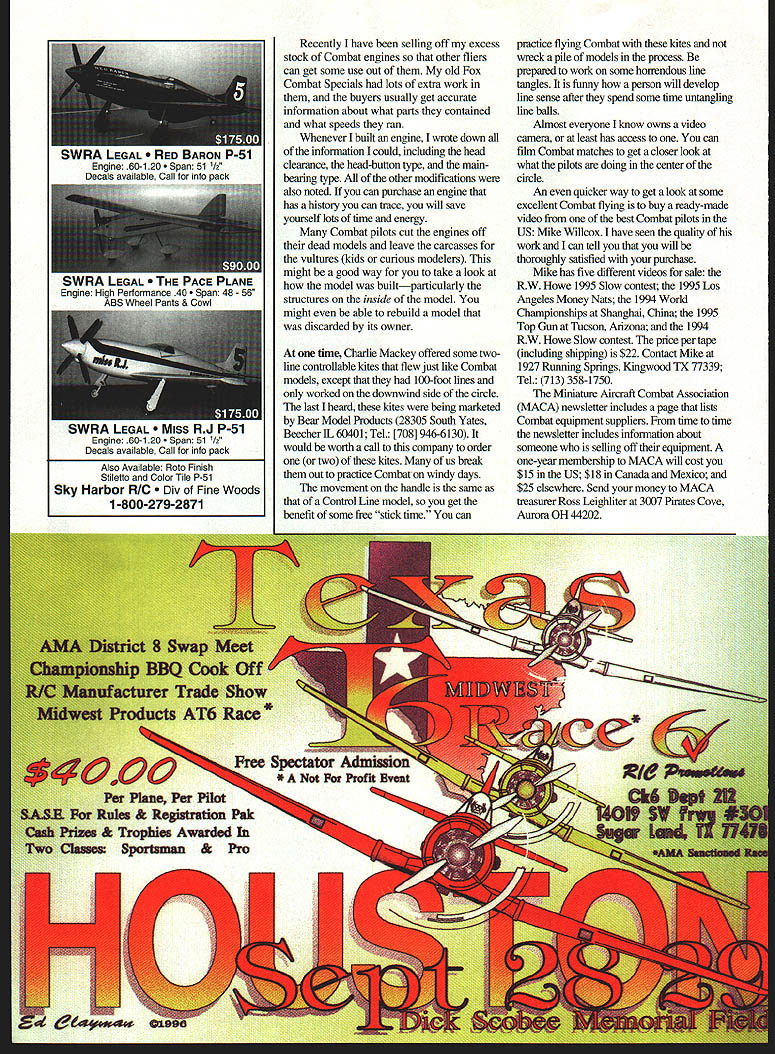
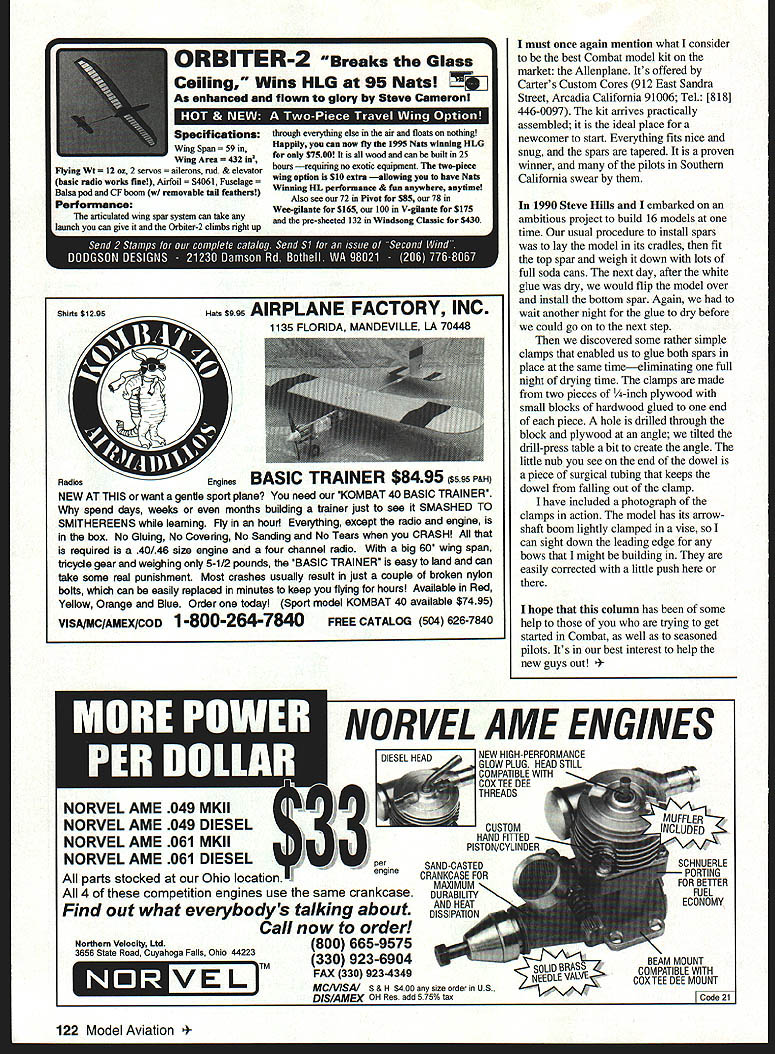
In 1990 Steve Hills and I set out to build 10 models at once. Our usual procedure was to install spars in the cradles, fit the top spar and weigh it down overnight, then flip the model to install the bottom spar and wait another night. We discovered simple clamps that let us glue both spars at the same time, eliminating a full night of drying time.
The clamps are made from two pieces of 1/4-inch plywood with small hardwood blocks glued to one end of each piece. A hole is drilled through the block and plywood at an angle (we tilted the drill-press table slightly). A dowel through the hole is held by a nub of surgical tubing on the end to keep it from falling out. With the model’s arrow-shaft boom lightly clamped in a vise, you can sight down the leading edge for bows and correct them with small pushes.
I have included a photograph of the clamps in action in the original column.
Closing
I hope this column helps those of you starting in Combat as well as seasoned pilots. It’s in our best interest to help the new guys out!
Transcribed from original scans by AI. Minor OCR errors may remain.

