
CONTROL LINE: Combat
Rich von Lopez 8334 Colegio Drive, Los Angeles, CA 90045
Fox Mark 7 Combat Special
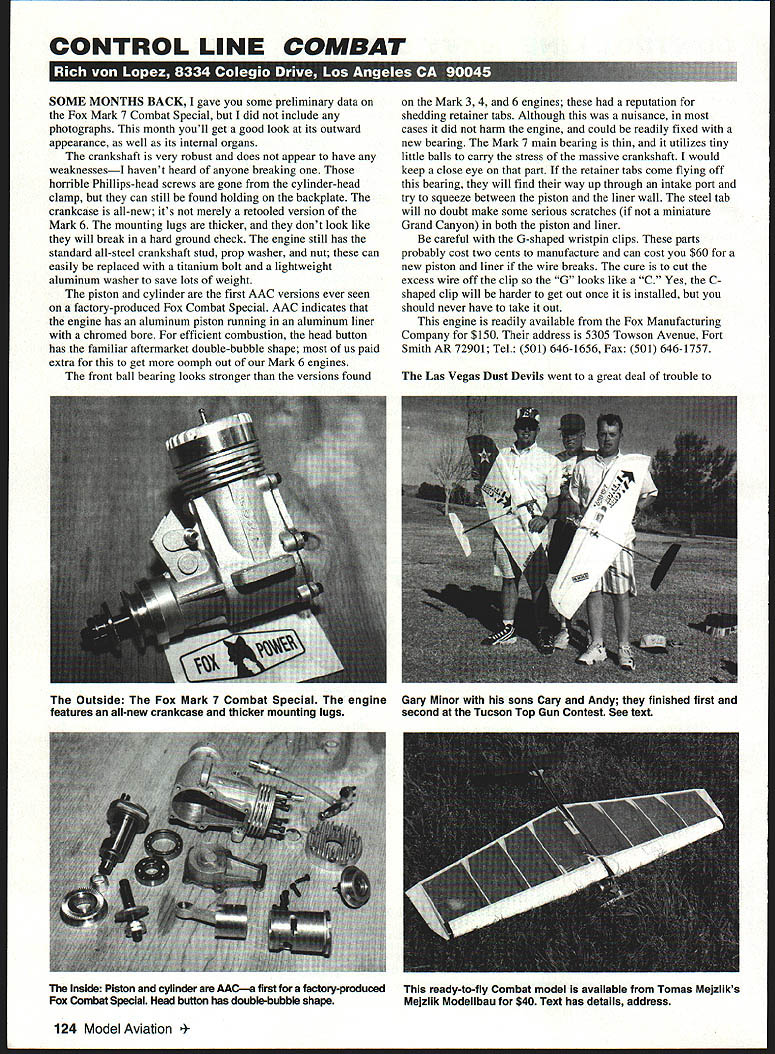
Some months back I gave preliminary data on the Fox Mark 7 Combat Special but did not include any photographs. Here is a detailed look at its outward appearance as well as its internal components.
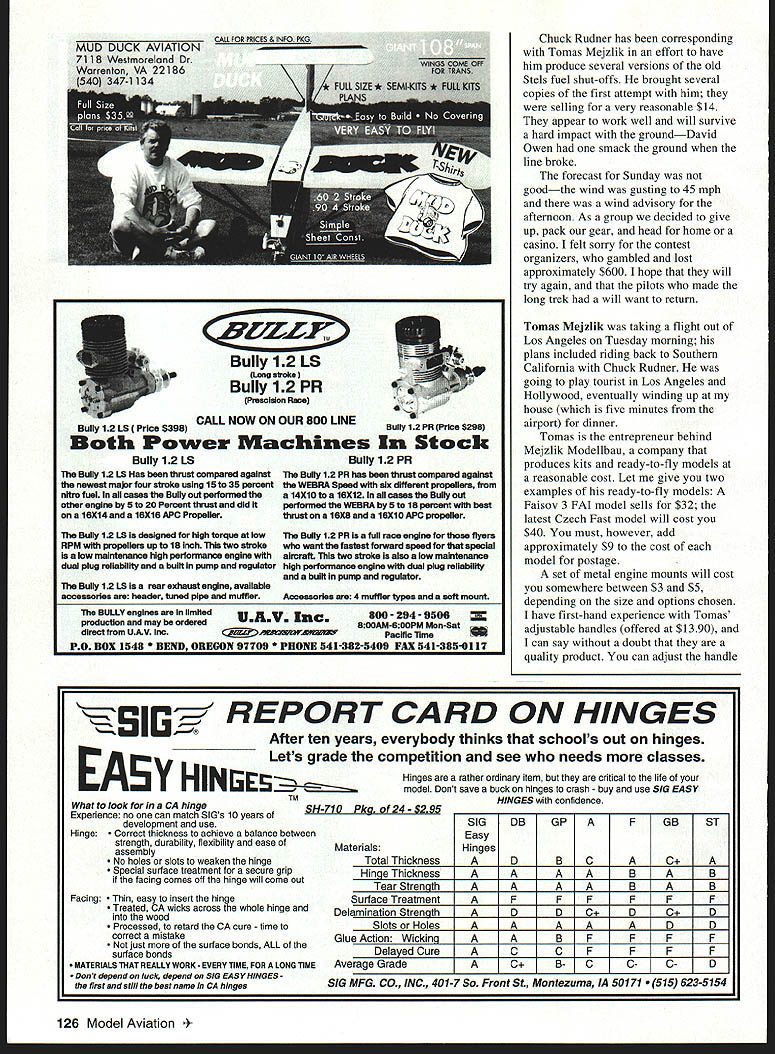
The crankshaft is very robust and does not appear to have any weaknesses—I haven't heard of anyone breaking one. Those horrible Phillips-head screws are gone from the cylinder-head clamp, but they can still be found holding the backplate. The crankcase is all-new; it's not merely a retooled version of the Mark 6. The mounting lugs are thicker and don't look like they will break in a hard ground check. The engine still has the standard all-steel crankshaft stud, prop washer, and nut; these can easily be replaced with a titanium bolt and a lightweight aluminum washer to save a lot of weight.
The piston and cylinder are the first AAC versions ever seen on a factory-produced Fox Combat Special. AAC indicates the engine has an aluminum piston running in an aluminum liner with a chromed bore. For efficient combustion, the head button has the familiar aftermarket double-bubble shape; most of us paid extra for this to get more power out of our Mark 6 engines.
The front ball bearing looks stronger than the versions found on the Mark 3, 4, and 6 engines; those had a reputation for shedding retainer tabs. Although this was a nuisance, in most cases it did not harm the engine and could be readily fixed with a new bearing. The Mark 7 main bearing is thin and utilizes very small balls to carry the stress of the massive crankshaft. I would keep a close eye on that part. If the retainer tabs come flying off this bearing, they can work their way up through an intake port and try to squeeze between the piston and liner wall. The steel tab will no doubt make some serious scratches (if not a miniature Grand Canyon) in both the piston and liner.
Be careful with the G-shaped wristpin clips. These parts probably cost two cents to manufacture and can cost you $60 for a new piston and liner if the wire breaks. The cure is to cut the excess wire off the clip so the "G" looks like a "C." Yes, the C-shaped clip will be harder to get out once it is installed, but you should never have to take the engine apart unless necessary.
Availability and Price
This engine is readily available from the Fox Manufacturing Company for $150.
- Fox Manufacturing Company
5305 Towson Avenue, Fort Smith, AR 72901 Tel: (501) 646-1656 Fax: (501) 646-1757
Las Vegas Dust Devils: Fast Combat Contest (May 18–19, 1996)
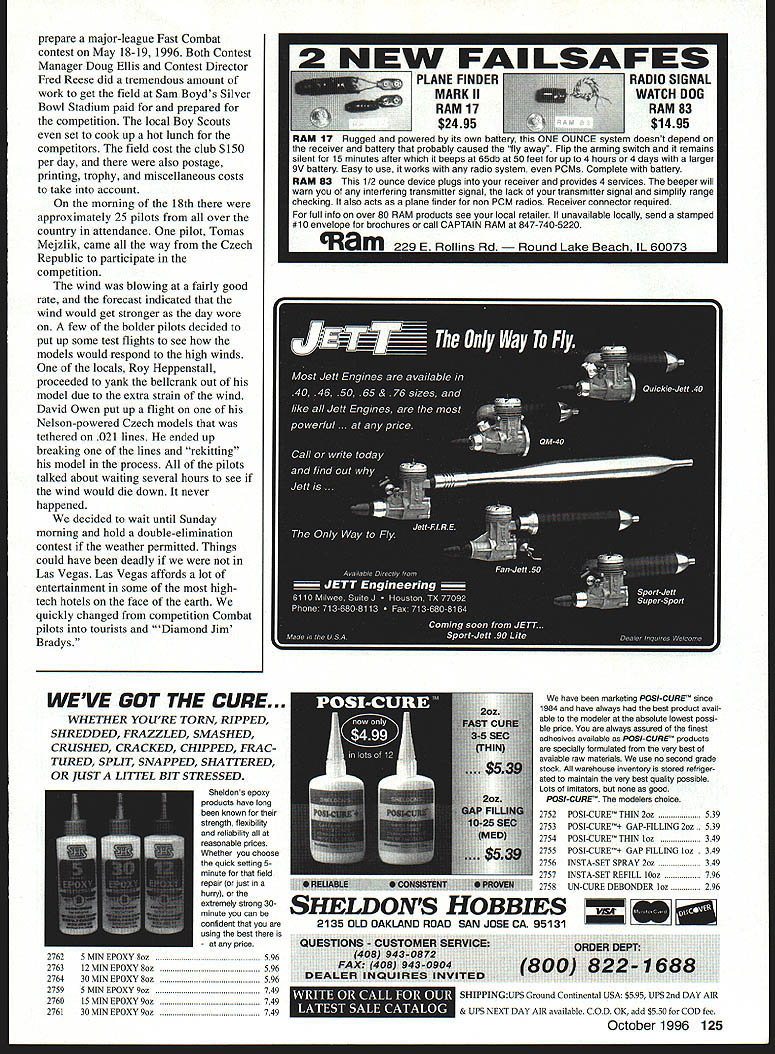
The Las Vegas Dust Devils went to a great deal of trouble to prepare a major-league Fast Combat contest on May 18–19, 1996. Both Contest Manager Doug Ellis and Contest Director Fred Reese did a tremendous amount of work to get the field—Sam Boyd's Silver Bowl Stadium—paid for and prepared. The competition and the local Boy Scouts set up and cooked a hot lunch for competitors. The field cost the club $150 per day; additional costs included postage, printing, trophies, and miscellaneous items.
On the morning of the 18th, approximately 25 pilots from around the country attended. Pilot Tomas Mejzlik came all the way from the Czech Republic to participate. The wind was blowing steadily and the forecast indicated it would strengthen as the day wore on. A few pilots put up test flights to see how their models would respond to the high winds. Local Roy Heppenstall proceeded to yank the bellcrank out of his model due to the extra strain from the wind. David Owen put up a flight with a Nelson-powered Czech model and the tethered .021 lines ended up breaking; he spent time re-kitting the model. Several pilots talked about waiting several hours to see if the wind would die down, but it never did. They decided to wait until Sunday morning and hold a double-elimination contest if the weather permitted.
Chuck Rudner has been corresponding with Tomas Mejzlik in an effort to have him produce several versions of the old Stels fuel shut-offs. He brought several copies of the first attempt with him; they were selling for a very reasonable $14. They appear to work well and will survive a hard impact with the ground—David Owen had one smash the ground when the line broke.
The forecast for Sunday was not good—the wind was gusting to 45 mph and there was a wind advisory for the afternoon. As a group we decided to give up, pack our gear, and head for home or a casino. I felt sorry for the contest organizers, who gambled and lost approximately $600. I hope they will try again and that the pilots who made the long trek will want to return.
Tomas Mejzlik and Mejzlik Modellbau
Tomas Mejzlik was flying out of Los Angeles on Tuesday morning; his plans included riding back to Southern California with Chuck Rudner and playing tourist in Los Angeles and Hollywood before coming to my house for dinner.
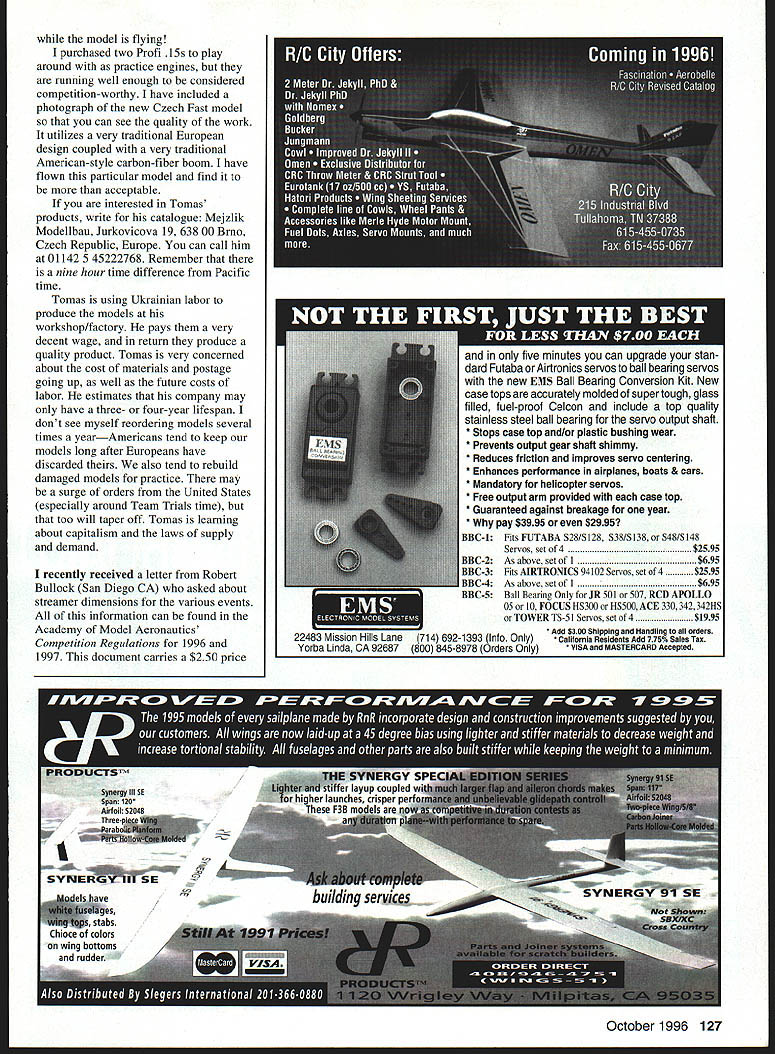
Tomas is the entrepreneur behind Mejzlik Modellbau, a company that produces kits and ready-to-fly models at reasonable cost. Examples of his ready-to-fly models:
- FAI F3A model: $32
- Czech Fast model: $40
- Add approximately $9 per model for postage
A set of metal engine mounts costs between $3 and $5, depending on size and options. I have first-hand experience with Tomas' adjustable handles (offered at $13.90) and can say without a doubt they are a quality product. You can adjust the handle while the model is flying!
I purchased two Profi .15s to use as practice engines; they are running well enough to be considered competition-worthy. The new Czech Fast model uses a traditional European design coupled with a traditional American-style carbon-fiber boom. I have flown this particular model and find it more than acceptable.
If you are interested in Tomas' products, write for his catalogue:
- Mejzlik Modellbau
Jurkovicova 19, 633 080 Brno, Czech Republic, Europe Tel: 011 42 5 45222768
Remember there is a nine-hour time difference from Pacific Time.
Tomas uses Ukrainian labor to produce the models at his workshop/factory. He pays them a very decent wage, and in return they produce a quality product. Tomas is very concerned about the cost of materials and postage going up, as well as the future costs of labor. He estimates his company may only have a three- or four-year lifespan. Americans tend to keep models long after Europeans discard theirs, and we also tend to rebuild damaged models for practice. There may be a surge of orders from the United States (especially around Team Trials time), but that too will taper off. Tomas is learning about capitalism and the laws of supply and demand.
Streamers and Rules
I recently received a letter from Robert Bullock (San Diego, CA) asking about streamer dimensions for the various events. All of this information can be found in the Academy of Model Aeronautics' Competition Regulations for 1996 and 1997. This document carries a $2.50 price and is available free of charge to AMA members upon request.
While looking up the exact wording in the rule book, I discovered an error in the Engine Size, Max. Model Weight, and Required Line Length for CL 1/2A Combat: the values listed are for Fast and Slow Combat, not 1/2A.
Specifications:
- Fast and Slow Combat (AMA):
- Streamers shall be supplied by contest management.
- Streamers shall be made of crepe paper sheet, of uniform length, using at least two (2) distinct colors.
- Streamers shall be cut two (2) inches wide and up to 10 feet long.
- The crepe paper shall be doubled and then folded lengthwise for two (2) inches before being double-tied with the string leader.
- The string leader shall be 16 to 20 pound test cotton, shall be marked with ink 84 inches from the knot, and shall extend beyond the ink mark 18 inches.
- 1/2A Combat (AMA):
- Streamers shall be cut one-half (1/2) inch wide and seven and one-half (7-1/2) feet long.
- The string leader shall be four (4) to eight (8) pound test cotton, shall be marked with ink 48 inches from the knot, and shall extend beyond the ink mark 12 inches.
- Fédération Aéronautique Internationale (FAI) streamers (from the FAI Sporting Code):
- The streamer shall consist of double weight crepe paper (80 g/m²) or any replacement with equivalent strength.
- Length: not less than 2.25 m and not more than 3 m.
- Width: 3 ± 0.5 cm.
- Fixed to a sisal string with minimum length 2.5 m.
- All streamers must be of the same size and length.
- There shall be a clearly visible ink mark 2.5 m from the junction of the string and streamer.
- The streamer shall be attached to the model so that the ink mark is level with, or behind, the rearmost portion of the model.
- The attachment part of the string shall have a minimum length of 0.75 m.
- The attachment end of the streamer shall be reinforced on either side by fibre/fabric reinforced tape approximately 2 cm wide, affixed diagonally to the length of the streamer with one at right angles to the other and extending for a minimum of 5 cm.
A diagram detailing the streamer layout is also included in the FAI Sporting Code.
Transcribed from original scans by AI. Minor OCR errors may remain.

